
A roll of synthetic grass looks finished long before you ever see the machine that made it. That is exactly why buyers get caught out: two green rolls can look identical in a warehouse and still behave nothing alike after two seasons outdoors. The difference hides in the recipe, in the twist of the yarn, and in the temperature of a drying tunnel nobody shows you.
This guide explains how artificial grass is made, step by step, from plastic pellets to a sealed, perforated roll ready for export. Producing synthetic grass is our daily work as a factory-direct manufacturer, so the sequence below is the one our own line follows. Once you can name the eight stages, a quote for an artificial turf installation starts telling you where the quality actually sits.
What Synthetic Grass Is Made Of
If you have wondered how synthetic grass is made, start with the polymers, because the yarn decides most of what follows. Polyethylene (PE) is soft and realistic, which is why it carries most residential faces. Polypropylene (PP) is stiffer and more economical, doing structural work. Nylon is the toughest and the most expensive, reserved for extreme traffic.
Producing synthetic grass then becomes a recipe: colour masterbatch for consistent green, UV stabilisers for sun life, plus anti-static or flame-retardant additives where the application calls for them. Our standard build pairs a PE monofilament face with a curled PP thatch layer, balancing softness against body. Those choices branch across our artificial grass product range, and the material basics are summarised in the Wikipedia entry on artificial turf.

Step 1: Compounding — Mixing the Recipe
Compounding is where quality is decided before anything looks like grass. Plastic pellets, colour masterbatch and additives are weighed into a recipe and blended at high speed, the way flour and ingredients are measured for a bake. Right ratios mean every kilogram of yarn from that batch colours and weathers the same. Wrong ratios mean one container ships with two shades of green in it.
Recipe stability is the quiet divide between suppliers. Anyone can copy a formula sheet; holding it batch after batch, so container three matches the approved sample, is where factories earn their keep. Our blunt view: this step separates manufacturers from traders with a catalogue. It is a fair question to put to any supplier.
Step 2: Extruding the Yarn
The blended compound feeds into a screw extruder, melts at roughly 200 degrees Celsius, and is pressed through a spinneret, a steel plate pierced with shaped holes. What leaves the plate is not grass yet, only continuous plastic strands in whatever cross-section the die dictates. A water trough cools and sets the strands immediately.
Shape is destiny at this stage. Flat strands feel soft underfoot, while C, S and diamond profiles add body and resilience. Softness, bounce and strength are fixed here, not later. Crucially, the UV stabiliser is already inside the strand, so sun protection cannot wear off the way a surface coating can.
Step 3: Cooling, Stretching and Twisting
Freshly extruded strands are weak, so rollers stretch them to about three to five times their original length. Stretching aligns the polymer chains and builds the longitudinal strength that stops yarn snapping underfoot. It also thins each strand toward the calibre of a natural grass blade.
Then comes twisting, the step buyers hear about least. Several filaments are plied together and wound onto spools, and plied yarn resists flattening and shedding far better than loose fibre. Two to four green shades plus brown or beige thatch are combined at this stage, so the finished face reads as mixed growth instead of one flat, fake green.
Step 4: Tufting — Where Yarn Becomes Grass
A tufting machine is best pictured as a giant sewing machine. Hundreds of needles punch the yarn through a primary backing of woven PP, and a small knife under each needle cuts the loop into blade ends. This is the moment yarn stops being yarn and starts being grass.
Three settings on this machine define the product: stitch rate for density, gauge for row spacing, and pile height for blade length. The same yarn can fill anything from a balcony roll to an artificial turf installation for weekend sport, depending on how those dials are set. Pile height, density and face weight are programmed per project, which is what our customization page is for.
Step 5: Coating the Backing
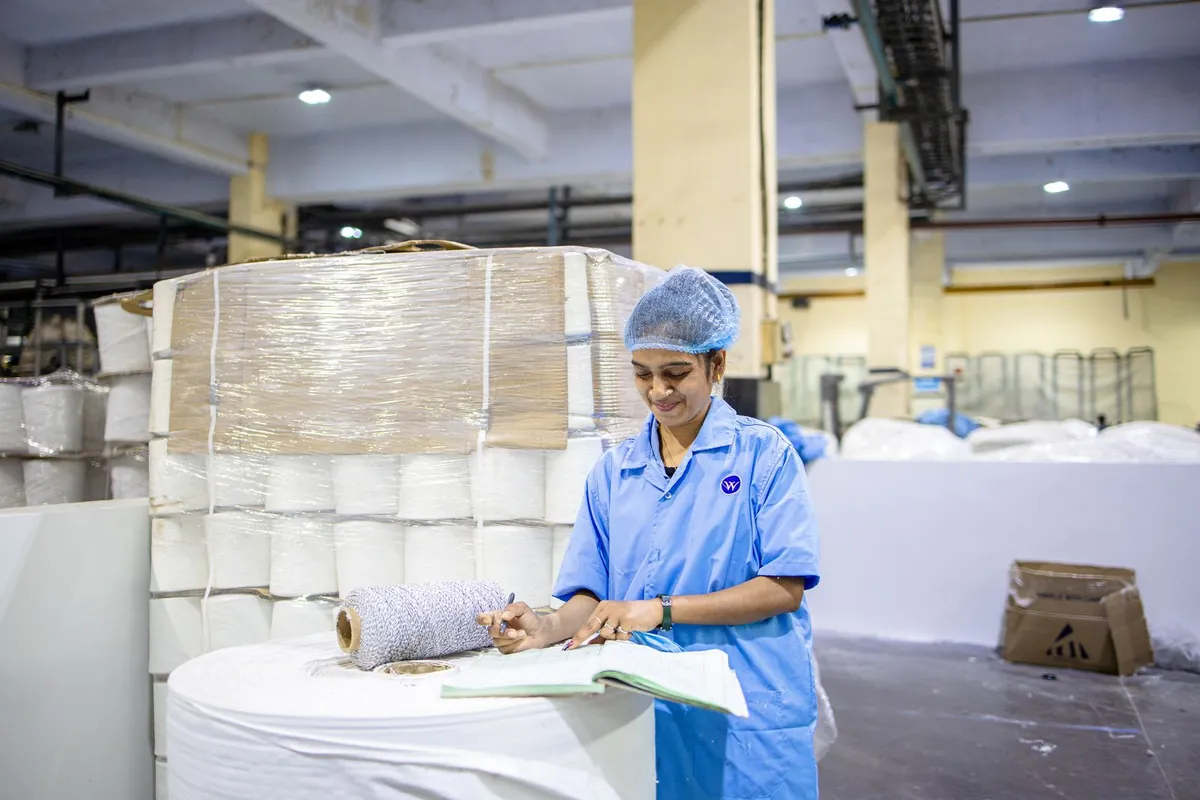
Loose tufts hold nothing, so the carpet now runs through a coating line that spreads adhesive across the underside and locks every tuft into the primary backing. Latex is the economical choice; polyurethane (PU) costs more and handles weather and traffic better. The coat also keeps the sheet dimensionally stable, so an artificial turf installation neither stretches nor shrinks in service.
We build two backing tiers for this reason: PP with a reinforcing net, and PU. They map to two budget levels rather than two quality levels, since the yarn above them is identical. When quotes differ by a few dollars per square meter, ask which backing sits under the pile before comparing anything else.
Step 6: Drying and Curing
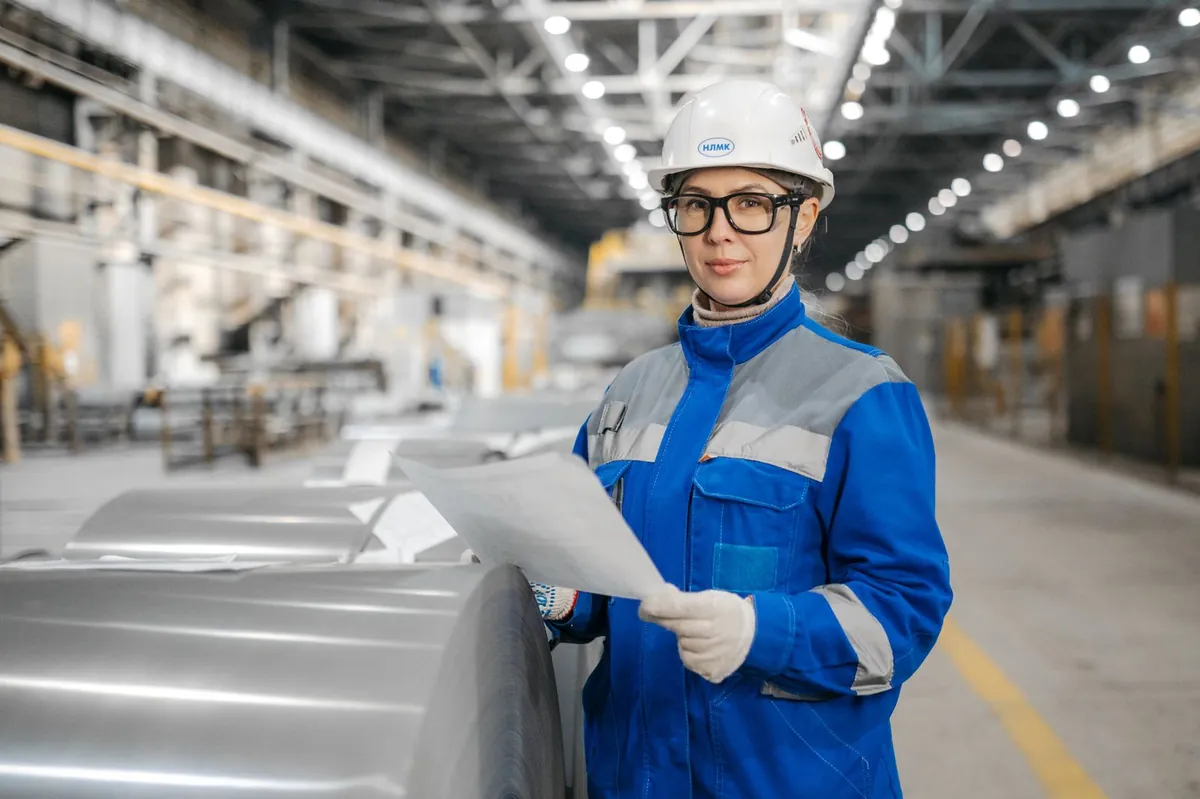
The coated carpet enters a long oven that raises temperature in stages, curing the adhesive from the backing up. Curing is a knife-edge process. Under-cure it and the glue never reaches full grip, so tufts pull loose in the first season. Over-bake it and the backing turns brittle and can crack in transport. Line speed and tunnel temperature are calibrated together, and you will never see that calibration on a finished roll, only its result.
Step 7: Perforating for Drainage
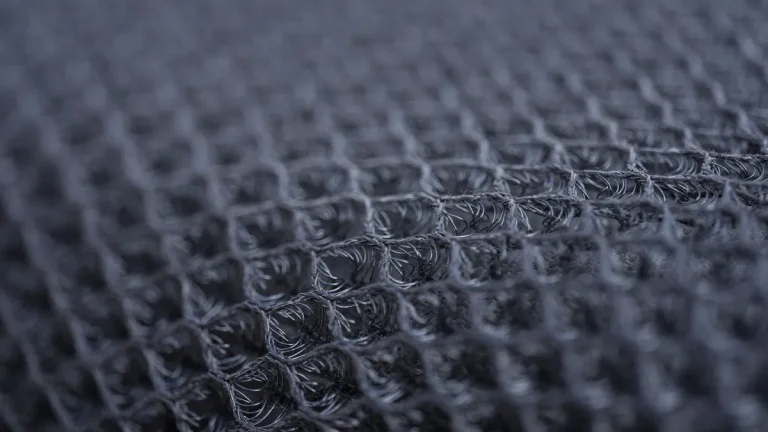
Straight after curing, heated pins punch a regular grid of drainage holes through the backing. Without them, an outdoor roll is a water bed after the first storm, pooling instead of draining. The pattern is dense enough to move heavy rain off the surface and regular enough never to weaken the coating around a tuft.
Step 8: Inspection, Trimming and Rolling Up
Finished carpet is trimmed to a uniform pile height, inspected across its width, and slit into standard 2m and 4m roll widths. Defects are cut out, the good length is wound onto cores, and everything is wrapped for shipping.
The last act before a roll reaches you is the least glamorous. A crane lifts wrapped rolls into our 12,000 sqm warehouse, where stock waits for container bookings. Factory-direct only means anything if the factory can actually hold goods and ship on your schedule, and storage capacity is what makes that promise real.
Quality Control Tests Every Roll Must Pass
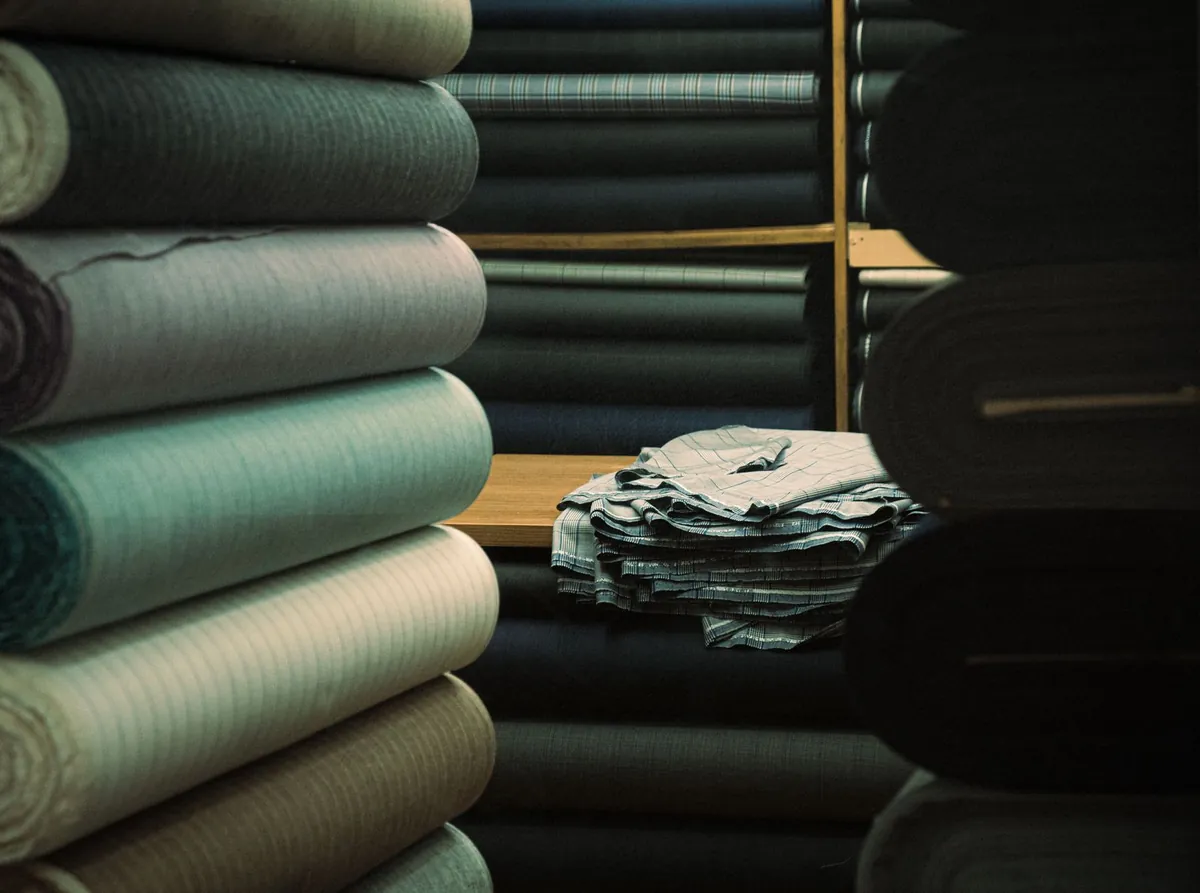
Quality control is the last gate in how artificial grass is made, and the only one a buyer can partly reproduce. Approved rolls pass UV exposure, tensile strength, colourfastness, yarn pull-out and drainage tests. A roll that fails any of these does not ship.
Buyers can run two crude versions of the same tests on a sample, and we encourage both. Tear a corner of the backing and look at the adhesive layer: it should be even, with no dry patches where tufts sit unglued. Then grab a tuft and pull; a properly cured carpet resists with conviction and sheds nothing. Both checks take a minute and predict how an artificial turf installation will age better than any brochure.
Twenty centimetres of carpet is enough to run both checks, and producing synthetic grass ends, for us, in proving that to you rather than telling you.
See the Craft in a 20cm Swatch
Order free 20 x 20 cm samples and run the buyer’s checks yourself: tear the backing, pull a tuft, compare colours in daylight. The swatches go out free; you cover the courier.
Why Factory-Direct Manufacturing Matters for Buyers
Every stage above runs under one roof: compounding, extruding, twisting, tufting, coating, drying, perforating and rolling. That integration is not trivia; it is traceability. When a fault shows up in a shipment, a factory that owns its line can name the failing stage and fix the recipe, the oven or the tufting program. A trading company can only forward your email.
Our automated sports-turf line adds what B2B buyers actually price: capacity and batch stability across container-sized orders. That efficiency, plus a supply chain we control, holds factory-direct costs 30-50% below international competitors at comparable grades, indicative until grade and volume are quoted. Custom work is the other dividend. Pile height, density, colour, logo and roll size are realistic only where the line is ours to reprogram, which is what custom artificial grass manufacturing means in practice.
Once you understand how artificial grass is made, the factory-direct difference stops being a slogan and becomes a process you can audit.
The Environmental Side: Recycling and Sustainability
The environmental ledger has two columns, and honesty means reading both. On the positive side, the yarn is non-toxic and free of allergens, the surface needs no herbicides, pesticides or fertiliser, and it needs no irrigation water at all. Against a natural lawn, that absence of water and chemicals is where most of the real savings sit.
On the harder side, end-of-life recycling is still maturing, and this is the honest account behind how artificial grass is made today. Some manufacturers already use recycled material in backings, and clean production scrap goes back into the line. A roll at the end of its service life, though, has no universal collection route yet. We would rather say that plainly than claim a circularity that does not exist.
Frequently Asked Questions
Is synthetic grass made from plastic?
Yes. How artificial grass is made is essentially a plastics process: polyethylene or polypropylene pellets, colour masterbatch and UV stabilisers melted and extruded into yarn, then tufted into a plastic backing.
What is the difference between PE and PP artificial grass yarn?
Polyethylene feels soft and looks most like natural grass, so it leads residential faces. Polypropylene is stiffer and more economical, used for the curled thatch layer and for decorative turf under light traffic.
How are the drainage holes in artificial grass made?
Heated pins perforate the finished backing on the production line, punching a regular grid that lets rain through without weakening the coating that locks the yarn in place.
Why does some artificial grass shed fibres?
Usually a curing problem: if the backing adhesive never fully sets in the drying tunnel, tufted yarn pulls loose. Twisting and stretching at the yarn stage matter too, which is why process control decides shedding.
Can synthetic grass be recycled at the end of its life?
Partly. Some manufacturers already use recycled material in backings, and clean production scrap is reused. End-of-life collection systems are still maturing, so honest suppliers talk about progress rather than promising full circularity.
 English
  Arabic
  French
  German
  Portuguese
  Russian
  Spanish