
One question reaches our factory from rugby clubs more than any other: is rugby pitch surfacing real grass or 3G turf the right call? Clubs, schools and contractors ask it with a fixture list and a budget already in hand. Both surfaces can host great rugby; what differs is everything that happens around the game.
The comparison below settles it with the numbers that decide the outcome: hours of use, maintenance rhythms, lifetime costs, weather behaviour and player safety. We build the 3G side of that comparison, so we will say plainly where real grass still beats carpet. Club, school or contracting project, the same four questions apply at any scale.
Why Rugby Demands More From a Surface
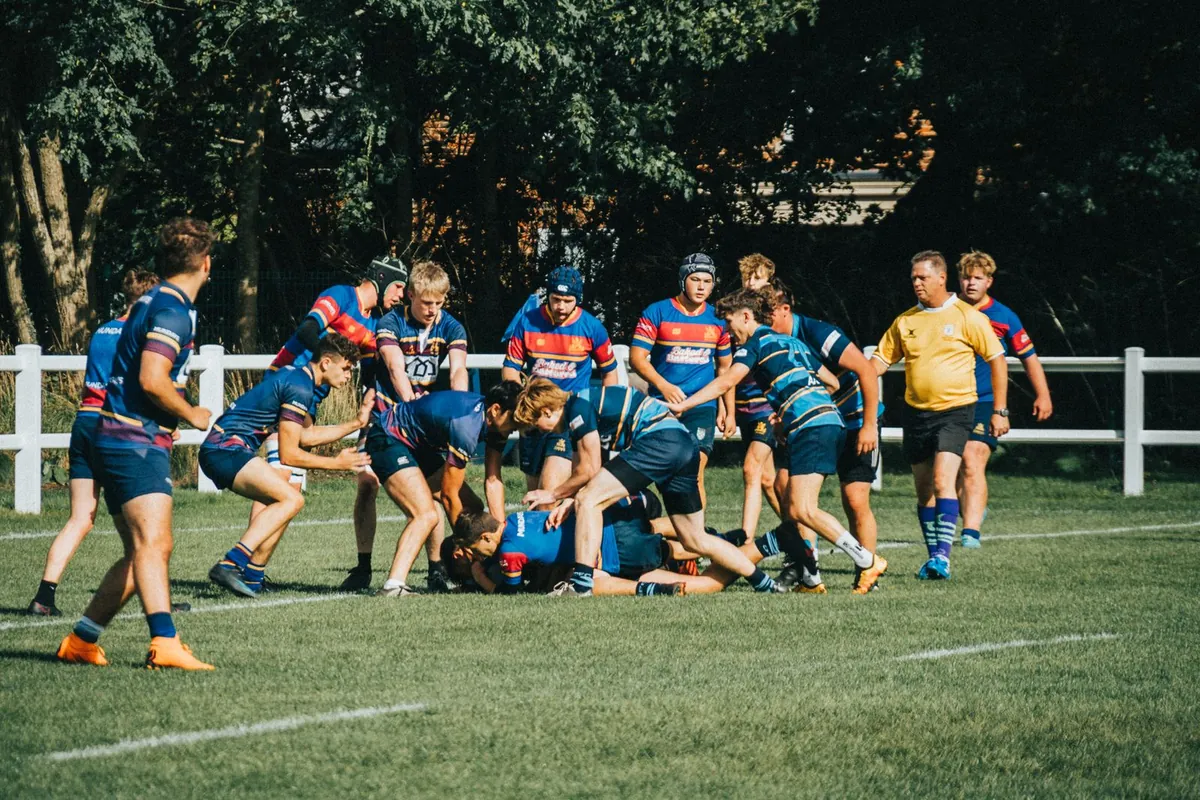
Rugby is one of the hardest sports a playing surface can host. Scrums and mauls concentrate tons of moving weight into small patches of ground. Studs shear the turf at every change of direction, and tackles put bodies down where the ground meets them. A surface that survives a football season can be worn bare halfway through a rugby one.
That is why the real-versus-synthetic debate matters more here than in most sports. Wear on natural pitches concentrates in the scrum zones, the midfield corridor and around every breakdown, and recovery takes the kind of rest a fixture list rarely grants. A club that trains Tuesdays and Thursdays and plays Saturdays is already asking a grass pitch for everything it has.
What Counts as 3G Turf Today
Third generation turf, or 3G, is a long-pile carpet filled with sand for stability and rubber or organic crumb for performance. Rugby builds typically run a pile around 60 mm, tall enough for the infill to cushion falls and reproduce the bounce players expect. World Rugby, the sport’s global governing body, first approved artificial surfaces for rugby in 2003, and systems used for match play are tested on installation and retested every two years.
That approval history matters commercially. Saracens became the first professional UK side to play home matches fully on 3G turf back in 2013, and clubs at every level have followed. What has not changed is the generation ladder. The 4G and 5G labels describe non-infill concepts that no governing body currently recognises, a trap we unpack in our comparison of 3G vs 4G pitches.
Where Real Grass Still Wins
The rugby pitch surfacing reality is that real grass keeps genuine advantages, and pretending otherwise costs credibility. Players describe the feel, the variable bounce and the grip of a good natural pitch as authentic, and many coaches still rate it highest on exactly those qualities. A groundsman can also mow patterns and adapt the surface week to week in ways no carpet allows.
Climate hands grass another edge, because natural turf stays noticeably cooler than synthetic in summer heat, which matters in hot regions. The costs sit in the workload instead. Mowing, watering, aeration, fertilising and divot repair after every session add up to a skilled grounds team and a running budget that never pauses.
None of that makes grass the wrong answer. For venues with hours to spare, grounds expertise on site and a fixture list the weather rarely disrupts, a well-kept natural pitch remains a perfectly good place to play rugby.
Where 3G Turf Pulls Ahead
For rugby pitch surfacing, real grass tolerates roughly two to six hours of adult play a week before it starts to fail; a 3G surface absorbs sixty to eighty hours. That single number rewrites a club’s week. Training can move onto the match pitch, sessions survive the rain, and the surface can be hired out between fixtures for income the grass could never carry.
Weather closes the rest of the gap. A 3G pitch drains freely through the carpet into the engineered base below, so heavy rain rarely cancels anything. Water savings compound the case: US research cited by sports construction firms puts the saving at 1.8 to 3.7 million litres of irrigation water per full-size football field each year.
Consistency is the quieter advantage. Every blade is manufactured to the same height and the infill is spread to specification. Bounce and footing stay predictable from goalpost to goalpost and from match day to match day. Natural pitches develop lumps, worn lines and soft patches that quietly change how the game bounces.
Whichever surface wins the paper comparison, the backing under the carpet decides how the bond holds up — our latex versus PU backing guide breaks that choice down.
Head to Head Comparison at a Glance
Use the table to compare rugby pitch surfacing real grass against 3G turf on the criteria that decide budgets. Read it as a summary of trade-offs rather than a scorecard, because the right column depends on how your pitch is actually used.
| Criterion | Real Grass | 3G Turf |
|---|---|---|
| Weekly capacity | About 2-6 hours of adult use | 60-80 hours |
| All-weather play | Rain and frost close the pitch | Free-draining, playable year-round |
| Maintenance workload | Mowing, watering, aeration, fertiliser, divot repair | Brushing, infill top-ups, de-compaction |
| Typical lifespan | Continuous renovation, periodic full relays | 8-10 years to yarn replacement, base reused |
| Feel and bounce | Authentic, varies with conditions | Consistent, cushioned by the infill |
| Summer heat | Stays cooler | Can run hot in direct sun |
| Cost curve | Cheap to establish, costly to run | Costly to build, cheap to run |
| Best fit | Low-hours venues with grounds staff | Clubs, schools and hire facilities |
One line in that table deserves unpacking. The infill behaves like ballast in a ship’s hull: invisible while it sits where it should, and the first suspect the moment the surface misbehaves. Every system-level judgement about a 3G pitch, from cushioning to drainage to footing, traces back to how the sand and rubber layer is specified and maintained.
Multi-sport value belongs in the same column. A 3G rugby pitch can host football, American football and lacrosse at training intensity, and the same system logic is behind our football turf for football-first venues. That is why schools and community clubs pool budgets around one carpet instead of three separate surfaces.
What a 3G Rugby System Is Built From
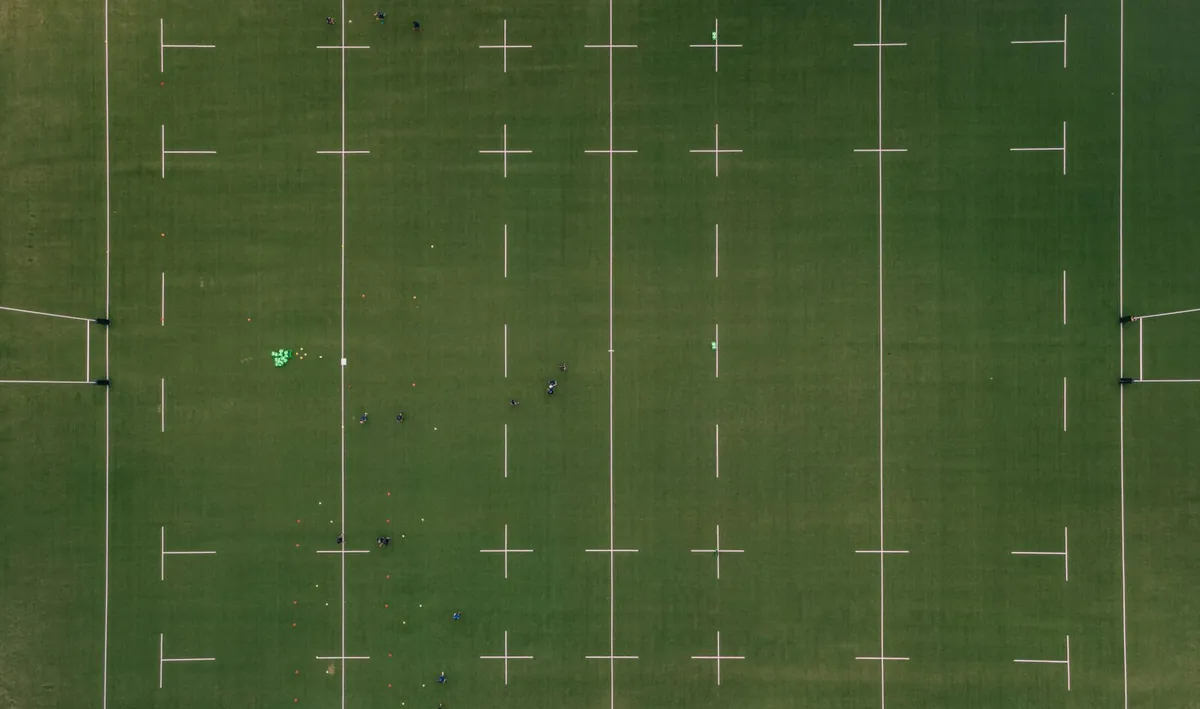
A 3G pitch is a layered system, and the carpet is only the visible top of it. Below sit the groundworks and drainage, an engineered base that sets the falls, and, in rugby builds, a shock pad that adds impact absorption beneath the carpet. Sand and rubber infill then sit inside the pile, weighing the carpet down and holding the blades upright underfoot.
That is the selection knowledge worth having before comparing quotes: the carpet is one component in a system whose safety depends on the layers and the infill plan around it. Once a full-size build is approved, on-site construction typically runs ten to fourteen weeks. What the factory side controls is the carpet itself, and that is where roll format quietly matters.
Carpet arrives in rolls, and roll width decides how many seams a pitch carries. Standard widths run 2 m, 4 m and 5 m at 25 m long, and a 4 m roll covers about 100 square meters. Wider 5 m widths cross a full-size pitch in fewer passes and leave fewer seams to weld and inspect. The wider the roll, the heavier the freight and handling, so the choice is a genuine trade-off rather than a slogan. Facilities that want the surface matched to their drainage plan can browse our rugby artificial turf range to see the formats side by side.
Maintenance Each Surface Really Needs
Grass maintenance never pauses: mowing to height, watering, aeration, fertilising and divot repair after every session, all carried by grounds staff. A neglected natural pitch does not merely look tired; it becomes unsafe as bare patches and holes open up through the season.
A 3G pitch trades that workload for a different routine. Light brushing and litter removal after every 12 to 15 hours of play keeps the blades upright. Deeper work, meaning vigorous brushing, infill top-ups, de-compaction and weed control, runs on an annual cycle tuned to usage. Facilities that skip the routine watch ball roll degrade first and player complaints arrive second.
Be wary of anyone selling carpet as maintenance-free. Brushing, cleaning and inspection never disappear on an outdoor surface, whatever the brochure says. The honest comparison is workload against workload, and on those terms 3G asks for a caretaker where grass asks for a grounds crew.
Costs Across the Whole Life of the Pitch
Rugby pitch surfacing real grass runs cheap to establish and expensive to operate; 3G runs the opposite way. Over a full life cycle the synthetic curve usually wins, which is why capacity-hungry venues keep converting. The payback arrives as saved maintenance hours, hired-out evenings and fixtures that never move.
Replacement economics favour carpet too. A 3G surface is typically replaced after eight to ten years because the yarn degrades. The engineered base beneath it stays serviceable, so resurfacing costs a fraction of the original build. Natural pitches need continuous renovation and, sooner or later, full relays of their own.
Carpet pricing itself is more negotiable than most buyers expect. Factory-direct turf runs $7-60 per square meter depending on pile specification, grade and type, indicative until specification and quantity are fixed, so request exact quotes against your drawings. Set that line against full-system quotes from installers and the carpet’s true share of the budget becomes visible for the first time.
Safety, Comfort and the Honest Caveats
Safety debates deserve straight answers, and the available evidence points one way. A national governing body risk assessment found overall injury risk on artificial turf was not significantly different from good natural grass. The practical takeaway is consistency. A surface with no holes, no divots and no mud patches removes an entire class of uneven-ground injuries from the game.
Impact comfort is a system property rather than a carpet property. In rugby builds, the shock pad beneath the carpet and the sand and rubber infill inside it are specified together to absorb the energy of scrums and tackles. That is why system quotes deserve as much attention as carpet quotes. A slide on a properly filled surface lands on cushioning rather than bare ground.
Two caveats keep the picture honest. Synthetic surfaces can run hot in summer sun, a real consideration in warmer climates that argues for scheduling around peak heat. And players raised on grass notice the difference in feel; some adapt within a session, others never fully warm to the surface.
Weather, Drainage and Winter Play
Rain is the case synthetic surfaces were built for. Water passes through the perforated carpet backing into the free-draining base, and the engineered falls carry it away. Training and fixtures survive the wet months that close natural pitches. When a 3G pitch does hold water, the fault usually sits in a blocked or badly graded base rather than the turf.
Frost is the honest exception. Moisture held in the sand and rubber infill can harden in a cold snap, and a frozen surface stays closed until it thaws. Responsible operators inspect and close rather than schedule through it, the same call a groundsman makes on a waterlogged pitch, just considerably rarer.
Winter exposes the rugby pitch surfacing reality that real grass loses playability exactly when the fixture list is fullest. A maintained 3G pitch keeps its footing and its drainage through the months that decide league tables. Winter capacity is where carpet wins the season, and it is the argument that converts most multi-team venues.
How to Choose Between Them
Four questions sort the decision faster than any brochure. How many hours a week will the pitch actually host, counting training, matches and hire? Who maintains it, and what does that labour cost by year three? What level of play must it host, and does a governing-body-approved route matter to your fixtures? Will other sports or clubs share the surface with you?
Capacity-hungry venues such as schools, community clubs and hire facilities reach for 3G almost automatically, and multi-sport sharing strengthens the case further. Low-hours venues with grounds expertise can stay on grass quite comfortably. Hybrid systems, which stitch synthetic fibres into natural turf, split the difference for stadiums with stadium budgets.
Rugby pitch surfacing real grass or 3G turf is, in the end, a question about weekly hours and budget shape. If capital is tight and operating budget is loose, grass fits. If you can fund the build once and want operating costs to fall, carpet pays you back year after year.
Real Grass Pitch Losing Weeks to Weather?
Winter cancels more rugby than the calendar allows. Synthetic pitch rolls to order. We quote off our own line, typically 30–50% under market for matched specifications.
How We Would Spec the Carpet
Asked to judge a rugby brief tomorrow, we would start from the yarn rather than the label. Most rugby-grade builds pair polyethylene monofilament blades with a polypropylene thatch beneath, tuned to the pile height and density the usage plan demands. The backing comes next: a PP and net construction as standard, with PU coating added where the site needs extra dimensional hold.
Perforating happens on our line before the carpet is rolled up, so drainage is punched into every roll at the factory rather than improvised on site. Then comes the format. 5 m widths suit pitch-scale projects that want the fewest seams, and 4 m rolls are the safe default at about 100 square meters each. 2 m rolls fit tight sites instead. We spec each of these against the site, never against a brochure.
Samples settle arguments that specifications cannot. We cut 20 x 20 cm swatches from production stock and ship them by DHL or FedEx in four to six days. We would rather a buyer stretch, spike and crush a sample than take our word for anything. The carpet that survives your test is the carpet worth quoting.

Questions to Ask Any Supplier
Whatever surface you buy, put the same five questions to every supplier. What test reports back the finished system, and who ran them? What is the maintenance plan in hours per month, and who trains our crew? Which layers of the system does the quote actually cover? What happens at year eight, and can we touch a sample before committing to anything?
Suppliers who answer with documents are worth shortlisting. Suppliers who answer with adjectives are selling the meeting, not the surface. Those questions cost nothing to ask, and they have protected more budgets than any specification sheet ever printed.
Frequently Asked Questions
How long does a 3G rugby pitch last?
Industry estimates run eight to ten years, set by yarn degradation and usage hours. The engineered base usually outlives two carpets, so resurfacing costs far less than the original build. Maintenance discipline decides where you land in that range.
Does a 3G pitch freeze in winter?
It can. Moisture held in the sand and rubber infill hardens in a cold snap, and a frozen surface stays closed until it thaws. Good operators inspect, close and reopen; cancelled sessions are rarer than on natural grass, not absent.
Does artificial turf get too hot for rugby?
It can in summer sun, because synthetic fibres absorb heat faster than grass. Hotter regions schedule sessions around peak afternoon heat and cool the surface where permitted. Natural turf stays cooler, one of its genuine remaining advantages.
Can a 3G rugby pitch host other sports?
Yes. Football, American football and lacrosse all train comfortably on rugby-grade 3G turf, which is why schools and community clubs pool budgets around one carpet. Line markings for several sports are usually stitched into the same surface.
Can you resurface an existing natural grass pitch?
Usually yes, provided the ground conditions and drainage can support an engineered base. The existing surface is removed, the base is built, and the carpet follows. Site surveys decide feasibility, since poor groundworks under new carpet are a false economy.
What boots should players wear on 3G turf?
Moulded studs and artificial-ground soles are the safe default; they grip the pile without punching through into the base. Long metal studs tear carpet, and most facilities ban them. Follow the site’s footwear rules whenever they are stricter.

 English
  Arabic
  French
  German
  Portuguese
  Russian
  Spanish