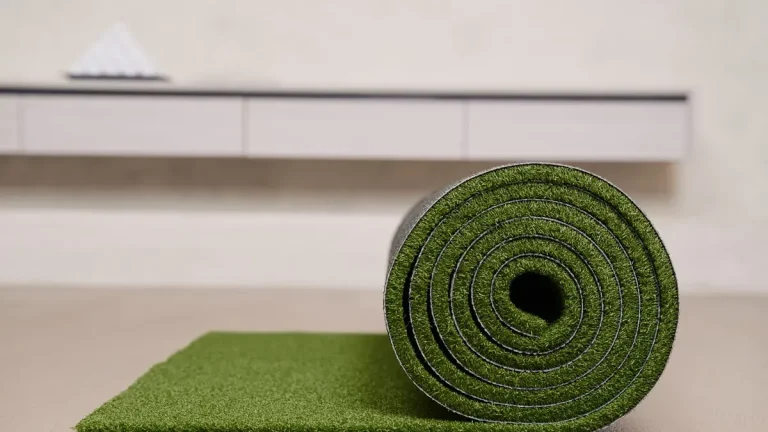
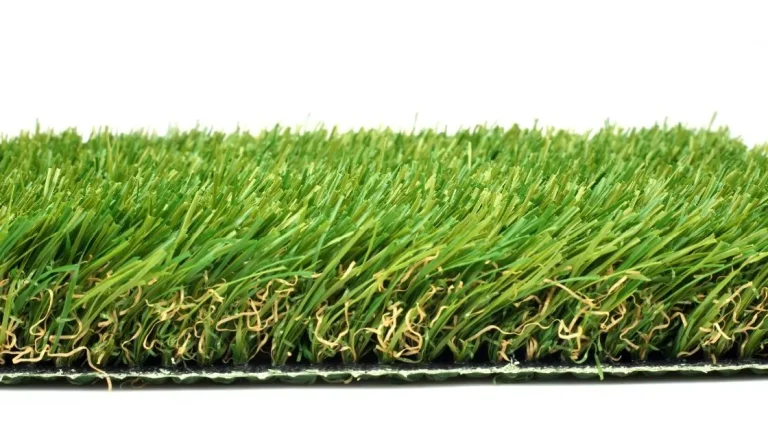
The first sign of a backing problem never arrives on the order confirmation – it arrives in the sweepings. Loose fibres collect in the bag, a seam tape refuses to stay bonded, and a low spot holds water two days after rain. By then the carpet is paid for and the crew has left the site. Vendor pages describe a durable, premium, heavy-duty artificial turf backing, yet no adjective survives contact with a test method.
We build carpet, so we read the back of every sample before the front. The front is marketing; the back is engineering. This page walks through that engineering layer by layer, swaps adjectives for the numbers test methods actually produce, and closes with the questions that make a backing specifiable.
What the Backing Actually Is
An artificial turf backing is the layered structure beneath the fibres, and it decides whether the surface you bought is the surface you still have in year eight. The word covers more than one material, which is why it tells a buyer almost nothing on its own.

Artificial turf is a surface of synthetic fibres made to look like natural grass, per the standard artificial turf reference (e-16). The backing of artificial turf sits under those fibres, keeping them where they were tufted and adding weight that stabilises the carpet (e-17, vendor-reported).
Read from the fibre down, the structure separates into three functional parts:
- Primary backing. The woven or non-woven fabric the yarn is tufted into – the substrate every other layer depends on (e-20).
- Secondary coating. The latex or polyurethane layer applied after tufting that locks the tufts in place (e-20).
- Perforations. Holes punched through the finished coating that carry rain and cleaning water out of the system (e-21).
Each part answers a different failure mode, and each carries numbers of its own. For the system view first, see where the backing sits inside the full layer stack.
The Primary Backing: Woven or Composite
The primary backing is the fabric the yarn is tufted into, and it quietly sets dimensional stability and seam behaviour for everything above it. Get this layer wrong and no coating above it can fully compensate.
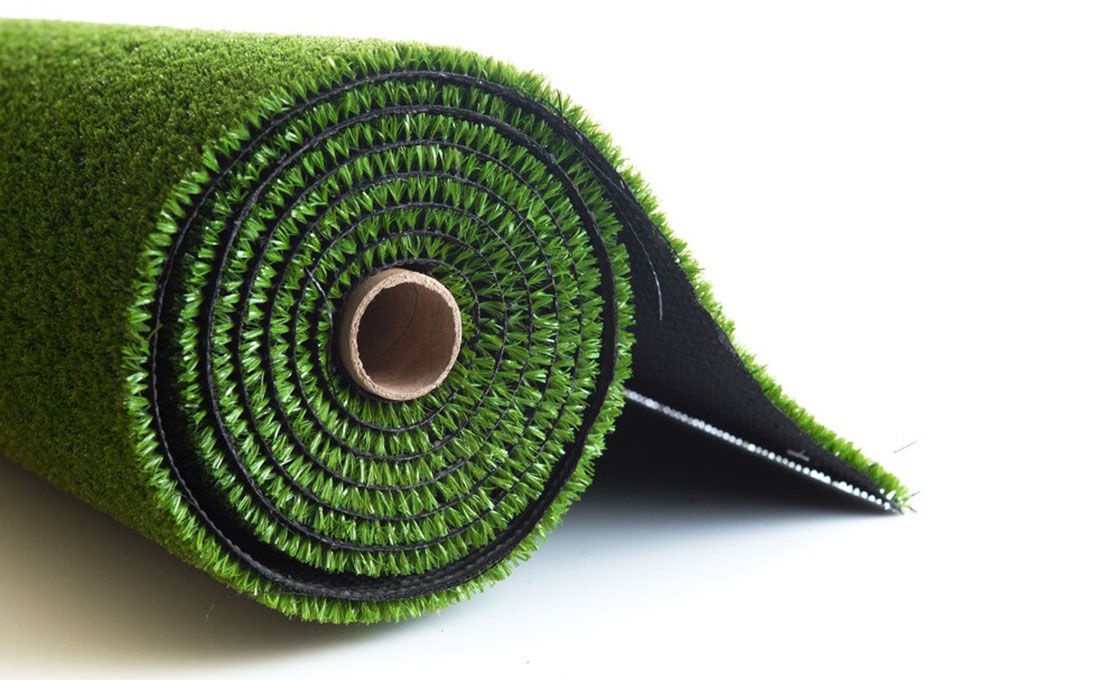
Construction starts from woven or non-woven fabric of high-strength polyester or polypropylene, the material that holds the blades in place by tufting (e-20). Three builds dominate current supply: PP fabric plus net fabric, PP plus non-woven fabric, and two layers of PP (e-19, vendor-reported).
Layer count is the stability lever. Single-layer PP stays light and budget-friendly for temporary use, while double-layer composite adds horizontal and vertical stability for high-traffic areas (e-18, vendor-reported). Most artificial grass runs two layers of 13-pic Polybac, some use 18-pic instead, and a mesh stability layer between them adds tuft bind (e-26, vendor-reported). More layers generally mean more stability (e-26, vendor-reported).
- Tuft anchor. The fabric grips every tuft sewn through it, so yarn retention starts here.
- Dimensional stability. A stable woven polypropylene resists stretching and shrinking, so the turf lies flat instead of wrinkling (e-24, vendor-reported).
- Seam substrate. Seaming tape and adhesive bond to this layer, which is what makes permanent joints between rolls possible (e-20).
The Secondary Coating: Latex, PU and Hot-Melt
The secondary coating is where an artificial turf backing earns its tuft bind – and where cost-cutting hides. A liquid polyurethane or latex coat is applied after tufting and cured, supplying most of the tuft bind the carpet carries (e-20, e-27, vendor-reported).

Geography shapes the default choice: in the US most artificial turf is coated with polyurethane, while Europe and Asia lean toward latex (e-27, vendor-reported). Latex is susceptible to extremely wet conditions, where reduced tuft lock can let fibres work loose after years (e-17, vendor-reported). PU penetrates the fibres more evenly and is not affected by wet conditions (e-17, vendor-reported).
| Material | How it locks the tufts | Wet-weather behaviour | Cost position |
|---|---|---|---|
| SBR latex | Coat sets around the tufts; basic hold at low cost (e-23) | Susceptible in extremely wet conditions; tuft lock can drop over years (e-17) | Lowest |
| PU | Penetrates the fibres more evenly; greater tear resistance (e-17) | Unaffected by wet conditions; resists moisture, temperature swings and delamination (e-23) | Higher raw-material cost |
| Polyolefin hot-melt | Solvent-free thermoplastic bond; fully recyclable (e-23) | Waterproof and free-draining | Mid-to-high; needs tight process control, standards not yet widespread (e-23) |
| Hybrid emulsion (PU plus acrylic) | Interlayer peel resistance roughly twice that of SBR (e-23) | Strong water resistance | Mid-to-high |
One warning belongs beside that comparison. Some manufacturers reduce the amount of latex or polyurethane in the secondary layer to cut costs, compromising the strength and longevity of the turf (e-19, vendor-reported). The saving shows up later as tuft loss.
For lawn products, read the PU-versus-latex verdict for lawn turf before fixing a lawn coating. Sports surfaces answer to a different set of criteria altogether.
The Numbers Governing Bodies Test
Vendor adjectives cannot be verified; the artificial turf backing numbers that can be verified come from test methods. The most complete public set sits in Annexe A of the FIFA and FIH DualSport turf quality criteria (e-01). Five of its carpet criteria read like a buyer’s checklist:

- Tuft withdrawal force of 40N or more for the carpet, tested to EN 12228 Method 2 and EN 13744 (e-01).
- Joint strength of 1000N/100mm or more for stitched carpet and 75N/100mm or more for bonded carpet, unaged and after hot-water immersion (e-02, e-03).
- Dimensional stability within plus or minus 0.5% after each test stage (e-04).
- Carpet strength above 15N/mm, with directional variation capped when either direction falls below 20N/mm (e-05).
- Pile-yarn tensile strength of 5N up to 1200dtex, 8N above that denier and 30N for fibrillated yarns (e-10).
Criteria are tested dry, wet and after simulated wear, with wear created on the Lisport XL apparatus per FIFA TM 13 across 6,000 cycles (e-09). The same table caps yarn weathering loss at 25% of peak breakage force after artificial ageing (e-10). Surface regularity is set at 6mm or less, measured over a 3m straight edge (e-13).
What a Tuft-Bind Number Measures
Outside pitch certification, tuft bind has its own method: ASTM D1335, the tuft-bind test method, measuring the force needed to pull a tuft from a pile covering sample (e-14). It applies to cut and loop pile alike (e-14).
The significance notes read like a failure catalogue. Inadequate tuft bind may end in complete pile loss in areas exposed to severe wear, and in looped pile the loops can pull out into unsightly, hazardous long loops (e-15). The method is used for acceptance testing of commercial shipments (e-15) – the same check a buyer can demand at receiving.
Where Certification Stops
One boundary matters before any quality mark is read as evidence. The FIFA Basic quality mark is an installation certification, not a product approval: no laboratory product testing before installation and no assessment of the carpet, fibres, infills or shockpad (e-07).
Where certification does apply, product identification tests confirm that materials delivered to a pitch match those previously tested (e-08). The same DualSport table reaches past the carpet, requiring shockpads to conform to EN 15330-4 and limiting dust and PAH content in infill materials (e-11).
Drainage Is a Backing Specification
Artificial grass is non-absorbent, so every drop that lands on it has to leave through the turf backing. Drainage is therefore a coating and perforation decision, not an afterthought beside the carpet.

At pitch level the number is explicit: water permeability of 150mm/h or more under EN 12616 (e-06). Vendor practice translates that into perforation terms: holes of 5-8mm allowing runoff up to 30 litres per square metre per minute on well-designed systems (e-18, vendor-reported). Commercial sites sometimes go further, with high-density patterns of up to 60-80 holes per square metre (e-22, vendor-reported).
Holes are usually evenly spaced, with size and spacing affecting drainage speed (e-21). A permeable, non-absorbent secondary backing raises capacity further, which pays off in heavy-rainfall areas and in installations like dog runs (e-21, vendor-reported). Faster-draining backings also reduce the risk of infill floating (e-17, vendor-reported).
The backing is only half of the path. The base under it should be a compacted layer of aggregates, with a slope or gradient integrated to encourage flow (e-21). Three questions close the drainage file:
- Hole pattern and count. Diameter, spacing and density across the full roll width, not just a sales line.
- Permeability target. A declared rate the installed system can be tested against.
- Base exit. How the compacted aggregate base and its gradient carry water away (e-21).
How Turf Backings Fail in Service
When an artificial turf backing fails, it fails in one of three ways. None of the three shows on installation day. All three surface after handover, when the invoice has been paid.
- Tuft loss. Latex loses tuft lock in extremely wet conditions (e-17), and inadequate tuft bind can end in complete pile loss under severe wear (e-15).
- Delamination and cracking. Layers that peel apart cleanly or adhesive dripping unevenly signal a primary and secondary that never fused (e-25), and SBR is prone to cracking and aging under UV (e-23).
- Dimensional instability. A primary that stretches or shrinks leaves wrinkles (e-24), while an overly rigid backing cracks in cold weather or on uneven substrates (e-22).
The cost of buying cheap is documented. One practitioner reports a European train station plaza that chose a single-layer PP backing with a thin latex coat to cut costs (e-22, vendor-reported). Tuft loosening appeared along the main walking paths within six months, and 40% of the surface was replaced ahead of schedule (e-22, vendor-reported).
Failure rule. A weak backing does not announce itself at installation. It shows up as loose fibres in the sweepings, a seam that will not stay taped, or a low spot that holds water after rain.
Which Backing Does Your Project Need?
Artificial grass rolls specified by primary backing, coating type and perforation pattern – samples and spec review before commitment.
What to Ask Before You Buy
Turn adjectives into numbers, and four questions make an artificial turf backing specifiable. Ask them before the quote is signed, not after the roll is on the ground.
- Coating type and weight. Twenty ounces per square yard is standard, with some turf carrying 26 ounces for more tuft bind and durability (e-27, vendor-reported).
- A tuft bind or tuft withdrawal number. Judge it against the 40N benchmark the DualSport criteria use (e-01).
- A permeability rate. Judge it against the 150mm/h pitch benchmark (e-06).
- Dimensional and joint numbers. Plus or minus 0.5% dimensional stability and 1000N/100mm for stitched joints (e-04, e-02).
Receiving is where weak batches get caught. ASTM D1335 is used for acceptance testing of commercial shipments (e-15), and product identification tests confirm that delivered materials match those previously tested (e-08). For the full selection routine, see how to choose the proper artificial grass backing.
One practitioner monitored tuft retention, drainage rate and surface stability on a 20 m2 sample across three backing structures over three months of traffic before committing (e-22, vendor-reported). One metric needs clarity too: face weight excludes the backing, so ask whether a quoted weight is face weight or total weight including it (e-27, vendor-reported).
When the four answers come back as numbers, hold them roll against roll. Artificial grass rolls specified by backing structure, coating and perforation pattern make that comparison direct instead of descriptive.
Reading the Spec, Not the Brochure
The brochure sells the surface; the spec describes the system. A complete turf backing specification is three lines deep: primary substrate, secondary coating and perforation pattern. Numbers already exist for every line (e-01, e-04, e-06).
That is what separates a sample that impresses from a system that survives. When a supplier describes a backing only in adjectives, the missing numbers are the answer. Adjectives cannot be tested; numbers can.
Our team sends the backing spec with every sample. If a supplier cannot answer the four questions in numbers, the sample is the only honest part of the offer. Read the back first, and the front will take care of itself.
Frequently Asked Questions
What is artificial turf backing?
It is the layered structure under the fibres. A primary woven or non-woven fabric takes the tufted yarn, plus a secondary latex or polyurethane coating that locks the tufts and carries the drainage perforations.
Why is the backing so important?
It anchors the fibres, holds the roll dimensionally stable and carries the drainage holes. When it fails, fibres pull out, seams open and water pools – problems that surface after installation, not before.
Is latex or PU backing better?
PU resists moisture and delamination better and penetrates fibres more evenly; latex costs less. Wet climates and heavy-use projects usually justify PU – the choice should follow the site.
What tuft bind should I look for?
Ask for the number, not the adjective. The FIFA and FIH DualSport criteria set tuft withdrawal force at 40N or more, tested dry, wet and after simulated wear on the Lisport XL apparatus (e-01).
Do all artificial turf backings drain?
The turf itself is non-absorbent, so water leaves through perforations in the backing into the base. The DualSport criteria set water permeability at 150mm/h or more for pitches (e-06).