
Bocce court turf lives or dies on four specifications: pile height, padding versus infill, permeability and the base that sits underneath. Get those four right and the court plays true for years. Get one wrong and no amount of grooming fixes the way the ball dies or skids.
This guide reads like the spec sheet a buyer should demand from a supplier. Every line exists because a court somewhere failed without it, and every number comes from published court-building guides rather than guesswork.
The Specification Sheet at a Glance
Before the deep dives, here is the whole specification conversation in one table. Each row gets its own section below, because the rows interact: pile height affects infill, infill affects drainage, and the base sits under everything.
| Specification | What the guides say |
|---|---|
| Pile height | Shorter pile gives more rebound, absorbs less energy |
| Surface system | Padded turf (such as 5 mm foam-backed) or brushed-in infill |
| Permeability | Choose permeable turf so water drains through |
| Drainage exits | Weep holes about 1/4 inch every 8 feet of frame |
| Base slope | About 1 inch per 10 feet toward the drain end |
Treat those five lines as the minimum a supplier quote should address. A quote that skips any of them is a quote that will be amended later, at your cost.
Every row in that table interacts with the rows above and below it, which is why the specification belongs on a single sheet rather than scattered across emails.
Pile Height and Ball Response
Pile height is the visible spec with the invisible consequences. Greatmats’ build guide states the relationship plainly: a shorter pile height creates more rebound and absorbs less energy, while a taller pile results in less. Translated to the court, shorter turf plays faster and livelier, and pointing shots run further than players expect.
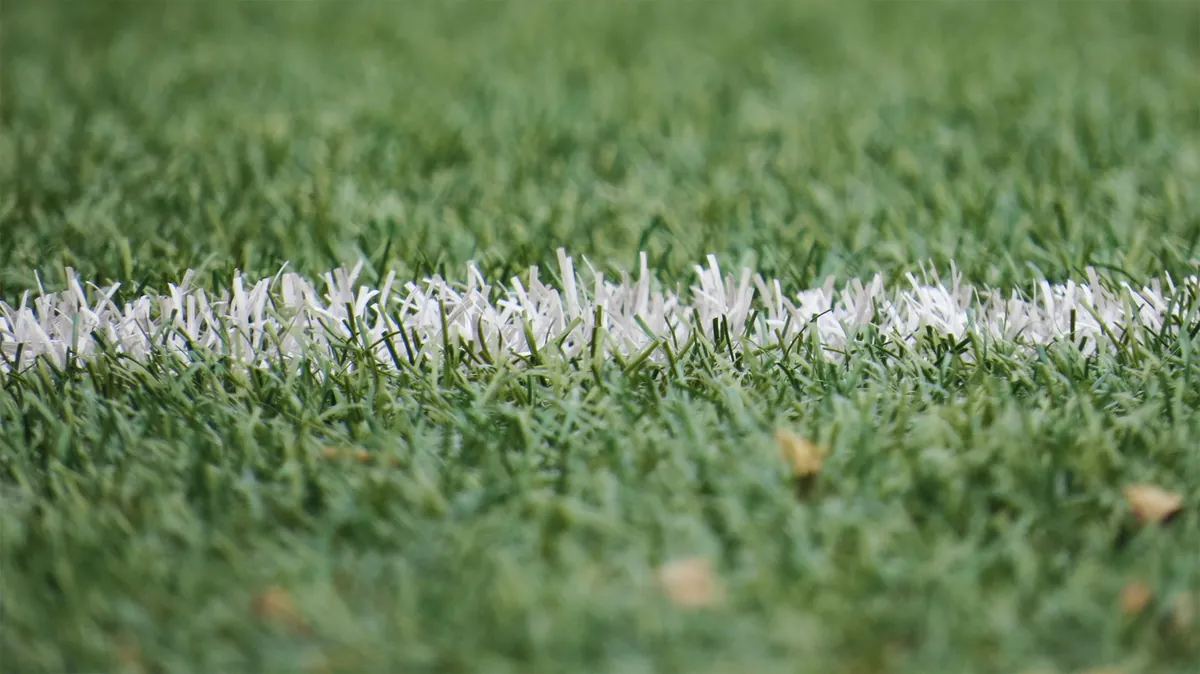
Face weight is the hidden specification behind pile height. Two products with identical pile height can differ significantly in face weight, which is the amount of yarn woven into each square metre of surface. Higher face weight means denser coverage, better wear resistance and a more consistent ball response. Lower face weight costs less but thins out in the delivery lanes within a season or two. Ask for the face weight in writing, because it is the number that separates a three-year surface from a ten-year surface.
There is no single correct bocce court turf height, only a correct match to your players. Social courts often like a touch more cushion; competitive players want the faster, truer roll of shorter pile. What matters at specification stage is that the height is written down, consistent across every roll delivered, and the same at every seam.
Padded Turf or Infill Systems
The surface system decides how the court feels and how much work it takes to build. An infilled system uses brushed-in material to support the pile and tune ball speed, layer by layer, and it gives the builder fine control. A padded product, such as a 5 millimetre foam-backed turf, arrives with the playing feel engineered in and skips the infill step entirely.
Greatmats’ guidance adds the commercial angle. For buyers keeping court price at a minimum, larger rolls of padded turf often deliver the best value, because you avoid buying and installing infill altogether. Infill rewards teams who want control; padding rewards teams who want it done. Both play, and the specification should say which one is being purchased.
Climate adds another layer to the specification conversation. In hot climates, a lighter-coloured pile reflects more sun and keeps the surface temperature lower underfoot. In wet climates, permeability moves from recommended to required, because a non-permeable product turns the court into a shallow pool every time it rains. In freeze-thaw climates, the backing needs to flex without cracking, which narrows the product range. Each of these environmental factors narrows the specification and should be raised with the supplier before ordering.
Permeability and the Drainage Layer
Water is the specification killer, and the defence is layered. The turf itself should be permeable so rain passes through the surface rather than ponding on it. The base beneath should be compacted but sloped, roughly 1 inch per 10 feet, so the water that passes through keeps travelling.
The frame needs weep holes too, about a quarter inch across every 8 feet, so the water that reaches the edge has somewhere to leave.
Those three layers were designed as a system by the court guides that publish them. A quote that upgrades one layer while ignoring the other two is not a bargain; it is a future puddle with paperwork.
Matching Specs to Play Style
Specifications are a means, and the end is how your court plays. Casual family courts lean toward padded turf for comfort and forgiveness. Serious players lean toward shorter pile and the faster surface it produces. Mixed-use courts, which host other games between bocce sessions, tend toward the middle: medium pile, padded base, and colours that read as landscaping rather than sports kit.
Sample packs settle bocce court turf debates faster than spec sheets, and every option above is available in Relyir’s bocce ball turf range. Relyir’s free samples in 20 by 20 centimetre squares ship by DHL or FedEx in 4 to 6 days, so the pile decision happens with a pallino in hand. Send us your court dimensions and level of play. We will return the specification options, a roll width plan and indicative material pricing from $7 to $60 per square metre, indicative until fixed.
Spec Sheet Full of Numbers You Can’t Verify?
Vague pile and stitch specs are how clubs get burned. Ours are made to order. Factory-direct pricing, typically 30–50% below market on like-for-like specifications.
Backing, Faces and Court Lines
Behind every good face is a good backing. Relyir builds on stable PP+Net or PU backings. They hold the turf dimensionally steady through seasons of sun and rain, and the pile itself can be specified for density as well as height. Colour belongs in the same conversation: greens are standard, but custom colours and inlaid lines are available when the court doubles as landscape design.
Backing choice ripples forward into maintenance as well. A dimensionally stable backing keeps seams tight, which means fewer repairs, and it keeps line inlays exactly where they were produced rather than wandering with the weather. Buyers comparing quotes should ask what is inside the backing, not just what is on top of it, because two identical-looking faces can sit on very different foundations.
UV stability is the specification most buyers never ask about and the one that determines whether the court still looks good in year five. Quality bocce turf is produced with UV inhibitors in the yarn itself, not just a surface coating that washes off. Cheap products without proper UV stabilisation fade to a pale blue-green within two or three seasons of direct sunlight. The colour specification should include a UV guarantee from the manufacturer, in writing, because the difference is invisible on day one and obvious by year three.
Court lines are better specified than improvised. Whether the lines are inlaid turf strips or painted markings, the specification should say which, because painted lines on turf are maintenance items while inlaid lines are features.
What Regulation Play Demands From Specs
Players who compete should anchor their court to the official frame. The US Bocce Federation figure is 86.2 by 13.12 feet, and 91 by 13 feet is also quoted as regulation in court-building guides. The turf specification does not change the lines, but it changes whether the court plays honestly at speed, which is what regulation play actually tests. The game itself is governed by bodies that publish their own court standards, as the bocce overview records. Our guide to bocce court design covers the sizing choices in full.
Spec Checklist Before You Commit
Check the Pile, in Writing
Height, density and face construction belong on the quote. Two products can look identical in photos and play differently for years.
Check the Surface System
Padded or infilled, and if infilled, what material and how much. The answer changes the budget and the maintenance plan at the same time.
Check the Drainage Story
Permeable turf, sloped base and weep holes are three purchases that arrive as one system. A supplier who cannot explain all three is selling you the top layer only.
Frequently Asked Questions
What pile height is best for bocce court turf?
Guides favour shorter pile for bocce because it creates more rebound and absorbs less energy. The right choice balances fast play against the cushion your players prefer.
Does bocce turf need infill?
Not if you choose a padded product, which arrives with the playing feel built in. Infill systems remain an option for builders who want to tune ball speed on site.
Is bocce court turf permeable?
Quality bocce turf is permeable by design, and guides recommend it so rain drains through the surface instead of pooling on top of the court.
What base goes under bocce turf?
A compacted base of decomposed granite or crushed stone, sloped about 1 inch per 10 feet, with weep holes in the frame so water can exit.
Can bocce court lines be inlaid?
Yes. Inlaid lines are specified during production and become a permanent feature, while painted lines are a maintenance item that needs periodic renewal.
 English
  Arabic
  French
  German
  Portuguese
  Russian
  Spanish