








Futsal court dimensions run from 25 m by 16 m up to 42 m by 25 m, and the level of play decides where a court sits between those bounds. International matches ask for at least 38 m by 20 m, and no match at any level may exceed 42 m by 25 m. The court most facilities build, 40 m by 20 m, covers 800 m² of playing area. Futsal itself is five-a-side football played to lines, restarted with a kick-in, on a flat, smooth surface.
None of those numbers is the area you pave. Run-off sits outside every touchline and goal line, and its depth moves the paved area by hundreds of square metres. We work from the paved rectangle rather than the playing area, because that is where a futsal budget is fixed.
Futsal Court Dimensions: International and Domestic Ranges
The FIFA Futsal Laws of the Game 2024-25 set futsal court dimensions as ranges rather than one fixed rectangle, and let competition rules pin the exact size. For non-international matches the touchline must measure 25 m to 42 m and the goal line 16 m to 25 m. For international matches the touchline runs 38 m to 42 m with the goal line at 20 m to 25 m. One ordering rule holds everywhere: the touchline must be longer than the goal line.
| Level | Length (touchline) | Width (goal line) | Playing area |
|---|---|---|---|
| International minimum | 38 m (about 125 ft) | 20 m (about 66 ft) | 760 m² |
| International maximum | 42 m (about 138 ft) | 25 m (about 82 ft) | 1,050 m² |
| Non-international minimum | 25 m (about 82 ft) | 16 m (about 52 ft) | 400 m² |
| Non-international maximum | 42 m (about 138 ft) | 25 m (about 82 ft) | 1,050 m² |
| Common full size, per The FA | 40 m (about 131 ft) | 20 m (about 66 ft) | 800 m² (about 8,611 sq ft) |
The areas are arithmetic on the two bounds: 38 x 20 gives 760 m², 42 x 25 gives 1,050 m² and 25 x 16 gives 400 m². Feet conversions use 3.28084 feet to the metre, and 800 m² works out at 8,611 sq ft. Every area in the table is the pitch inside the lines, with no run-off counted.
Two notes keep the table honest. The upper bounds converge at 42 m by 25 m, so the largest international and non-international courts are the same rectangle. And 40 m by 20 m is not a FIFA value; The FA describes it as a full size futsal pitch in its own guidance.

The 40 x 20 m Court and Its 800 m²
One size inside both ranges has become the default, which is why 40 by 20 dominates futsal court dimensions searches. Forty metres sits inside the 38 to 42 international band and twenty metres sits on its width floor, so an international court and a domestic one are the same build. The FA calls 40 x 20 m a full size futsal pitch, and its area is 40 x 20 = 800 m², about 8,611 sq ft.
Futsal is not eleven-a-side football scaled down, and the two games share nothing in the markings. Our guide to football field dimensions covers the full-size pitch separately. In feet, the same court runs about 131 ft by 66 ft, a useful cross-check when a site drawing is done in imperial units.
800 m² is a playing area, not an order. Four bands of run-off sit outside those lines, and their depth sets the real rectangle. Ordering before that arithmetic is how 396 m² goes missing at installation.
Line Widths, Penalty Marks and Goal Size
Every line on a futsal court is 8 cm wide, and measurements are taken from the outside of the lines because each line belongs to the area it encloses. The 8 cm rule covers the boundary lines, the penalty-area arcs and the corner arcs alike. The FA Law 1 – The Pitch restates the same markings for domestic play, and most local leagues work from that page.
Centre Circle and the Two Penalty Marks
A circle with a 3 m radius surrounds the centre mark. The penalty area starts with two 6 m lines drawn from the outside of each goalpost. Quarter circles of the same radius join a 3.16 m line running parallel to the goal line. The penalty mark sits 6 m from the midpoint between the posts, and the second penalty mark sits 10 m out.
Corner Arcs, Goals and Substitution Zones
Each corner carries a quarter circle with a 25 cm radius, drawn inside the pitch with the same 8 cm line width. Goals measure 3 m between the inside of the posts and 2 m from the lower edge of the crossbar to the floor. Posts and crossbar are 8 cm wide and deep. Substitution zones run 5 m along the touchline in front of each bench, closed off by 80 cm marks at each end.
- All lines: 8 cm wide, measured from the outside edge.
- Centre circle: 3 m radius.
- Penalty mark: 6 m from the midpoint between the posts.
- Second penalty mark: 10 m from the same midpoint.
- Corner arc: 25 cm radius.
- Goal: 3 m by 2 m inside measurement.
- Substitution zone: 5 m long, with 80 cm end marks.
FIFA places the second penalty mark 10 m out, and different rule systems handle that mark in their own way. Confirm which rulebook the competition runs under before the markings are painted, because spot distances do not transfer between systems.
Two spaces sit outside the markings but inside the plan. Benches, referee tables and officials need room beyond the run-off, which the FA guidance lists as a separate requirement. Futsal markings define no separate goalkeeper area; the penalty area serves that role.

Run-Off Depth by Level and Clear Height
Futsal pitch dimensions on paper end at the lines. The The FA Futsal Pitch Size Guidance adds the band that makes the pitch playable, and it grades that band by level of competition. Read what follows as The FA’s domestic competition ladder, whose top row is labelled International. The FIFA length and width ranges are a separate scale, and the two cannot be checked against each other.
- International: 38 m by 20 m with 3.00 m of run-off.
- FA Futsal Cup semi-finals and finals, and National Futsal League Tier 1: 38 m by 18 m with 2.00 m.
- FA Futsal Cup regional rounds and the National Futsal League: 30 m by 15 m with 1.00 m, the absolute minimum, though 2.00 m is preferred where feasible.
- Youth courts: 18 m by 11 m for under-9s, 20 m by 12.5 m for under-11s, and 30 m by 15 m for ages 12 to 16, each with 1.00 m.
- No walls and no rebound boards at any level; run-off is a requirement, not a preference.
The band is working space, not decoration. Fencing, floodlight positions and the team bench area all live in it, and the FA guidance asks for additional room beyond the run-off for benching, tables and officials. A court that measures the lines and stops there has bought a pitch it cannot seat. The same guidance asks event organisers to record a safety risk assessment of the pitch dimension and its run-offs in the competition log. That is the paperwork step private projects skip most often.
Height is the one dimension the Laws refuse to fix. On indoor pitches the FIFA text says only that the minimum height of ceilings should be stipulated in the competition rules, and the Laws themselves set no figure. Some published guides quote a ceiling height the Laws do not contain, so treat any such number as the host venue’s own requirement, not as a rule.

From 800 m² to the Real Paving Area
Add the run-off to the rectangle and futsal court dimensions become a site plan. The court that looked like 800 m² on the order turns into one of three rectangles.
- 1.00 m run-off: 42 m by 22 m, or 924 m².
- 2.00 m run-off: 44 m by 24 m, or 1,056 m².
- 3.00 m run-off, the international depth: 46 m by 26 m, or 1,196 m².
The range runs wider at the extremes. The smallest legal court, 25 m by 16 m, needs 31 m by 22 m with 3 m run-off, or 682 m². The largest, 42 m by 25 m, reaches 48 m by 31 m and 1,488 m². That is more than twice the land for the same sport. Every figure in this list is the turf rectangle, the area a quote actually has to name.
The difference between order and reality is easiest to see at international depth: 1,196 m² against 800 m² leaves 396 m² that no line encloses. Benches, the officials’ table and floodlight positions all sit in that ring. On a shared site the ring is also where other sports’ run-offs have to fit, which our multi-sports court page covers in detail.
Two of those rectangles matter for the roll plan. A 46 m outer length breaks a 25 m roll, and so does 48 m, which is where the roll arithmetic below starts.

Futsal Courts Versus 5-a-Side Turf Cages
A turf cage and a futsal court are different products that happen to host five players a side. The FA’s Futsal Factsheet draws the line: futsal is played to lines and restarts with a kick-in, while traditional five-a-side has no by or end lines and uses rebound boards. The comparison decides what gets built.
Lines Against Rebound Boards
On a futsal court the ball is out when it crosses a line, and play restarts with a kick-in. In a five-a-side cage the boards keep the ball alive, so no by or end lines exist. Build the wrong one and the game the client intended cannot be refereed properly.
Goals, Balls and Fouls
Futsal uses square goals 3 m by 2 m and a size 4 ball with its bounce reduced by 30 percent. Traditional five-a-side uses rectangular goals and a size 5 ball for adults. Futsal also counts accumulated fouls, with a direct free kick from 10 m after the fifth.
The Surface Rule That Decides Turf
The Laws ask for a pitch that is flat, smooth and non-abrasive, preferably wood or artificial material. Artificial turf is permitted in exceptional cases and only for domestic competitions, which is the compliance line every grass project sits on. A turf futsal court is therefore a domestic or community build by definition, and international fixtures expect a hard floor.
Indoor and outdoor do not change the rectangle. FIFA sets no separate length or width for indoor futsal, and the ceiling question belongs to the competition rules as shown above. Outdoors, the run-off, drainage and the artificial-turf exception decide the build. The dimensions travel; the construction does not.
So the drawing test is simple: if the brief shows rebound boards, it is not a futsal court. Futsal lines can be painted over a multi-sport surface, and our basketball court dimensions guide shows how shared layouts work, but the run-off ring cannot shrink to fit.

Turf Specification When Grass Is the Surface
Where the rulebook allows grass, the specification starts from pile height. Domestic artificial turf installations for futsal and five-a-side sit in the 40 to 50 mm band, which keeps the surface quick and the ball roll even. Full-size eleven-a-side pitches run taller at 50 to 60 mm, which is why the two specifications should never be cross-ordered.
A standard 3G build is specified with roughly 20 to 30 kg/m² of silica sand as the stabilizing layer, plus 8 to 15 kg/m² of performance infill. The sand holds the pile upright; the performance layer tunes ball behavior. Both are part of the surface system, and both are calculated per square metre before a single roll is cut.
- Pile height: 40 to 50 mm for futsal, five-a-side and multi-sport courts.
- Infill: silica sand at 20 to 30 kg/m², with 8 to 15 kg/m² of performance infill on top.
- Backing: PP + net or PU, both open to perforation for drainage.
- Rolls: 2 m, 4 m and 5 m widths by 25 m long, with custom sizes on request.
The surface is a system, not a single carpet: turf, sand, performance infill and the base beneath it get chosen together. We cut rolls to the court drawing rather than to a catalogue width, because the run-off ring from the sections above is what the rolls actually have to cover.
Specifying turf for a futsal court, not a cage?
Courts sized off a drawing, not a catalogue: roll width and length cut to your court drawing, for domestic and community futsal where competition rules permit artificial turf.
Roll Counts for a 46 m by 26 m Site
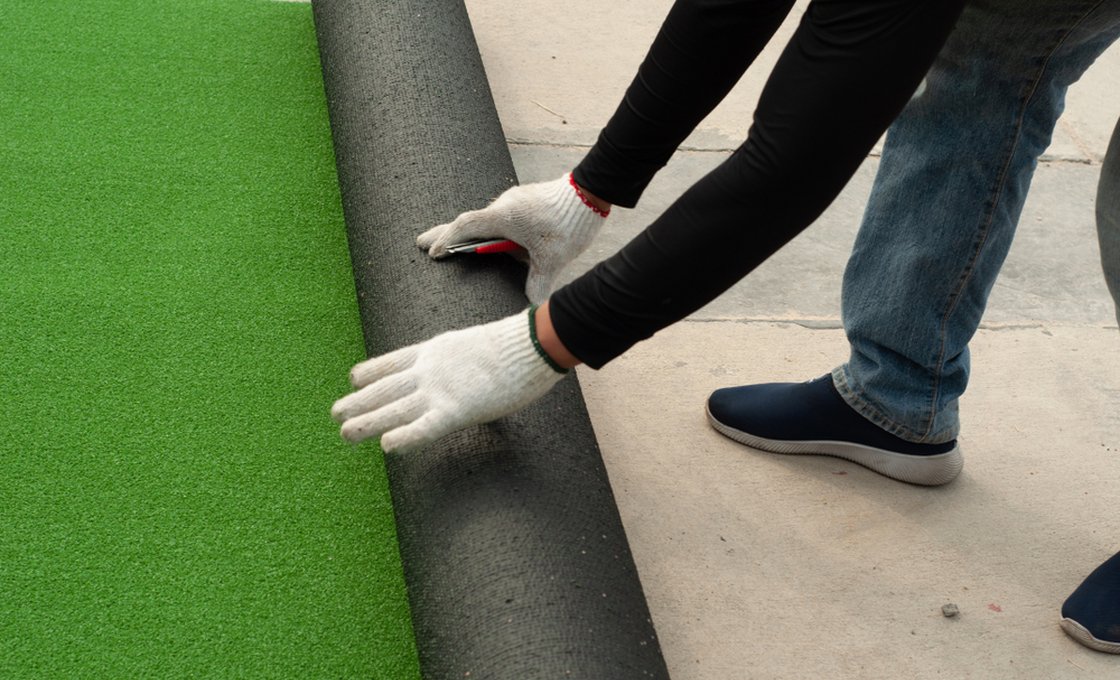
Roll counts are where futsal court dimensions meet the 25 m roll. Divide the 1,196 m² site by the 125 m² of a 5 m roll and the answer is 9.57, which rounds to 10 rolls. Ten rolls cover the area, but only as five straight lanes plus a 1 m strip pieced together from the offcuts, and that strip adds one more longitudinal seam. The seam falls inside the court, which is exactly what a straight-lane layout avoids.
- 5 m rolls: 10 rolls by area, 12 rolls in straight lanes (6 lanes, 2 segments each).
- 4 m rolls: 12 rolls by area, 14 rolls in straight lanes (7 lanes).
- 2 m rolls: 24 rolls by area, 26 rolls in straight lanes (13 lanes).
- Straight-lane lane counts are therefore 6, 7 and 13; the area layouts use 5, 6 and 12.
Straight lanes are the clean version: six lanes of 5 m, each laid from two 25 m segments, with every lane losing 4 m as offcut. That is the 12-roll order. The 10-roll layout is not a cheaper order; it is a different drawing with a pieced strip, and both need the layout on paper before the order goes in.
The two reference courts behave differently. A 40 m by 20 m court with no run-off takes four lanes and two segments, 8 rolls of 5 m turf. A 25 m by 16 m minimum court takes four lanes of exactly one 25 m segment each, so 4 rolls with no transverse seam at all.
Roll width trades width waste against seams. Narrower rolls leave less offcut on the side lanes, but every extra lane adds a longitudinal seam that has to be bonded and kept flat. The general division method sits in our guide to how many rolls of artificial grass you need. The futsal-specific problem is the 46 m length, which no standard roll covers in one piece.
Sizing Mistakes That Cost a Full Season
Six mistakes turn correct futsal court dimensions into a lost season, and every one of them is committed on paper. Each has a source behind it, which is what makes it worth naming.
Ordering 800 m² as the Whole Site
The 800 m² is the playing area inside the lines. With 3 m of run-off the site is 46 m by 26 m, or 1,196 m², and the 396 m² difference has to come from somewhere at installation time. Land, base works and turf all price on the larger figure.
Building a Cage and Calling It Futsal
Rebound boards and run-off are mutually exclusive in the FA guidance, which states plainly that walls are not used in futsal. A fenced cage hosts five-a-side football well. It does not host futsal, whatever the line paint says.
Writing a Ceiling Height into the Drawing
The Laws set no ceiling figure and hand the question to the competition rules. A published guide states a minimum height anyway, and drawings get signed against it. When the hosting league’s rules ask for something different, the building is the part that cannot be changed.
Treating the Area Division as the Order
Ten rolls of 5 m turf cover 46 m by 26 m on paper, but the coverage only works with a 1 m strip pieced from offcuts. Straight lanes take 12 rolls. The layout drawing decides which of the two answers applies, so the drawing comes first.
Reading 30 x 15 m as the FIFA Minimum
Thirty metres by fifteen is a real size in FA guidance for youth and community play. The FIFA floor for non-international play is 16 m wide, so 30 x 15 does not meet it, while remaining legal in FA community guidance. The size is fine; the rulebook it gets filed under is not.
Reading 38 x 18 m as the International Minimum
Eighteen metres is the width The FA assigns to Cup semi-finals and Tier 1 domestic play. The international minimum width under the FIFA Laws is 20 m, which is why the FA’s own International row reads 38 m by 20 m. Two rulebooks, two width floors, one drawing.
Frequently Asked Questions
What are the official futsal court dimensions?
International futsal is played on courts of 38 m to 42 m in length and 20 m to 25 m in width. Non-international play runs from 25 m by 16 m up to 42 m by 25 m.
How many square metres is a 40 x 20 m futsal court?
A 40 m by 20 m court covers 800 m² of playing area, about 8,611 sq ft. That figure excludes run-off.
How much run-off does a futsal court need?
The FA guidance asks for 3.00 m at international level and 2.00 m for Cup semi-finals and Tier 1. 1.00 m is the community minimum, with 2.00 m preferred.
Can you play futsal on artificial grass?
Yes, but only within limits: the Laws permit artificial turf in exceptional cases and only for domestic competitions. International fixtures expect a hard surface.
How many turf rolls does a futsal court need?
A 46 m by 26 m site takes 12 rolls of 5 m turf in straight lanes. By area alone it is 10 rolls, with a 1 m strip pieced from the offcuts.
Is a futsal court the same as a 5-a-side pitch?
No. Futsal is played to lines with a kick-in, while traditional five-a-side uses rebound boards and keeps the ball in play.


