Laying turf straight on bare soil fails the same way every time: water pools to mud, wet soil shifts into bumps, weeds push through, and the surface wrinkles. Buyers report these exact failures after install day. We have heard them from crews who inherited a site someone else built cheap. The fix is never a better roll of grass. It is the parameter discipline behind a proper install of artificial grass on soil.
This page sets those parameters out with their units paired and their sources named. US inch figures and UK metric figures describe the same specification, so both sit side by side rather than merging into one number. Every acceptance criterion is phrased as something a boot, a hose or a level can verify. That is how a soil build gets signed off without a call-back.
What Happens When Turf Goes Straight onto Bare Soil
Can you lay artificial grass straight on soil? Physically yes, and that is why the question keeps returning. The honest answer is that bare soil is not a base. It is the single layer every one of these failures grows from.
Water comes first. Plain soil holds moisture and turns to mud under rain, because only a graded, drained stone layer carries water off a lawn. Wet soil then shifts and settles, printing dips and bumps through the turf above.
Weeds follow. Natural soil is a seedbed, and green shoots find every seam and drainage hole within a season. With the ground moving underneath, the surface loses stability and wrinkles under traffic. Each failure compounds the next, which is why an artificial grass on soil shortcut rarely fails at a single point.
These four failures grow from below and stay invisible on install day. Nothing on the surface betrays them until the first heavy rain or the first summer of weed growth.
The over-lawn version of this shortcut has its own biology, and our guide to how to install artificial grass on top of natural grass answers the sibling question. Soil brings its own variants, starting with what kind of soil is actually under the site.
Read the Soil Before You Dig
Soil is not one material, and laying artificial grass on dirt without reading it first is how the wrong fix gets priced. Three conditions change the design, and each has a specific response. A fork pushed into the ground tells you most of what a lab would.
- Soft, uncompacted ground: firm it first and verify the result with a simple penetration test before any base discussion. Installing turf on uneven soil before the subgrade stops moving is how dips get pre-printed into a new lawn.
- Expansive clay: lay a high-tensile woven geotextile directly over the native soil before any aggregate goes down. Heavy clay swells when wet and cracks a base, and cheap non-woven fabric from big-box stores lacks the tensile strength to stabilize it.
- Poor drainage or a high water table: build a gradient into the sub-base so water flows away, and fit perforated land-drainage pipes beneath it. On ground like this, drainage design is not an upgrade; it is the build.
One check precedes all of it. Locate buried cables and pipes before digging starts, because a severed service line converts a landscaping budget into a repair bill. Marking utilities takes a phone call and a crew’s worth of patience.
Excavation Depth and Grading for Drainage
How deep do you dig for artificial grass on soil? US guidance puts soil preparation for artificial grass at 3 to 4 inches of excavation, while UK guidance states 75 to 100 mm. The two systems describe the same specification rather than two standards. To install artificial grass on soil that lasts, dig past the root zone and clear every trace of organic matter.
One guide breaks the figure down compositionally: 3.5 to 4 inches below the finished grade, enough for a 3-inch aggregate base, a 0.5-inch leveling layer and the turf backing itself. Organic matter left beneath the base decomposes into voids and causes severe surface subsidence. That is a mechanism, not a stylistic preference for digging.
Slope is the second half of any plan to install artificial grass on soil. Set a 1 to 2 percent fall away from buildings so surface water leaves the lawn, and note that US guidance variants call for 2 to 3 percent toward drainage. Both bands read as regional conventions of one requirement. The full layer ordering, from subgrade to screed, is covered in our guide to what goes under artificial grass: layers and drainage.
The Base: Materials, Depth by Use, and Compaction
What base do you put under artificial grass on soil? Crushed angular stone and decomposed granite lead the field because they drain fast and lock together when compacted. An artificial turf installation on soil also accepts Class II road base, whose fines lock into a structural layer. Every other decision in the build keys off this one.

Three materials are excluded for cause:
- Pea gravel and rounded stone roll instead of locking, so the surface never stabilizes.
- Sand alone bears no load and serves only as a top dressing.
- Plastic sheeting is banned outright, because it traps water and breeds mold.
Base depth follows use rather than habit. Light foot traffic takes 2 to 3 inches, pets and regular use take 3 to 4 inches, and heavy loads or cold-winter regions need 4 inches or more. UK guides span two bands: one sets crushed aggregate at 50 to 75 mm, another accepts 30 to 80 mm for a compacted sub-base. Pet-specific guidance sets crushed stone at 2 to 3 inches for light dog use and 3 to 4 inches or deeper where several dogs run.
Compaction is where soil builds are won or lost. Spread the base in thin lifts of 1 to 2 inches, moisten each before rolling, and compact with a plate compactor in overlapping passes. Acceptance is phrased four ways across the trade, and the table lists them side by side. Read together they are regional and trade variants of one test, not four standards.
| Parameter | Common range | Whose figure |
|---|---|---|
| Excavation depth | 3–4 in (US guidance); 75–100 mm (UK guidance) | US installer guides; UK landscaping guides |
| Base depth by use | 2–3 in light traffic; 3–4 in pets and regular use; 4 in or more heavy load or cold regions; 50–75 mm and 30–80 mm UK aggregate bands (two guides) | US installer guidance; pet-turf guidance; UK guidance |
| Slope | 1–2% fall away from buildings; 2–3% US variant | Independent install guide; US vendor guidance |
| Compaction acceptance | Boot barely dents at about 90%; 95% Modified Proctor in 1-in lifts; firm as a gravel driveway; settles about 0.3 in | Installer practice; specification guide; pet-turf guidance; vendor guide |
| Membrane position | Permeable woven geotextile on graded soil, under the base; overlaps 4–6 in or 6–12 in; skipped at pet urine zones | Ground-prep guides; installer guidance |
| Anchoring spacing | Perimeter nails 5–6 in every 3–4 in; 6-in staples every 6–8 in; field rows 12–24 in; pet edges every 2 in | Installer guidance; pet-turf guidance |
The rows above are the sign-off sheet for a soil build. The reasoning behind the material column sits in our guide to why base materials matter for artificial turf. Tick each row before invoicing, because every one of them is checkable with a boot, a string line or a hose.
Weed Membrane: Placement, Overlap and the Pet Exception
Do you need a weed membrane on soil? Usually yes, with the placement decided by drainage pressure rather than habit. A permeable woven geotextile sits on the graded soil, under the base, so water and urine flush down through the stone. Plastic sheeting never substitutes for it.
Overlap figures differ by source: 4 to 6 inches in one ground-prep guide, 6 to 12 inches in an installer guide. Both are quoted here rather than averaged, and the fabric is staked so it cannot migrate while the base is spread.
Pet sites rewrite the rule. Fabric under a dog’s urine zone traps ammonia and manufactures the exact odor complaint the build was meant to prevent. Skip the fabric there or re-sequence the layers so urine flushes through. Zeolite or antimicrobial infill completes that design. Where dogs dig at the boundary, anchoring rather than fabric does the holding.
On pet sites, move the fabric budget to odor-controlling infill and a fast-draining base. The three-question placement rule: is this a dog urine zone, is weed pressure high, does the native soil need separation?
Laying, Seaming, Anchoring and Infill
With the base accepted, the roll work begins, and sequence discipline matters as much as the base did. A crew planning to install artificial grass on soil should hold this order. Every step below carries a number, and every number is checkable. Seam work in particular only holds on a base that was made gluing-ready, which the base preparation before gluing artificial turf checklist covers gate by gate.
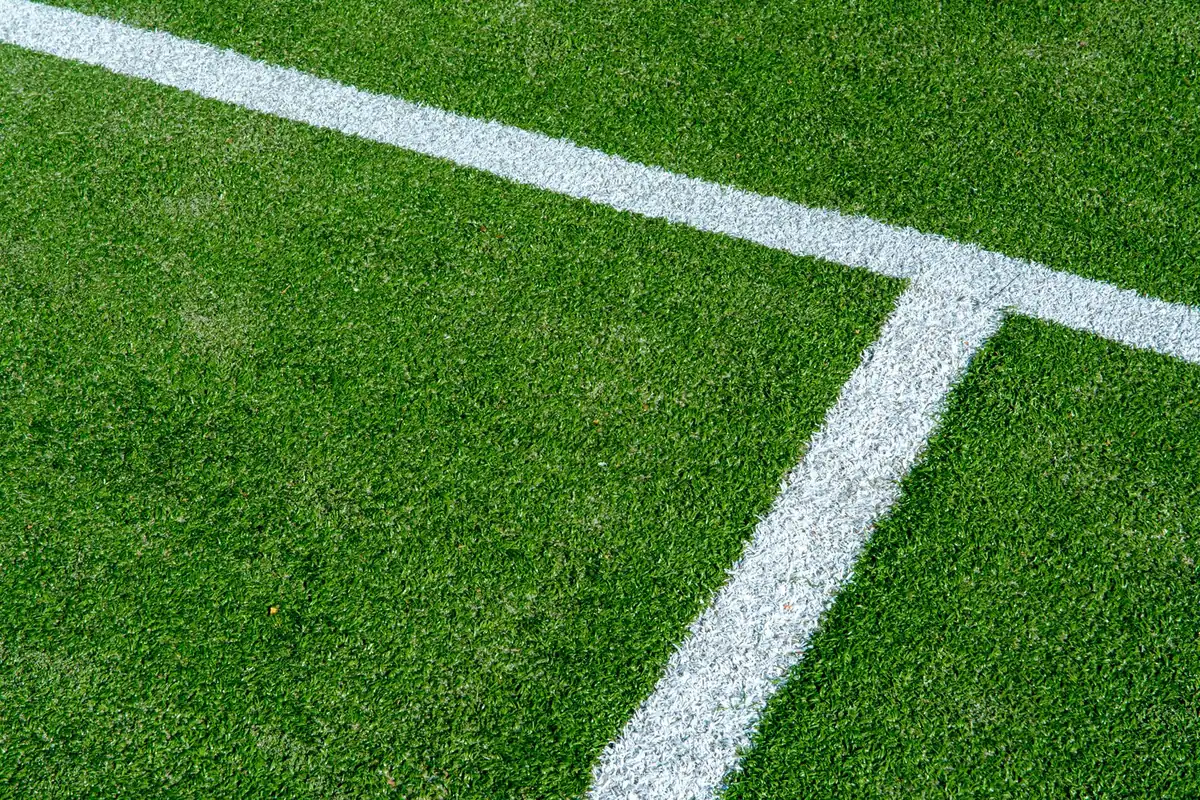
- Relax and orient the rolls. Lay the turf flat for at least two hours so the backing relaxes, and point every blade in the same direction, because mismatched pile reads as color shift in sunlight.
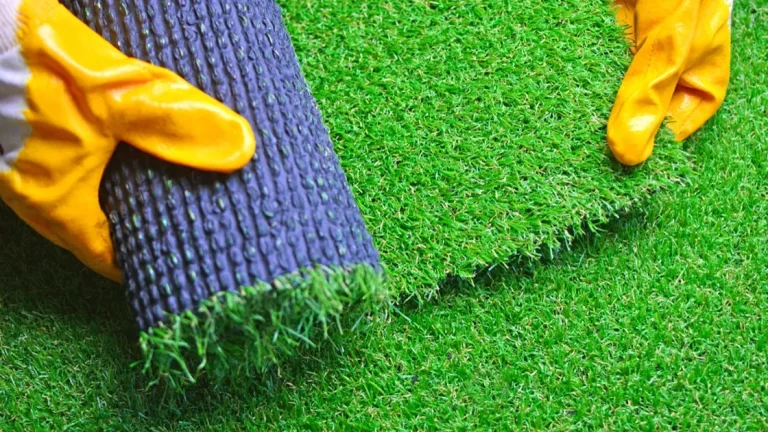
- Cut and seam in a brickwork offset. Cut from the back along the stitch lines, join with seam tape and outdoor adhesive, and let the adhesive cure 12 to 24 hours before infill goes down.
- Anchor the perimeter in two systems. Run 5- to 6-inch nails every 3 to 4 inches along the edges, or 6-inch galvanized staples every 6 to 8 inches. Keep field rows 12 to 24 inches apart. Where dogs work the boundary, tighten fixings to every 2 inches.
- Infill by system and use. US practice spreads silica sand at 1 to 2 pounds per square foot, with a 1-to-3-pound band by pile height in a second guide. UK practice finishes with kiln-dried sand at 4 to 5 kg per square metre. Pet zones switch to zeolite or antimicrobial media, and a power broom works the material down before handover.
Crews who install artificial grass on soil lose more edges to fixing spacing than to fabric choice. Hardware for that fight is covered in our guide to how to secure artificial turf perimeter edges.
Base Done Right – Which Roll Goes on Top?
Send the site dimensions and intended use. Roll width, pile height and drainage backing are matched to the base you built.
What It Costs and How Long It Takes
Per LawnStarter’s 2026 cost guide, installed turf averages $15 to $19 per square foot with labor alone at $3.45 to $12, and regional rates run $12 to $23. Per Home Depot’s published installed range, the typical band is $8 to $15 per square foot, rising past $20 on complex sites. Per a lawn care guide’s 2026 estimate, professional installation runs $9 to $16 per square foot against DIY materials plus tool rental at $3.00 to $6.50. Every figure in this section is a third-party published number carrying its source in the sentence.
Component lines tell the real story. The crushed-rock base itself runs $0.40 to $0.80 per square foot and weed membrane $0.10 to $0.20, per the same 2026 estimate. Base work is therefore the biggest DIY line and the layer the entire build leans on. Timeline figures follow the same published-source discipline.
For a 400 to 800 square foot yard, professional crews finish in 1 to 2 days against 3 to 4 DIY working days, per a 2026 installation guide. Per an installation-timing breakdown, stage hours run ground preparation 5 to 9, base installation 4 to 8, laying and securing 3 to 5, and finishing 2 to 3. The same breakdown scales a 500 square foot yard to 8 to 16 professional hours against 24 to 32 DIY hours, with rain adding 2 to 3 weather-delay days. Anyone budgeting to install artificial grass on soil can carry these ranges into a bid via our artificial grass cost: how much does turf cost to install guide.
Troubleshooting the Five Failures Buyers Actually Report
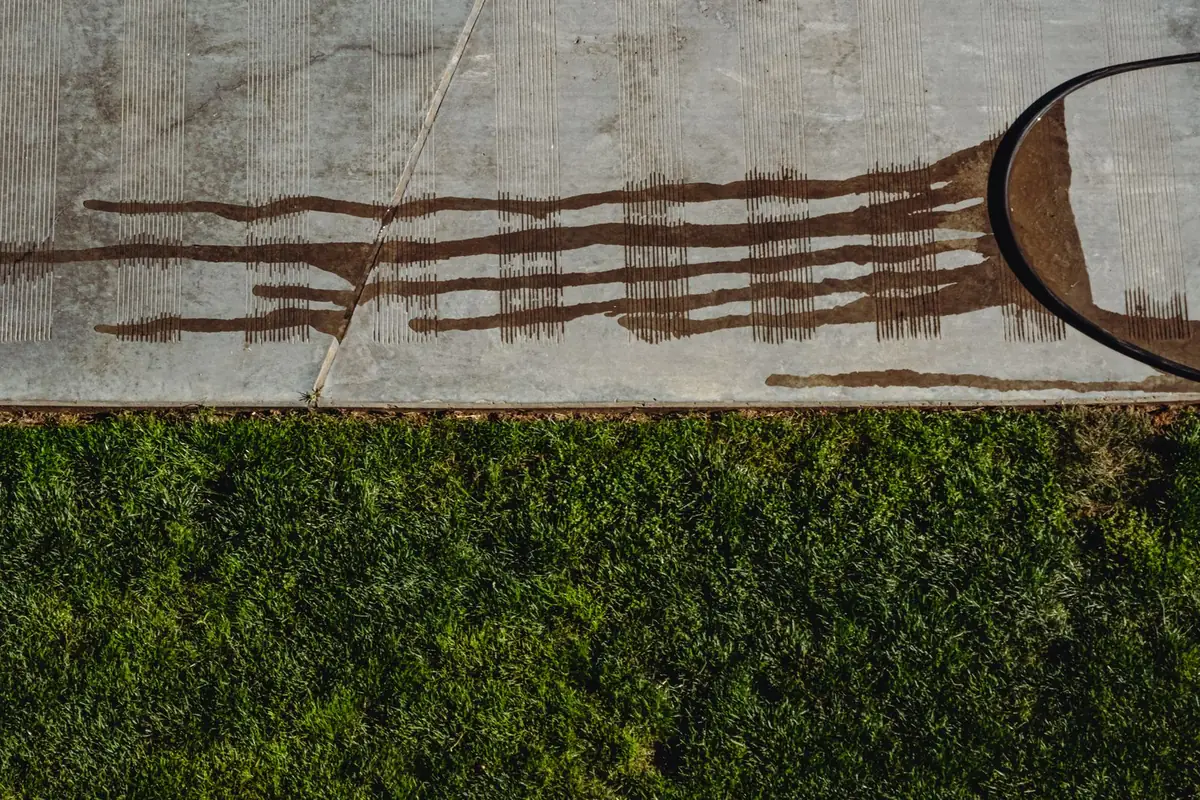
Every failure on the call-back list maps to a parameter that was skipped, which makes troubleshooting a re-verification exercise rather than guesswork. Water finding its own path across a finished lawn is the classic opening complaint. The five below cover what buyers actually report.
- Standing water means the base or the slope fell below spec. Re-check the excavation and compaction parameters before touching the turf itself.
- Urine odor points at membrane position or infill type. Zeolite or antimicrobial media over a re-sequenced, fast-draining layer stack is the fix.
- A weed flush means the membrane is missing, clogged, or overlapped too short to stop shoots at the seams.
- Dips and bumps trace to under-compaction or organic residue. Re-run the boot-print test across the suspect zone and dig out anything soft.
- Lifted edges and dog digging are anchoring spacing problems. Tighten boundary fixings to every 2 inches and bury them into an edging.
Close every handover with the day-one hose test: five minutes of watering verifies the drainage the base was built for. Standing water during that test means the slope or base needs adjustment before the crew leaves the site. Together with the boot-print check and the string-line slope reading, it forms the acceptance record for anyone set to install artificial grass on soil. Our guide to how to tell if artificial grass is installed correctly collects those checks in one place.
Frequently Asked Questions
Can you lay artificial grass straight on soil?
No, not for anything permanent. Bare soil holds moisture, shifts under load and lets weeds through, so the turf wrinkles and smells within months. Strip the organic layer, then build a compacted, graded base before the roll goes down.
How deep do you excavate for artificial grass on soil?
US guidance sets 3 to 4 inches; UK guidance states 75 to 100 mm. The two figures describe the same specification, and the dig must clear the root zone and all organic matter. Go deeper under heavy rain exposure or pet use.
What base material goes under artificial grass on soil?
Crushed angular stone or decomposed granite, compacted, is the standard answer; Class II road base also qualifies. Depth follows use: 2 to 3 inches for light traffic, 3 to 4 for pets, 4 or more for heavy loads or cold regions.
Do you need a weed membrane under artificial grass on soil?
Usually yes: a permeable woven geotextile on the graded soil, under the base, with seams overlapped and staked. Skip it where dogs urinate, because fabric traps ammonia and creates odor, and switch to zeolite or antimicrobial infill there instead.
How long does it take and what does it cost to install artificial grass on soil?
Per a 2026 guide, a 400 to 800 square foot yard takes 1 to 2 professional days or 3 to 4 DIY days. Per LawnStarter’s 2026 data, installed turf averages $15 to $19 per square foot; DIY materials run $3.00 to $6.50.