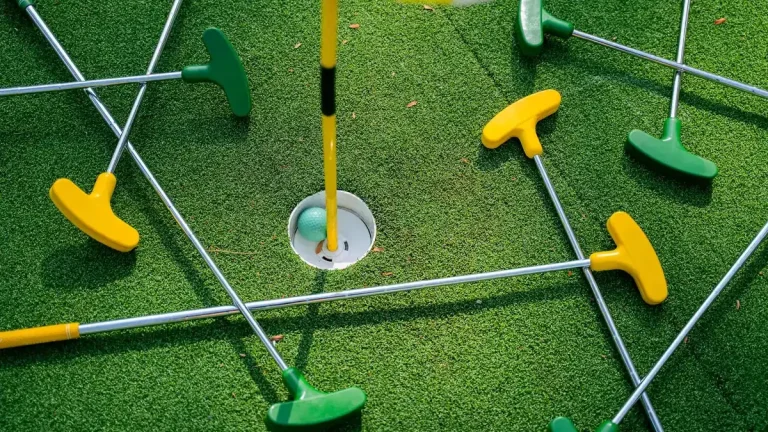
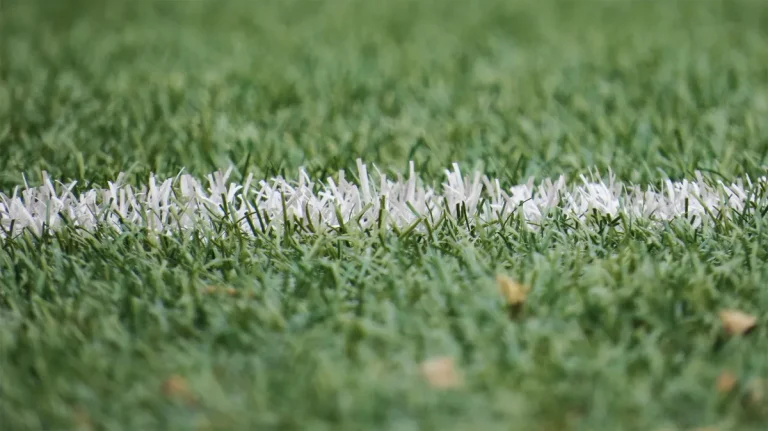
A contractor marks out a cup on a fresh lawn-grade roll and lines up the first putt. The ball skids on the fibre tips, hops offline and dies within a few feet. The post-mortem that follows rarely blames manufacturing quality: the turf did not fail, the application was incorrect. Regular artificial grass was engineered to look and feel like a lawn, and it succeeds. Asked to control a rolling golf ball, the same roll disappoints within months.
That failure pattern is the cleanest way into the putting turf vs regular artificial grass question. The two products share a tufting hall and a polymer family, yet they answer different briefs. The split shows up in the spec sheet before it shows up on an invoice. We build both lines on one production floor, and the fastest way to tell them apart is to read each spec sheet the way a green reads a ball.
Same Product Family, Two Different Design Briefs
Landscape turf descends from the tall-pile polyethylene generation that arrived with infill, built to mimic natural grass rather than to grade equipment on it. Its brief is appearance, softness underfoot and freedom from irrigation or mowing, with periodic cleaning as the main chore. Putting turf answers a different brief: it exists to govern how a ball rolls. In the putting turf vs regular artificial grass comparison, every downstream spec follows from that fork in the brief.
One screen sorts most listings before you shortlist: does the product page publish ball specs, meaning a speed rating, a pile height and a named fibre? A listing without those three lines is landscape turf dressed as a green, whatever the photo suggests.
Roll Speed: The Spec Landscape Turf Doesn’t Publish
Roll speed is the hardest boundary between the two lines, because only one carries a metric for it. A green wants low, even resistance and a line that holds; a lawn wants to cushion footsteps and look lush from a distance. Landscape turf publishes no speed figure at all; a serious putting product states one on the page. That single omission says most of what the putting turf vs regular artificial grass split is worth in practice.

How Green Speed Is Measured
The industry yardstick is the Stimpmeter, a device designed in 1935 by the golfer Edward Stimpson. The bar tilts to about 20 degrees and releases the ball at a repeatable 6.00 ft/s. Whatever distance the ball covers, in feet, becomes the speed number. See exactly how a Stimpmeter releases the ball and reads green speed in the reference entry.
Against that scale, USGA everyday guidance for course greens runs 8 feet slow, 10 medium and 12 fast. Its US Open guidance moves to 10, 12 and 14 feet; Oakmont has measured 15 feet. Our own line publishes Stimp 9 to 11, right where everyday golf lives.
Why Landscape Turf Has No Speed Rating
Landscape turf could in principle be measured, but its design brief never asks the question. Roll speed on any surface is set by three variables: pile height, fibre stiffness and infill density, as one installer guide summarises the trade. A lawn product fixes those variables for looks and comfort, so it ships without a number worth quoting.
Pile Height and Density: Short and Tight vs Lush
Pile height is where the putting turf vs regular artificial grass gap becomes visible to the eye. Published vendor comparisons put green turf between 0.4 and 0.6 inches, with another house charting 3/8 to 5/8 of an inch. Landscaping grass runs 1.5 to 2 inches and taller. Short blades alone do not make a green; density has to arrive with them.
Our two fairway grades show how the pairing works in practice. The 15 mm grade is curled polyethylene tufted at 63,000 stitches per square metre. The 20 mm grade is curled polypropylene at 42,000 stitches, a looser face that leans on sand infill for support. Height and stitch density move together by design.
| Spec dimension | Putting green turf | Regular artificial grass (landscape) |
|---|---|---|
| Pile height | 0.4 to 0.6 inches per published vendor comparisons | 1.5 to 2 inches (vendor comparison) |
| Roll speed metric | Published Stimp rating; one vendor guide reports 9 to 12.5 | None published |
| Fibre | Nylon, or curled PE and curled PP | Straight PE with a PP thatch layer |
| Infill job | Kiln-dried sand sets ball speed on polypropylene faces | No published ball-roll spec |
The natural world needs daily machinery to stay that short. Creeping bentgrass tolerates mowing heights of 0.125 inches or less. Course greens are cut there daily with a reel mower, per the AggieTurf mowing benchmark for creeping bentgrass greens. Synthetic green turf compresses that maintenance story into pile height and stitch count.
Need Putting Turf Built to a Real Spec?
Our putting green line publishes pile, density and stimp specs, with yarn, backing and roll sizes made to your spec.
Infill: Two Different Jobs for the Same Sand
Sand plays a part on both surfaces, but it answers to a different boss on each side of the shelf. On landscape turf the generations tell the story: longer fibres brought sand for blade support, and crumb rubber joined in the third generation. Roughly 80 percent of scrap tires are recycled today, and a significant share of that becomes crumb rubber infill, per the Synthetic Turf Council.
On a green, infill is a speed instrument. Polypropylene faces need kiln-dried sand to keep fibres upright and hold ball speed, while nylon needs little or none, as installer guides note. Adding sand and brushing the fibres upright pushes a polypropylene roll faster. We tune on the same principle: sand depth moves the Stimp reading within a 9 to 12 window.
Green infill depth is set by the target speed, not by underfoot feel. A freshly installed green often rolls slower at first and firms up as the sand settles, which installer field notes describe as normal. Chasing softness by over-filling sand slows the roll and buries the pace you paid for.
There is also a route with no sand at all, and it changes the trade-off rather than removing it. It is worth a short read on how the non-infill route shifts the infill trade-off before you fix a spec. What you give up in tunable speed you gain back in lower maintenance labour.
Yarn: Curl, Stiffness and What the Extruder Changes
The deepest difference in the putting turf vs regular artificial grass pair starts before tufting, at the extruder. Everything a green asks of its yarn is settled while the filament is still hot. Landscape blades are born straight; green yarn is taught to remember a shape.

Texturized vs Straight Yarn
The curl is a process, not an accident. Concerns over directionality and traction led Monsanto’s development team to texturize nylon, imparting a crimp after extrusion so the product became highly uniform, as the AstroTurf history records. Our putting faces apply the same logic in polyethylene. The 15 mm curled monofilament grips the ball instead of letting it skid on the fibre tips. Straight landscape blades paired with a PP thatch layer are the combination sold for a lawn, not for a rolling ball.
Nylon, Polypropylene, Polyethylene – and Where Each Belongs
Fibre choice then sorts the two lines cleanly. Nylon is the stiff, quick-recovering option that installer comparisons favour for putting faces, while polyethylene is the soft standard for landscape blades and polypropylene leans on sand for support. Our putting line proves two yarn routes can live in one factory: 63,000 stitches of curled polyethylene beside 42,000 of curled polypropylene. For a wider view, it helps to skim how yarn generations differ on sports fields before you commit to a polymer.
What the Spec Gap Means for Cost
None of this is cosmetic, and none of it is free. A putting surface costs more because the factory does more work per square metre before anything ships. The premium is structural; four places carry the extra process.
- A curl-setting step after extrusion: twisting and texturizing sit between extruding and tufting in the production sequence, each pass adding machine time.
- Higher stitch density: 63,000 stitches per square metre means more yarn weight and longer machine runs.
- Factory engineering of the playing surface: cup positions, fringe borders and contour shaping are pre-cut, labeled and sequenced before shipping.
- Per-order customization: yarn, density, height, backing and roll dimensions are set to the order instead of pulled from a standard-roll batch.
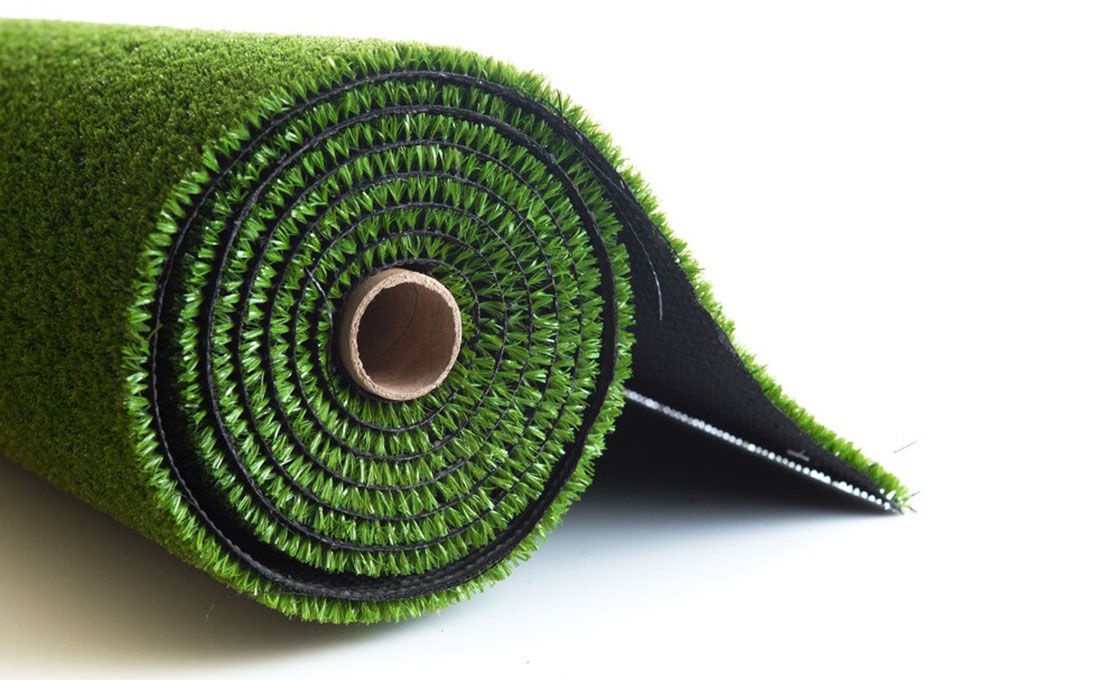
The quote gap is a spec and process gap, and it cuts both ways. Paying green prices for lawn turf is the same error as expecting green performance from lawn specs. Ask which spec sheet a quote was written against, and the premium usually explains itself.
Two Products, One Yard: Making Them Work Together
The two products are rivals on the spec sheet and teammates on the same site. A curled green face owns the speed; straight landscape grass owns the transitions, the fringe collar and the chipping zones. Installer guides make the same point: lawn-grade turf grabs the ball, which is what you want everywhere except on the green itself.
We build the combination as one order. Fringe boundaries and cup positions are handled at the factory, and the panels arrive cut, labeled and sequenced for installation. Sizes run from a 10 square metre chipping pad to a 100 square metre short-game complex; the perforated backing keeps drainage continuous across both. If the project outgrows a practice green, it is worth seeing how these specs scale up when the green goes tournament-grade. Separate the two spec sheets first, then place them in one order.
Frequently Asked Questions
Can I use regular artificial grass as a putting green?
No – lawn-grade pile grabs the ball and rolls slow and inconsistent; that is the whole point of the putting turf vs regular artificial grass split. It works fine as a fringe collar or chipping surround instead.
How fast should a backyard putting green roll?
The USGA’s everyday medium speed is 10 feet, which suits most players. Our line publishes Stimp 9 to 11, tunable to 9 to 12 by adjusting sand depth. Aim for a pace that matches the courses you actually play.
Does putting turf always need sand infill?
It depends on the fibre. Polypropylene faces need kiln-dried sand to stay upright and hold speed, while nylon needs little or none. Depth is the speed knob either way, so treat it as a tuning decision.
Why does putting turf cost more than landscape turf?
Because the factory does more work per square metre. The curl-setting yarn step, higher stitch density, pre-cut cups and fringe, and per-order customization all add process. The premium is structural, not a markup.
Can I combine a putting green with landscape turf in one yard?
Yes, and the pairing is standard practice: a curled green face for speed with straight landscape grass for the fringe and chipping surround. Boundaries and cups are pre-installed at the factory, so the two surfaces arrive as one sequenced layout.