Two grade labels dominate the artificial green market, both sold as badges: tournament grade and backyard grade. Every result that ranks for this comparison agrees a tournament green is denser and shorter than a backyard green, and almost none says by how much. The only two pages that name a grade split describe it in words alone and publish no per-parameter numbers.
We field the question weekly from golf club operators and green builders holding two quotations in one hand. Our reading: the label carries no information until the numbers behind it are on the table. Every one of those numbers can be tested before a deposit moves. A buyer comparing tournament greens with backyard grade has to assemble the figures from sources that never meet on one page.
Why “Tournament Grade” Is a Spec Bundle, Not a Badge
Tournament grade is not a single product property; it is a bundle of eight parameter values that move together. Pile height, fibre type and face weight, stimp target and uniformity, infill grade and rate, fringe, base depth, cost split and maintenance load are the numbers a buyer actually reads. The label is shorthand for that bundle, and it only works when all eight values are stated on the quotation.
The market rarely states them. One installer’s grade comparison describes tournament turf as denser and shorter than recreational turf and stops there; another splits the grades into four differences with no numbers attached. Installer-published speed figures exist, but the parameter rows behind them stay scattered across sources that each cover one grade in isolation.
The bands themselves are public. Recreational synthetic surfaces run about 8-11 on the stimpmeter while professional-style surfaces rise to 10-13, an installer-published split that already overlaps between the two grades. The table below assembles the rest of the bundle, one parameter per row, with both grade values side by side.
| Parameter | Backyard grade | Tournament grade | Published basis |
|---|---|---|---|
| Pile height | 1/2 to 5/8 in | 3/8 to 1/2 in | Installer-published bands (f-05, f-06, f-10) |
| Face weight | 22-30 oz on cheap residential turf | 40-60 oz | Manufacturer-published (f-07) |
| Stitch density | 40,000-55,000 per m2 landscaping band | 80,000+ per m2 | Industry-published bands (f-09, f-09b) |
| Target stimp | 8-11, typical installs rated 10-11 | 11-13 | Installer-published (f-01, f-04b, f-10b) |
| Infill | #30 silica at 1-1.5 lb/sq ft on a 1/2 in green | 20/40 washed silica at 2-3 lb/sq ft | Installer-published (f-15, f-15b) |
| Fringe | 8-12 in border at 1-1/4 in pile | 2-4 ft wide at 3/4 to 1.25 in pile | Installer-published (f-20, f-20b) |
| Base | 3-4 in aggregate base course | 4-6 in aggregate, 1/8 in over 10 ft | Trade-published (f-22b, f-23) |
| Maintenance | Crimped fibre, no rolling | Water-filled roller, grooming, infill levelling | Installer-published (f-31) |
Where a range is installer-published or vendor-quoted, the source kind stays attached, because the three kinds of figure never merge into one typical value. Read the rows as a bundle: a quote that names a grade without stating all eight is incomplete.
Pile Height: Where the Two Grades Split First

Installer guidance for backyard putting greens frames the fork at 1/2 to 5/8 inch of pile. One trade source treats anything taller as fringe or a pseudo-green rather than true green turf. A second installer-published recommendation puts a backyard green at 3/8 to 5/8 inch, with 1/2 inch the common centre. The two bands agree on the window even where the midpoint differs.
Tournament-quality greens specify 3/8 to 1/2 inch, an installer-published band that overlaps the backyard range but clears its upper half. Converted, the whole putting band runs 0.375 to 0.625 inch, or 10 to 16 mm. Within that band, UK installation guidance reads 10-12 mm as faster and firmer and 14-15 mm as slightly more forgiving for casual play.
The ceiling matters as much as the bands. Above roughly 15 mm the surface behaves as a lawn product rather than a green, whatever the label claims. The verification move is to ask for pile height in both inches and millimetres, held against the 10-15 mm window that trade guidance treats as genuine green product. For the backyard side of this fork, the backyard putting green turf page carries the matching product bands.
Fibre Type and Face Weight: Reading the Density Ladder
Face weight is where the ladder that separates backyard putting greens from tournament carpet begins, and installer-published bands tie it to grade. Tournament-grade turf runs 40-60 oz while cheap residential turf runs 22-30 oz and wears out within three seasons. A published placing ladder splits the middle: 40-50 oz budget, 50-65 oz mid residential, 65-80 oz premium and 80-100+ oz ultra.
Stitch density tells the same story from the other side. Tournament surfaces are published at 80,000+ stitches per square metre. The density ladder runs from 40,000-55,000 for landscaping work to 90,000-110,000+ for championship builds. UK guidance adds a checking unit: 18-22 stitches per 10 cm for green-quality turf.
Fibre type decides how the density survives traffic. Nylon has memory and springs back after traffic, polypropylene flattens permanently without sand, and polyethylene is softer and slower. Tournament surfaces use nylon or polypropylene monofilament in a multi-directional tuft pattern, which is why a light nylon can outplay a heavier polypropylene at the same face weight.
- Read stitch density second: 40,000-55,000 landscaping up to 90,000-110,000+ championship
- Name the fibre: nylon recovers, polypropylene flattens, polyethylene rolls slower
- Demand the spec card, not the adjective
A published spec card shows what a real green product declares. The card reads 0.5 inch pile, 34 oz/yd2 face weight, 3/16 inch gauge, 60 oz/yd2 total weight, 28 oz/yd2 backing and 4,200 denier yarn. One vendor’s case page quotes 1,800-2,200 g/m2 at 12-15 mm pile as standard, against 2,400-2,800 g/m2 at 15-20 mm as tournament. That vendor-quoted range stays a labelled claim here.
Where the carpet moves indoors instead of outdoors, the same numbers carry over and the open questions shift to headroom and roll width. Our article on indoor golf simulator turf specifications covers that fork line by line.
Stimp and What the Number Leaves Out
Stimp is the only metric every competitor quantifies, yet the published bands overlap more than the marketing admits. Backyard putting greens are typically installed at turf rated stimp 10-11, cheap surfaces run 6-7, and a common backyard target sits at 8-10.
The course-type ladder runs municipal 8-9, public and private courses 9-11, and tournament surfaces 11-13, an installer-published split matching the band other guides tie to PGA Tour standards. Country-club benchmarks land at 9-11 with tour greens at 12-14, and per USGA figures recreational courses average about 9.5 feet while pro events may exceed 13.
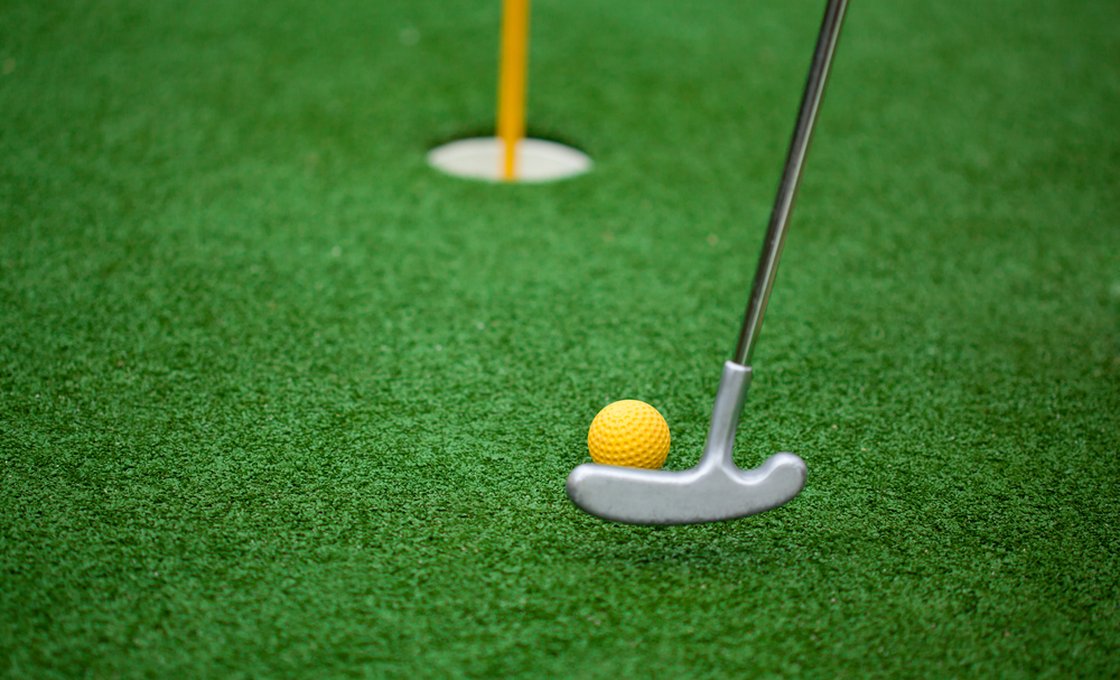
The number also fails on its own because the base holds it up. Premium putting turf installed on a soft base loses 2 to 3 stimp points instantly, so the same carpet measures differently on two sites.
USGA’s four-metric frame explains what raw speed leaves out. The USGA defines putting green quality with four metrics: speed, firmness, smoothness and trueness, and states that speed alone provides an incomplete picture. Its reference ranges put firmness at 0.300 to 0.500 inch of drop penetration and high-quality smoothness at 0.0 to 5.0. The GS3 device measures all four in a single roll test.
Read across the two grades, the defensible difference is uniformity, not raw speed. What the tournament grade buys is evenness of roll, measured as smoothness and trueness rather than another foot of pace. For the natural-versus-synthetic side of that decision, our artificial grass versus real grass putting greens comparison carries the roll and upkeep trade-offs.
Infill: Grade, Rate and Fill Depth
Infill is where the number set that putting greens actually receive has to be solved as one system: grain grade, application rate, fill depth and target stimp. One installer’s infill guide applies #30 silica sand at 1-1.5 lb/sq ft on a 1/2 inch green. On a 3/4 inch green the rate rises to 1.5-2 lb/sq ft to reach a stimp of 10-11. The rate moves with the pile, not with the grade label.
Other sources grade the grain differently. A green-builder FAQ specifies 20/40 round washed silica at about 2-3 lb/sq ft, while lawn and fringe take 30/50 at 2 lb/sq ft. Trade infill guidance recommends #60 grit for texturized putting turf inside a generic 1-3 lb/sq ft window. Heritage topdressing work uses 30/60 mesh silica at 0.25-0.60 mm, with fines held below about 2 percent.
One consensus emerges, and one outlier sits apart. Clean, dry silica sand graded 30-50 mesh applied at 2-3 lb/sq ft is the recurring putting-surface recipe. Rubber crumb is flagged because it absorbs impact and slows the roll. A single vendor claims professional-style greens need 5-7 lb of infill per sq ft against 2-4 lb for leisure greens. That figure stands outside every other published rate, so it reads here as an outlier contrast rather than a benchmark.

- Fill depth: all but the top third of the fibre covered by infill
- Grain: silica sand graded to the mesh window the carpet was built for
- Rate: the turf maker’s rate for that carpet, not a category average
- Outcome check: too little runs slow and inconsistent, too much or uneven makes the ball hop
The verification move is to ask the turf maker for the rate, the mesh and the target stimp as one number set. Where the three answers cannot be joined, the grade claim behind them is not complete.
Fringe and Edges: The Zone Buyers Add Too Late
Fringe is the zone most buyers add too late, and its parameters belong to the grade decision. The design standard runs 2-4 ft wide, with collar pile at 3/4 to 1 inch and fringe pile at 3/4 to 1.25 inch. One installer’s price guide adds about $8-15 per sq ft for fringe work and $2,000-5,000 for a standard 3 ft border. The figures are quoted from that publisher rather than ours.
Product-level bands differ from design-level ones. A manufacturer’s fringe spec lists 1-1/4 inch pile at 35-45 oz face weight in an 8-12 inch border. A supply guide puts fringe turf at roughly 25-30 mm of pile. Installation guidance plans 2-4 ft of fringe at 1.5-2 inch pile. The surface sits at a 1/8 to 1/4 inch height transition so balls settle at the edge instead of bouncing off it.
Skipping the zone has a measurable cost. Overlooking fringe and transitions is a published installation mistake that shortens green life; the transition height is what makes chips check up at the collar instead of skipping through. For the layout side of that decision, our guide on backyard putting course design carries the planning forks for courses, contours and fringe zones.
Base Layers: Where the Two Grades Diverge Most
The base is where the specification split between putting greens runs deepest, and the numbers are written in trade guidance rather than marketing. Residential greens use 3-4 inches of aggregate base course compacted in lifts, while commercial and high-traffic greens use 4-6 inches. That single fork carries more of the grade premium than any turf specification.
Tolerances tighten with the grade. Putting green base specs call for 4-6 inches of compacted aggregate against 3 inches for landscape turf. Three lifts go in at 95 percent or better density, final grade lands within 1/8 inch over 10 feet, and the cross-slope runs 1-1.5 percent. Compaction standards agree. Residential work sits at 95 percent maximum dry density with plus or minus 5 mm level tolerance, against sports surfaces at 98 percent and plus or minus 3 mm.

A backyard build codifies the floor of that range. Excavate 6-8 inches, lay a 3-4 inch compacted crushed stone drainage layer, and compact a finer top layer to at least 95 percent density, the method ASTM D 698 standardizes.
The failure timeline shows why the tolerance is the acceptance test. Months 4-12 bring low spots, proud or sunken cups and soft zones. Months 12-24 open seams at low points while matting kills the roll. Past month 24 there is no fix short of pulling the turf and redoing the base. A bobble across the surface is the field signal of a shortcut base, which is why putting greens demand the 1/8 inch over 10 feet tolerance.
The verification move is to hold the quote against the grade chosen and ask which depth, which compaction percentage and which tolerance the bid carries. The construction sequence behind those numbers is covered step by step in our guide on how to build a backyard putting green.
Spec Sheet Not Matching the Grade You Need?
Send the grade targets you are working to. Pile height, face weight, density, backing and roll size are all made to your spec.
Cost Structure: Where the Money Actually Sits
The cost split explains where a tournament budget actually goes. One installer’s build guide puts the face turf at 15-30 percent of a green’s total cost, while base, drainage and laser grading take 40-55 percent. Its own reading: a bidder competing on turf brand while underspending on base is bidding a failure.
The grade premium sits in the material line. Tournament-grade putting turf is published at 30-50 percent more than recreational-grade material, and a professional-level green at about 20-50 percent more than a leisure build. Both figures are installer-published ranges, not quotations.
Third-party ranges size the whole project. One external cost page runs $15-40 per sq ft installed, with DIY kits about $13-18 per sq ft. A third-party material comparison puts green turf at $6-12 per sq ft against $3-7 for standard landscape turf. Another independent installer prices $12-20 per sq ft installed including base, turf, infill and cups.
- Turf facing: 15-30 percent of total cost, per published build guides
- Base, drainage and laser grading: 40-55 percent, the layer where the grades diverge
- Grade premium: 30-50 percent more material cost for tournament-grade turf
- Add-ons: fringe border, lighting and contour work, each installer-quoted
A third-party tier list runs basic recreational builds of 150-250 sq ft at $12,000-16,000. Mid-range 400-600 sq ft builds land at $18,000-28,000, and tournament-grade 800+ sq ft at $30,000-40,000+. A 1,000+ sq ft tournament-practice green is published at $35,000-60,000+ by an external guide. UK guidance reads about GBP 150-300+ per m2 including groundworks, edging and turf. Add-ons stack on either grade: a fringe border at $2,000-5,000, low-voltage lighting at $2,000-6,000, and complex multi-tier contours adding 15-25 percent to base cost.
Read the two columns together and the premium belongs in the base, not the turf line. A bid that concentrates money in the carpet and starves the base buys the label without the numbers the label promises.
Maintenance: The Recurring Bill That Differs by Grade
Maintenance is where the grade’s benefit either survives or decays. Recreational surfaces use crimped, textured fibre and need no rolling, while professional-style builds need extensive rolling with a water-filled roller plus ongoing grooming, brushing and infill levelling. Upkeep figures published by independent installers put a synthetic green at about an hour a month, with materials under $100 a year. The routine is power brushing every 2-3 weeks, an annual sand top-off and a monthly rinse.
A published maintenance budget reads the same shape: monthly brushing of 10-15 minutes, an annual infill top-up at $100-200, an annual deep clean, for $200-500 a year in total. The intensity difference sits inside that routine, not outside it.
Neglect ties straight back to the failure modes. Infill compaction, fibre fatigue in high-traffic areas and debris below the surface slow the roll and open low spots where infill has migrated. The six premature-failure points — base compaction, drainage, infill levels, weak backing, seam separation and surface damage — are exactly what a brushing and top-up schedule holds off. Maintenance is the condition on which either grade keeps the numbers quoted here.
Which Grade Fits Which Project
The grade decision closes on four answers. Target stimp, practice intensity, how the budget sits between base and turf, and whether a realistic chip and pitch zone is needed. Write the four answers down before price enters the conversation.
- Target stimp: backyard installs typically rate 10-11, tournament band 11-13
- Practice intensity: multi-use play versus training to a number
- Budget split: 40-55 percent of cost sits in base, drainage and grading
- Chip and pitch zone: fringe width, transition height and contour work
Backyard putting greens fit most multi-use settings on those answers. The budget concentrates in a 3-4 inch base. Third-party tiers run basic recreational builds at $12,000-16,000, and upkeep stays inside the $200-500 a year envelope. The grade asks for the least and gives the most per dollar spent on the layers under the carpet.
Tournament grade fits training to a target stimp. The spec calls for a 3/8 to 1/2 inch pile at 11-13 on the stimpmeter. It adds a thicker base at 4-6 inches, 40-60 oz face weight, and a willingness to maintain on schedule. The premium is published at 30-50 percent more material cost, with the turf facing itself only 15-30 percent of the total.
Durability does not separate the grades. One installer’s lifespan reading puts both recreational and tournament grades at the same 15-20 years when properly installed and maintained, so the difference is playing characteristics, not longevity. If any of the four answers does not line up, clarify it in writing before talking price.
Frequently Asked Questions
How much faster is a tournament putting green than a backyard one?
The bands overlap, and the defensible gap is uniformity rather than raw speed. Published figures run 8-11 for recreational surfaces and 11-13 for tournament builds, so the ceiling rises about two stimp points.
What pile height should a backyard putting green have?
Installer guidance puts backyard greens at 1/2 to 5/8 inch, and one trade source treats anything above roughly 15 mm as a lawn product rather than a green.
How much face weight does a putting green need?
Tournament-grade turf is published at 40-60 oz, against 22-30 oz on cheap residential turf that wears out within three seasons. Read face weight together with stitch density, where tournament surfaces run 80,000+ stitches per square metre.
What infill grade and rate do putting greens use?
The recurring published recipe is clean dry silica sand graded 30-50 mesh at 2-3 lb/sq ft. One guide applies #30 silica at 1-1.5 lb/sq ft on a 1/2 inch green, so always take the turf maker’s rate.
How deep should a putting green base be?
Residential greens use 3-4 inches of aggregate base course compacted in lifts, while commercial and high-traffic greens use 4-6 inches. Final grade is held within 1/8 inch over 10 feet.
How much more does a tournament green cost?
Third-party published figures put tournament-grade material at 30-50 percent more than recreational grade, and tournament-tier builds of 800+ sq ft at $30,000-40,000+. The turf facing itself is only 15-30 percent of total cost.