
Relyir Grass
Factory-direct artificial grass since 2006 — full customization, samples and fast quotes.
-
Sports Turf
More Sports
Putting Green
Sports Turf Systems
25 mm sand-dressed turf for the low, fast ball behavior field hockey demands. Factory-direct from Relyir since 2006.

Why Specify Sand-Dressed Short Pile
Field hockey is unique among turf sports: the ball must roll fast and true across a dense, short-pile surface with minimal vertical bounce. The stick-ball-surface interaction is entirely different from football or rugby, and the turf specification reflects that.
A 25 mm sand-dressed pile produces the fast, low-bounce ball roll that hockey requires. Sand fills roughly 60–70% of the pile height, supporting the fibers and creating the smooth, firm surface that lets a hockey ball track true at pace across the full pitch.
Hockey sticks sweep close to the ground during dribbling, passing and trapping. The short, dense 27,300 tufts/m² pile provides a uniform surface that does not catch the stick blade — a requirement that 50 mm sports turf cannot satisfy.
Goalkeepers and outfield players slide on hockey turf. The sand-dressed system reduces skin friction compared to unfilled short pile, while the PE fibers maintain controlled abrasion for safe sliding without excessive friction burns.
Product Range
The Mesh Adventure 25 is Relyir’s sand-dressed hockey product — a 25 mm pile at 27,300 tufts/m² on 3/8″ gauge, designed to be sand-filled to approximately 60–70% of pile height for National-level hockey play.
| Model | Pile Height | Yarn | Density | Gauge | Stitch Rate | Backing | Colors |
|---|---|---|---|---|---|---|---|
| Mesh Adventure 25 | 25 mm | PP | 27,300 tufts/m² | 3/8″ | 26/10 cm | PP + PP (PU optional) | Olive green / white |
Roll sizes: 4 × 25 m or 2 × 50 m, maximum roll width 5 m. Shock pad underlay is typically required beneath hockey turf — specify with your installer. White line tufting and custom colorways available on request. Full datasheets are provided with your quotation.
Performance Design
Field hockey and football could not be further apart in their surface requirements. A 50 mm pile designed for a bouncing, rolling football produces the wrong ball behavior entirely for hockey — the ball would sink into the fiber, slow down, and bounce unpredictably off the tall pile. Hockey needs a short, dense, firm surface that keeps the ball on top.
The FIH Quality Programme defines three categories: FIH Global (elite, traditionally water-based), FIH National (club and national level, typically sand-dressed) and FIH Multi-Sport (community dual-use). Sand-dressed turf sits at the heart of the National and Multi-Sport categories, offering fast play without the water costs that irrigated systems require.
The 25 mm pile height, combined with sand filling to 60–70% of the fiber depth, creates a surface where the ball runs fast, stick-work stays clean, and the pitch is playable without irrigation infrastructure. FIH is actively developing dry (non-irrigated) turf standards, and sand-dressed systems align with that trajectory.
Shock pad underlay is standard beneath hockey turf — the short pile alone does not provide sufficient impact absorption for goalkeeper dives and outfield slides. The pad also contributes to surface evenness and ball-rebound consistency, both of which FIH testing evaluates.
For projects targeting FIH National or Multi-Sport certification, Relyir supplies the turf product with full specification documentation and works with your testing laboratory through the certification process.
Factory Direct from Jiangsu
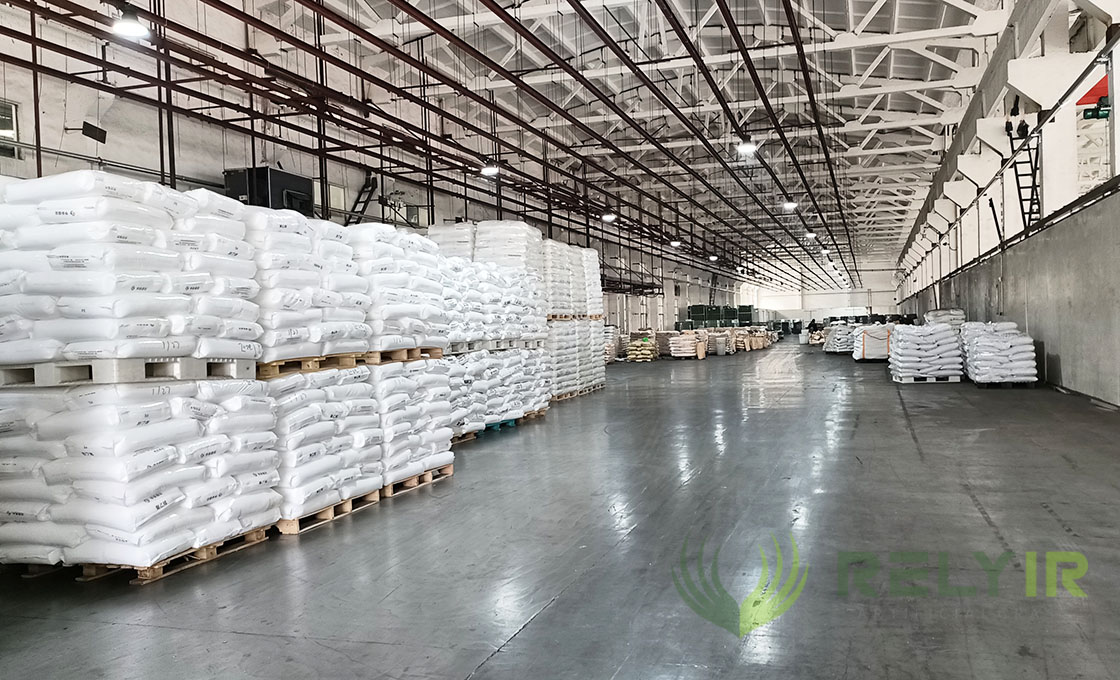
Relyir has manufactured artificial grass in Jiangsu since 2006. Every step — from raw PE pellets to finished rolls — runs on-site, which is how we control quality and hold pricing 30–50% below international equivalents.
All eight production stages are managed in-house, eliminating the quality gaps that arise when compounding, tufting and coating happen in separate facilities. The automated sports turf line, commissioned in 2015, lifted production capacity by 150% and tightened consistency across high-volume orders.
Customization is built into the line: blade density, pile height and fiber colors are adjusted to each project’s specification, with PP + net and PU backing options. The export team has shipped to more than 500 customers across 50+ countries since 2009 and handles all documentation — from commercial invoices to certificates of origin.
System Build-Up
Hockey turf installation differs from 50 mm sports systems. The short pile sits on a shock pad over a precision-leveled base, with sand as the sole infill. We supply the turf and share build-up guidance with every project.
Asphalt or engineered aggregate with tight planarity tolerances — hockey demands a flatter base than most sports because the ball rolls so close to the surface.
Elastic underlay bonded to the base — mandatory for hockey to provide the impact absorption that short pile alone cannot deliver.
The 25 mm sand-dressed carpet, glued to the shock pad with seams bonded for a flush, continuous surface.
Silica sand brushed into the pile to approximately 60–70% of pile height — the sand supports fibers and creates the firm, fast playing surface hockey requires.
Hockey surfaces demand exceptional planarity — any irregularity in the base transfers directly into ball behavior because the ball runs so close to the surface. The base preparation must achieve tighter tolerances than most other sports require.
Sand-dressed turf requires regular brushing to keep the sand level and the fibers upright. Over time, sand migrates toward the pitch edges and accumulates in low spots — periodic redistribution restores consistent ball speed across the full surface. UV-stabilized fibers resist degradation under continuous sun exposure.
Hockey requires a short, dense pile where the ball rolls on top of the surface. A 50 mm pile lets the ball sink into the fibers, slowing it down and creating unpredictable bounce. FIH testing evaluates ball roll speed and surface friction — values that a 50 mm system cannot achieve. Sand-dressed 25 mm turf is designed specifically for hockey’s ball behavior requirements.
Water-based turf (FIH Global) uses very dense, short fibers with no sand infill, played wet for the fastest ball speed and lowest friction. Sand-dressed turf (FIH National) uses sand to support fibers for part of the pile depth, offering fast play without irrigation infrastructure. Sand-dressed is the practical choice for clubs and schools with limited water budgets.
Yes, shock pad underlay is standard beneath hockey turf. The short 25 mm pile alone does not provide sufficient impact absorption for goalkeeper dives and outfield slides. The pad also contributes to ball-rebound consistency and surface evenness, both evaluated in FIH testing.
Sand-dressed hockey turf can serve as a multi-sport surface under the FIH Multi-Sport category — suitable for training-level hockey, tennis, and general community use. However, it is not suitable for football, rugby or other 50 mm pile sports. The intended use should drive the specification.
Mesh Adventure 25 ships in rolls of 4 × 25 m or 2 × 50 m with a maximum width of 5 m. White line tufting and custom colorways are available on request. We adjust sand fill levels and provide installation guidance matched to your project’s FIH category target.
Regular brushing to keep sand level and fibers upright, periodic sand redistribution from edges to center, and surface cleaning to prevent algae or moss growth in damp climates. Relyir provides maintenance guidance with every installation package so the pitch maintains consistent ball speed through its service life.
Send your pitch dimensions, intended use level and target timeline. Our export team replies with model recommendations, specification sheets and factory-direct pricing within 12 hours.
Get a Free Quote