

Backyard, club or competition: the three grades of a bocce ball court differ less in the game they host than in the hours they are asked to carry. A resort that buys tournament spec for a dozen weekend games pays for capacity that never sells. A community that under-builds loses its league nights every time a storm rolls through.
We tuft bocce carpet on our own line and quote against buyer drawings every week. The same three questions separate a fit from an overspend: who plays, how often, and to whose rules. Judged on those criteria, the three grades sort themselves quickly, and the money lands where it actually gets used.
Three Grades Every Bocce Buyer Weighs
Three grades cover practically every project we quote. The recreational grade serves residents, guests and 55-plus communities, where the game is an amenity and sessions are relaxed. The club grade serves leagues, hotels and resorts that book the lane on a weekly rhythm. The competition grade serves federated clubs that host sanctioned play, where the court answers to a rulebook.
The differences show up in the footprint, the surface specification and the calendar. Among artificial turf installations for sport, bocce is the least forgiving of mismatches. A pace tuned for league play feels dead to casual players, and a casual spec frustrates serious ones. The game rewards accurate rolling and placement, a discipline bocce has kept across its long history. The table our team sketches on the first call looks like this.
| Grade | Who it serves | Typical footprint | Surface emphasis |
|---|---|---|---|
| Recreational | Residents, guests, 55-plus communities | About 22 to 30 ft long, 6 to 8 ft wide | Clean look, forgiving pace, minimal upkeep |
| Club / community | Leagues, hotels, resorts, senior centres | About 45 to 60 ft long, 8 to 10 ft wide | Weekly traffic, consistent pace, fast drainage |
| Competition | Federated clubs, sanctioned venues | 86.92 ft x 13.12 ft (USBF) | Stated roll speed, regulation dimensions |
Read the grades as calendar tiers rather than quality tiers. A backyard lane built properly plays its role for years; a competition court used twice a month is an expensive ornament. Review the bocce ball turf options once the tier is clear.
Match the Court to Real Playing Hours
A bocce ball court earns its grade in the calendar. Occasional play — a weekend game, a resort activity slot, a retirement-community afternoon — never stresses the surface, so the recreational grade fits. Weekly league play compresses traffic into fixed nights, which is the pattern that exposes shortcuts first.
Traffic concentrates in the same running lanes whatever the grade, and the difference between grades is how much of it the surface is built to take. Density, not colour, decides how a court ages under league play.
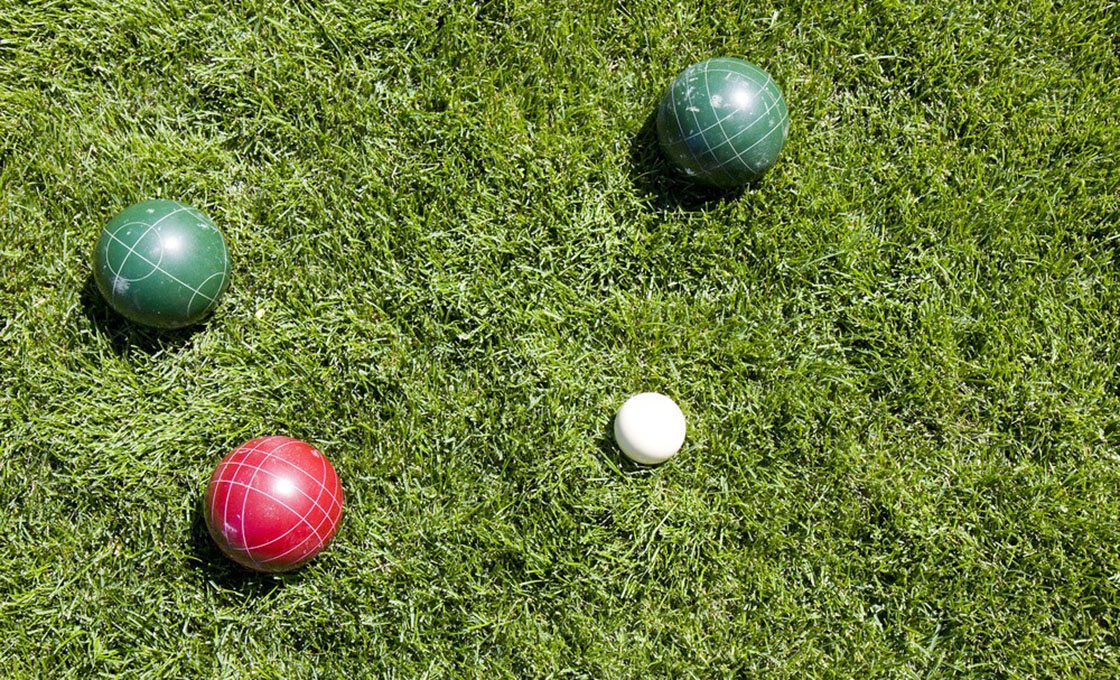
Ask the venue manager one question: how many nights a week does the lane actually fill? One honest number beats any brochure, because it sizes both the carpet and the base beneath it. Of the artificial turf installations we quote each season, the ones that disappoint were priced off the grand opening rather than the calendar.
Size the Court to Space and Rules
Space and rules set the footprint of a bocce ball court together. Federated competition answers to the US Bocce Federation, whose sanctioned court measures 86.92 feet long by 13.12 feet wide. International tournament play is specified at 26.5 metres by 4 metres, and club standards are often quoted at 91 by 13 feet.
The smaller grades have rules of their own. Community league formats run 45 by 8 feet, and social leagues in bars or halls play on courts near 30 by 8 feet. Special Olympics competition is standardised on 60 by 12 feet, and 55-plus communities get a complete game from courts around 22 by 6 feet. Curbs and sideboards belong in every grade, at least six inches high to keep balls in play.

| Standard | Length | Width | Where it applies |
|---|---|---|---|
| USBF sanctioned competition | 86.92 ft | 13.12 ft | Federated and sanctioned play |
| International tournament | 26.5 m | 4 m | Championship-level play |
| Commonly quoted club standard | 91 ft | 13 ft | Club and venue planning |
| Special Olympics standard | 60 ft | 12 ft | Adaptive competition |
| Community league format | 45 ft | 8 ft | Space-constrained facilities |
| Social league court | 30 ft | 8 ft | Bars, halls, cruise ships |
| Compact 55-plus court | 22 ft | 6 ft | Retirement and lifestyle villages |
One caution belongs here. Official tournaments are closed to courts outside federation dimensions, so sanctioned play leaves no room to compress. Social ambitions carry no such constraint, and the smaller formats often produce faster, higher-scoring games.
Pile and Speed by Player Expectation
The surface question is what the players expect the ball to do. Bocce turf sits in a narrow pile band of 10 to 15 millimetres, with 12 millimetres the common sweet spot, because a taller pile slows and deflects the ball unevenly. Casual players feel comfort and cleanliness long before they feel pace.
Serious players put a number on it. A tournament-grade surface is described at 12 to 13 seconds on a Stimpmeter, the device golf greens use, and a club wants that figure written into the specification.

Compared with most artificial turf installations, a bocce surface is judged on consistency before cushioning. Density carries the consistency: a face of 16,800 to 21,000 stitches per square metre resists the matting that turns running lanes slow. The full parameter list sits in our bocce court turf specifications. Specify pile and density for whichever group fills the calendar, and the surface plays the game that group came for.
The Budget Line Beyond the Invoice
Upfront cost rises with the grade, and pretending otherwise wastes everyone’s time. The honest comparison is between what the court costs to build and what it would otherwise cost to keep open. Shell and clay lanes need raking and topping up after games, while turf needs an occasional brush and rinse.
Service life helps the arithmetic. Commercial artificial grass serves up to 10 to 15 years, so the per-season cost depends on how many seasons the calendar actually uses. A bocce ball court matched to real hours repays itself in sessions kept; a grade above the calendar never does.
Our bocce court turf overview sets out what changes between grades and what stays fixed. The specification is the lever, and factory-direct production keeps it affordable to pull.
Choosing Between Backyard, Club and Competition Grades?
Grade too high and capacity idles; too low and league nights suffer. We cut bocce carpet to your tier, pile and density, typically 30–50% below market on like-for-like specifications.
Where Buyers Most Often Overspend
Four decision errors account for most of the regret we are called into after handover. None of them is a construction failure; all four are mismatches made at the ordering stage.
Buying Competition Grade for Occasional Play
The most expensive mistake is flattery. A venue buys federation spec because it sounds serious, then hosts a game a fortnight, and the capacity never sells. The upkeep savings of turf are wasted on a calendar a cheaper grade could have carried.
Under-Building a Court That Hosts Leagues
The mirror error shows up a season later. A casual spec under weekly league traffic mats in the running lanes first, and pace drift follows. That is the most common failure mode among artificial turf installations pressed past their grade. If the calendar says league nights, density and backing are the last places to save.

Copying a Neighbour’s Specification
The court down the road plays a different game, with different players, on a different base. A specification copied from another site inherits assumptions that were never yours. Ours start from your hours, your space and your rulebook.
Choosing the Surface From a Photograph
Colour reads differently in every light, and a photograph hides the pile entirely. A surface chosen from an image is a surface chosen for someone else’s court. All four errors are cheaper to fix on paper than on site; the construction then follows our court build guide.
Decision Checklist Before You Commit
Run five checks in order and the grade picks itself. Our team walks wholesale buyers through this list on the first call.
Count the Hours You Will Actually Play
Write down the busiest realistic week, not the opening week. Relaxed occasional use points to the recreational grade, a fixed weekly league night calls for the club grade, and sanctioned fixtures leave no choice at all.
Confirm Which Rules Your Players Answer To
Sanctioned play fixes the footprint at 86.92 by 13.12 feet for USBF competition, and international play at 26.5 by 4 metres. Social formats leave the dimensions to the space available.
Measure the Site Against the Tier
Walk the space with a tape, then allow room for the frame and a run-off margin. A tier chosen after measuring never has to be value-engineered down later.
Write the Roll Spec to the Players
Fix pile height in the 10 to 15 millimetre band, density to the traffic, and the backing, PP+Net or PU, to the base design as named values in the quote. A roll built to a stated specification can be checked against it on delivery.
Prove It on a Sample in Daylight
Request free 20 by 20 centimetre samples, usually three to four pieces, and judge them where the court will sit. They ship by DHL or FedEx in 4 to 6 days, with courier freight paid by the buyer, through our free turf samples page.
As with most artificial turf installations, roll width and lane plan settle together at the end. Rolls arrive in 2, 4 and 5 metre widths at 25 metres long, so the seams stay out of the playing line.
Frequently Asked Questions
What size is a competition bocce ball court?
The US Bocce Federation sets sanctioned courts at 86.92 by 13.12 feet, international play runs 26.5 by 4 metres, and club standards are often quoted at 91 by 13 feet.
Can a smaller court still host league play?
Yes. Community formats run 45 by 8 feet, social leagues play near 30 by 8 feet, and Special Olympics competition is standardised on 60 by 12 feet courts.
Which pile height suits each court grade?
The band is 10 to 15 millimetres across all grades, with 12 millimetres the common sweet spot. Competition surfaces add a stated roll speed of 12 to 13 seconds on a Stimpmeter.
How long does a synthetic bocce surface last?
Commercial artificial grass serves up to 10 to 15 years. Weekly playing hours, fibre density and base drainage decide where a court lands inside that band.
Does the base differ between the three grades?
The design goal stays the same: a compacted base with a 1 to 2% fall that keeps water moving. Higher grades add traffic the base must stay flat under.
Can we check the turf before a bulk order?
Request free 20 by 20 centimetre samples, usually three to four pieces. They ship by DHL or FedEx in 4 to 6 days, with courier freight paid by the buyer.


 English
  Arabic
  French
  German
  Portuguese
  Russian
  Spanish