The most common question about landscape turf vs sport turf is not which one is better. It is why the roll someone already bought cannot survive the job it was given. A backyard lawn put under weekend soccer practice flattens within a season.
We ship both families from the same tufting line and watch the specification fork at row one. Same polymer, two different engineering briefs. The brief, not the roll width, decides whether a surface survives its job.
Same Plastic, Two Different Jobs
The split between landscape turf vs sport turf begins with the goal written into the design brief. Landscape products are engineered for appearance. Their yarns come in multiple color tones – greens, yellows and browns – mixed with brown thatch layers and varied blade lengths that mimic the irregularity of real grass.
Sport products are engineered for performance. Their design targets ball roll, shock absorption, traction and athlete safety, so the surface is built around how a body and a ball interact with it. Sport pile is often shorter and denser than lawn product, because it must withstand repeated impact and still present a consistent playing surface.
The families share real common ground beneath the surface differences. Both carry UV and weather resistance, and either can serve a yard for many seasons. What they cannot do is trade jobs, because the structure under the color was tuned for someone else’s afternoon.
One line, two briefs. Both families start as polyethylene on the same tufting machines we run. What forks at row one is the specification: fiber shape, density, backing and infill are tuned to a different job from the first row of fabric.
Structure: Where the Two Products Diverge
Read the specification sheet and the divergence between landscape turf vs sport turf becomes physical. The fork starts in the yarn and runs through infill, backing and drainage. Each row below is a decision, not a detail.
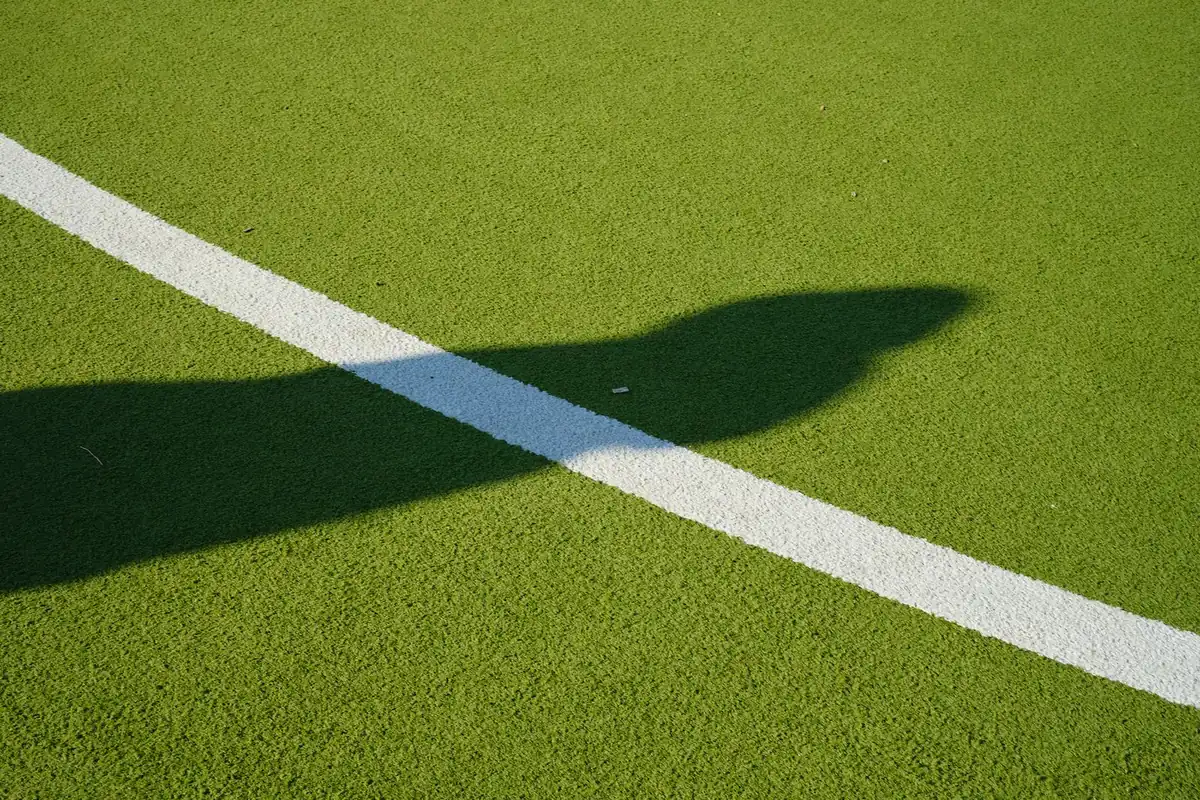
Landscape rolls use soft polyethylene monofilament blades in S or C shapes, topped with a curled polypropylene thatch layer for body. Sports rolls use durable polyethylene or nylon blends at heavier yarn weights, with curled monofilament or fibrillated designs that lock infill in place. Nylon often reinforces the high-wear zones of a sports field, where a lawn product would simply flatten.
Infill separates the families even more sharply than fiber does. Landscape products minimize or skip infill entirely, using at most a thin sand layer for weight and drainage. Sports surfaces carry engineered blends of silica sand and rubber granules, tuned for shock absorption, footing and ball response. The backing runs heavier too: a triple-layer sports construction with reinforced coating and high-density drainage holes keeps a field playable in the rain.
| Attribute | Landscape Turf | Sport Turf |
|---|---|---|
| Primary purpose | A natural look for the eye | Consistent play for the body |
| Fiber | Soft multi-tone polyethylene blades with thatch | Reinforced polyethylene or nylon, built for wear |
| Infill | Minimal or none, thin sand for weight | Sand and rubber, engineered for response |
| Backing and drainage | Standard coated backing | Triple-layer build, high-density drainage holes |
| Shock pad | Optional | Standard for contact sports |
| Shock absorption | Minimal | High |
| Upkeep | Low | Moderate |
What Happens When the Job Meets the Wrong Turf
Ask what happens when the landscape turf vs sport turf decision gets ignored, and the answer runs in both directions. Neither direction fails quietly. Each one shows up in the surface within a season of hard use.
Put ordinary landscape grass under soccer practice and the failures arrive early. The pile was never built for sliding and pivoting, so premature wear, injury risks and poor playability follow. Turf burns are abrasions caused by friction between skin and artificial grass fibers, per the Washington State Department of Health, and they happen during slides and falls.
Run the swap the other way and the problems change shape rather than shrink. Sport turf in a residential setting feels hard underfoot, costs more and looks less pleasing for casual use. It was never designed for aesthetics, so it lacks the multi-tone blades and soft texture that make a lawn read as natural.
Wear does not brush out. A landscape roll under regular sport use loses fiber resilience fast. Flattened, abraded blades cannot be restored by brushing, and the damage compounds with every session, because the pile was never specified to recover from traction loads.

How to Tell Which One You Actually Need
The choice gets easier once you stop comparing products and start interrogating the job instead. Five questions do most of the sorting before any specification sheet is opened. Answer them honestly and the right family usually names itself.
- Who uses the surface, and how often? Organized teams practicing more than twice a week call for sports turf with a shock pad; a family backyard with occasional kickabouts calls for quality landscape turf.
- Does anyone fall on it on purpose? Sliding, tackling and diving loads belong on a sport-rated surface, not on decorative pile.
- What does the ground under it need to do? The heavier sports system expects more from base preparation and drainage than a lawn roll does.
- Is the surface judged by the eye or by the body? Appearance goals favor landscape product, while performance goals favor sport product.
- Does one space have to carry both jobs? If so, the conversation changes from picking a winner to planning zones.
When one surface has to serve more than one job, the trade-offs get deliberate, and zoning almost always beats a single compromise roll. Splitting the yard into task zones lets each roll run at its own specification. The alternative, one surface stretched across two jobs, fails at both.
One Yard, Two Jobs – Zoning It Right?
See the residential turf range – pile, density and fiber specifiable per zone, samples first.
The Middle Ground: Training Corners and Multi-Use Yards
Most residential turf projects live between the extremes, and the landscape turf vs sport turf question does not have to end with a single winner. A growing share of yards now mix both families deliberately. The trick is to zone the space instead of compromising one roll across two jobs.
The Backyard Training Corner
A strip of sport-rated turf along one fence takes the shooting, sprinting and drill loads, while the rest of the yard stays soft and green under landscape product. Where the training zone needs more give, put a rubber shock pad between the backing and the base material. Doing so can greatly increase the shock absorbency of the system, per the Michigan State turf study.
Zoning a Multi-Use Yard
Zoning works best when each zone keeps its own specification instead of inheriting a neighbor’s. Specialist areas carry their own rules, and putting greens follow their own specification logic entirely, so treat them as a third family rather than a blend. Match each zone to its job.
One sub-decision inside the zoning plan deserves its own read. The pile-height trade-off behind that choice is a numbers decision of its own, so it gets a dedicated guide rather than a footnote here. Fiber shape and density follow the same per-zone logic.
Infill upkeep belongs on the same maintenance list as mowing once did. There is a strong correlation between infill depth and surface hardness, and keeping that depth proper also helps prevent premature fiber breakdown, per the Penn State surface-hardness guide. Check it as part of the seasonal routine on any zoned yard.

The Short Version of the Difference
The difference is decided before installation begins. Landscape turf is a visual product, soft and multi-tone and built to be seen. Sport turf is a mechanical product, denser and better cushioned and built to be played on.
Decide by usage first: who plays on it, how often, and whether the eye or the body owns the surface. Then read the specification sheet to confirm what the usage already told you. The roll that matches its job is the one that still looks right years from now.
Frequently Asked Questions
Can I use landscape turf for a backyard soccer area?
Only for light, occasional play. Regular practice will flatten and abrade the pile early, because the fibers were not built for sliding and pivoting loads. For frequent play, spec a dedicated sport-rated zone instead.
Why does sport turf feel harder underfoot?
It carries engineered infill and a denser, shorter pile tuned for ball response rather than softness. That construction prioritizes shock control and footing for players. Under bare feet it reads as firm, which is by design.
Is sport turf better for kids play areas?
It depends on the play style. For hard, sport-style use, sport turf holds up; for general play, landscape turf gives a softer, more natural surface. A shock pad under either choice handles falls better than the turf alone.
Can one yard use both types?
Yes, and zoning is the clean way to do it. A sport-rated strip along one edge absorbs the training loads while landscape turf covers the rest of the yard. Keep separate rolls, separate infill and clean seams at the transition.