
Buyers lose the most money on artificial grass in the gap between the stitch rate a supplier quotes and the density that actually arrives in the container. Stitch rate is the most-quoted spec in every turf quotation — and the most-gamed, because paper numbers are easy to inflate and hard to verify from a datasheet alone.
Suppliers compound the problem by quoting in at least three different units, so two seemingly identical offers rarely compare directly. This guide closes that gap with a 60-second normalization-plus-physical-count method: convert every quote to one common basis, then confirm the claim against a physical count on a free 20x20cm sample delivered via DHL/FedEx in 4–6 days (10–15 days for custom builds) — verification that lands before any deposit changes hands.
We then map the results to application bands: residential 14,000–16,800, pet/playground 21,000–26,250, commercial 16,800–21,000, and infilled sports 9,450–13,230 stitches/m². Before comparing any two quotes, though, unit alignment comes first.
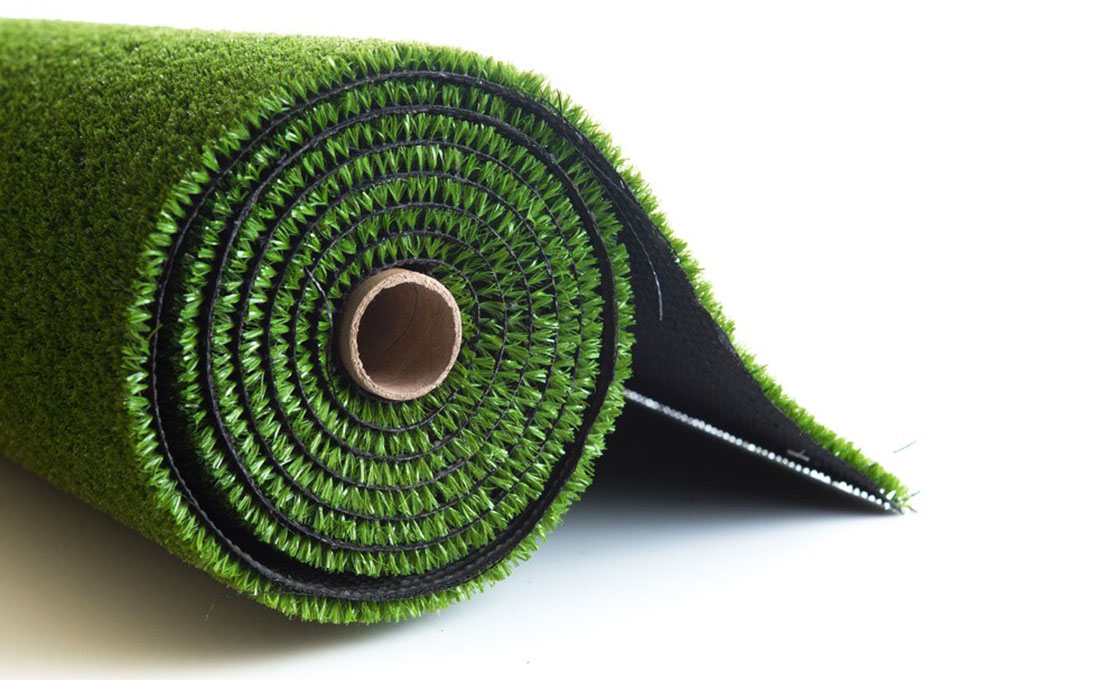
Reading Stitch Rate Specs in 60 Seconds
A stitch rate number is only comparable when it sits in the same unit as the number next to it — and suppliers quote in at least three: stitches per 10cm, stitches per meter, and stitches per inch. Normalizing any quote to a single basis takes about 60 seconds: convert everything to stitches per 10cm, then verify the figure physically on a sample. Here is exactly how.
What Stitches Per 10cm Actually Measures
A spec written as “15/10cm” means the tufting machine inserts 15 stitches into every 10 centimeters of travel along a single row of turf. That is all it measures — stitching frequency in one direction, along the row. It says nothing about the spacing between rows, which is set separately by the gauge (3/8 inch being the common balanced choice, 3/16 inch the tighter, denser option). Two products can carry an identical 15/10cm rate and still perform completely differently if one is stitched on a narrow gauge and the other on a wide one.
This is precisely why the biggest number on a quotation means nothing in isolation — and why buyers who rank suppliers by that number alone get burned.
Converting Per-Meter and Per-Inch Stitch Rates
Chinese manufacturers — our factory included — default to quoting per 10cm, because it is the unit a buyer can verify by hand with a ruler. European spec sheets tend to run per meter (sometimes written “stitches/ml”), while North American retail listings often use stitches per inch. The conversions are simple arithmetic:
- Per 10cm → per meter: multiply by 10. A 15/10cm turf equals 150 stitches/m.
- Per meter → per 10cm: divide by 10. A 165/m turf equals 16.5/10cm.
- Per inch → per 10cm: multiply by 3.94, since 10cm equals 3.937 inches. A 4/inch turf works out to roughly 15.7/10cm.
- Per inch → per meter: multiply by 39.4. That same 4/inch turf equals about 158 stitches/m.
Watch the rounding. A single product can legitimately appear on paper as 4/inch, 15.7/10cm, 16/10cm, or 157–158/m depending on who typed the datasheet. In our experience, once two competing quotes are converted into the same unit, most “density differences” under 5% simply evaporate — at that point the stitch rate is a tie, and the comparison should move to other parameters.
Counting Stitches on Your 20cm Sample
A datasheet is a claim; the sample in your hands is evidence. A standard 20cm × 20cm swatch — the free sample size we ship, with buyers covering only the DHL or FedEx freight — is more than enough surface to audit any supplier’s quoted figure in under a minute:
📋 Actionable Steps
- Step 1: Lay the sample flat under good light and pick one clearly defined row running lengthwise.
- Step 2: Mark a 10cm stretch along that row with two pieces of tape or a pen.
- Step 3: Count the insertion points (tufts) inside that 10cm stretch — not the individual grass blades.
- Step 4: Multiply your count by 10 for the per-meter figure, then repeat on two or three different rows and average the results.
- Step 5: Compare your count against the quoted number. A shortfall beyond roughly 5% is a question worth asking the supplier directly.
Sixty seconds of conversion plus one sample count will tell you more about a supplier’s honesty than any certificate in a PDF attachment.
Can Your Supplier’s Density Numbers Add Up?
A density figure only earns trust after it survives two cross-checks: rebuilding from stitch rate and gauge, then reconciling against Dtex and face weight. If the Dtex and face weight don’t corroborate the claimed density, one number on the sheet is fiction — and the face-weight check below will show you exactly how to catch it.
Turning Stitch Rate and Gauge Into Density
Stitch rate and gauge are the two axes of turf density, and any density figure that cannot be rebuilt from them is marketing, not engineering. Stitch rate counts tufts along the roll length; gauge is the center-to-center distance between tufting rows across the width. Multiply the two and the result is stitches per square meter — the only density number that means the same thing in every factory.
The notation trips up most first-time buyers. A stitch rate written as 15/10 means 15 stitches per 10 cm of row, which converts to 150 stitches per meter. Gauge converts the same way: a 3/8 inch gauge equals 9.525 mm, so the machine cuts roughly 1,000 ÷ 9.525 ≈ 105 rows per meter. Density therefore equals 150 × 105 = 15,750 stitches per square meter.
If a sheet quotes 18,000 stitches per square meter while also listing 15/10 on a 3/8 inch gauge, the numbers contradict each other before a sample is ever cut. Genuine spec sheets reconcile; inflated ones rely on buyers never doing this multiplication.
Dtex vs Stitch Rate Trade-Offs Explained
Dtex — the weight in grams of 10,000 meters of yarn — measures yarn thickness, and it trades off directly against stitch rate. A tufting machine can only push so much yarn through each needle punch per minute, so raising the stitch rate usually forces the mill to run thinner yarn. Total yarn mass per square meter is stitch rate × Dtex, which is why 15,750 stitches of 9,000 Dtex carries almost the same yarn as 12,600 stitches of 11,000 Dtex. A big stitch count on skinny yarn can hold less grass than a modest count on heavy yarn — the opposite of what the headline number implies.
One exception complicates the math: multi-end tufting. When a machine runs two yarn ends through a single needle, each stitch carries double Dtex, so a 9,000 Dtex tuft may actually be two 4,500 Dtex ends. Folded yarn is a legitimate construction and can even improve resilience, but the density-to-weight math only balances if Dtex counts every end. Ask whether the quoted figure is per end or per tuft; a reconciliation that fails on exactly this point may still be an honest spec.
Face Weight Checks That Expose Inflated Specs
Face weight — the mass of yarn above the backing, in grams per square meter — is where inflated specs get caught, because it cannot be faked once the other three numbers are fixed. The working formula: face weight ≈ stitches/m² × pile height (mm) × Dtex ÷ 5,000,000. Reconcile the sheet claiming 15,750 stitches/m², 40 mm pile, and 9,000 Dtex: 15,750 × 40 × 9,000 ÷ 5,000,000 = 1,134 g/m².
Production reality requires one correction term. The formula assumes every stitch apex reaches full pile height, yet curved blade profiles crest a few millimeters short and a small share of yarn is buried in the backing, so
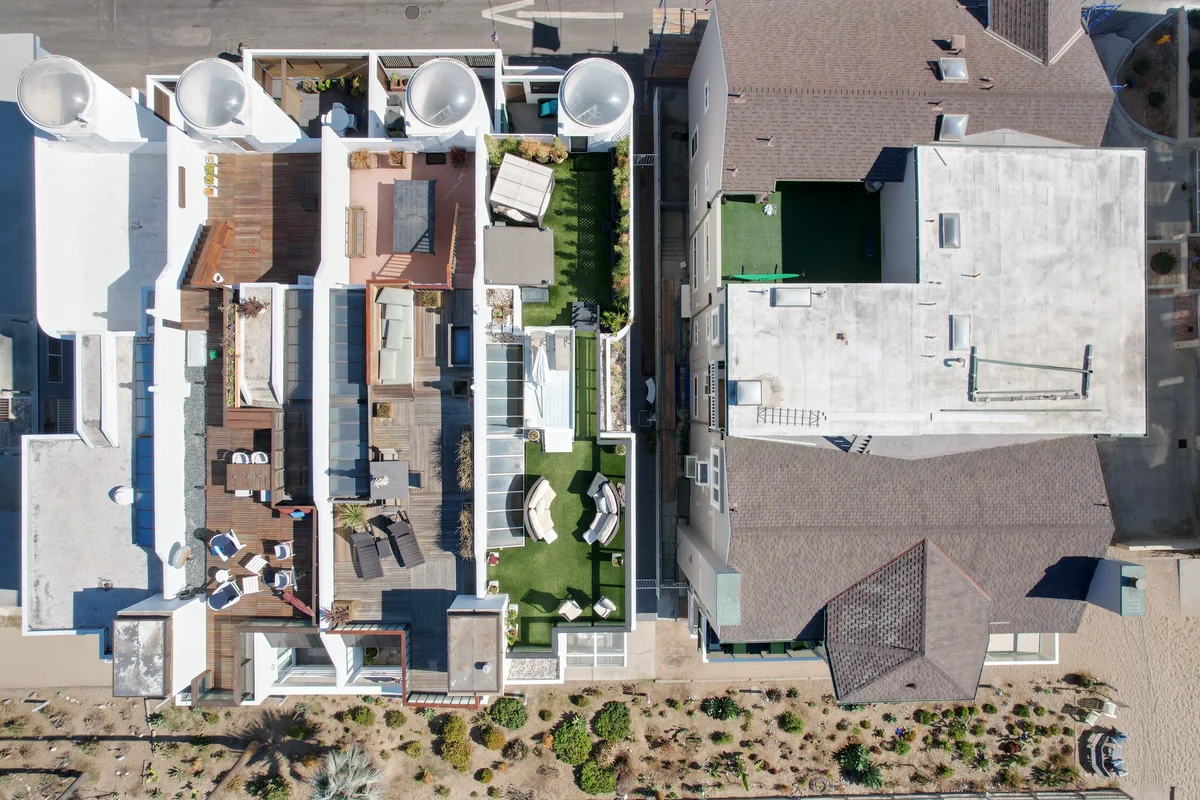
Stitch Rate for Home Lawns: 14,000–16,800
For home lawns, 14,000 to 16,800 stitches per square meter is the working band. It delivers the full, even carpet look a front yard or patio needs, without the spec inflation that pushes landed cost upward on turf that will never see stadium traffic. Most containerized landscaping programs are built inside this range, which is why it has become the default quote for residential projects worldwide.
How the Band Is Built: 3/8-Inch Gauge and 7,500–11,000 Dtex
Products in this tier almost always pair a 3/8-inch gauge with yarn in the 7,500–11,000 Dtex range. The 3/8-inch spacing offers a balance of softness and resilience — enough room for blades to stay upright at residential pile heights, yet tight enough that the backing never shows through. That Dtex band keeps each blade substantial enough for garden traffic, patio furniture, and kids or pets, while holding landed cost at a level that makes a full-yard project viable.
Tighter 3/16-inch gauges produce visibly denser stitching, but that construction serves specialty surfaces — not general landscaping.
Avoiding the Wrong-Spec Purchase
The most frequent residential buying error is mismatching application to spec. Putting-green construction — a very tight gauge, firm and dense, engineered for ball roll — installed in a garden feels harsh underfoot and costs more than the lawn requires. The reverse fails just as predictably: budget turf below this stitch band shows backing lines quickly wherever foot traffic concentrates, along gate paths and patio exits.
When comparing supplier quotations, hold three numbers together before signing: stitch rate, gauge, and Dtex. A 15,000 stitches/m² spec on a 3/8-inch gauge with 9,000 Dtex yarn is a coherent home-lawn product. The same headline stitch count quoted with an oddball gauge or unusually thin yarn warrants scrutiny — consistency across these three parameters is the fastest credibility check a buyer can run on a quotation.
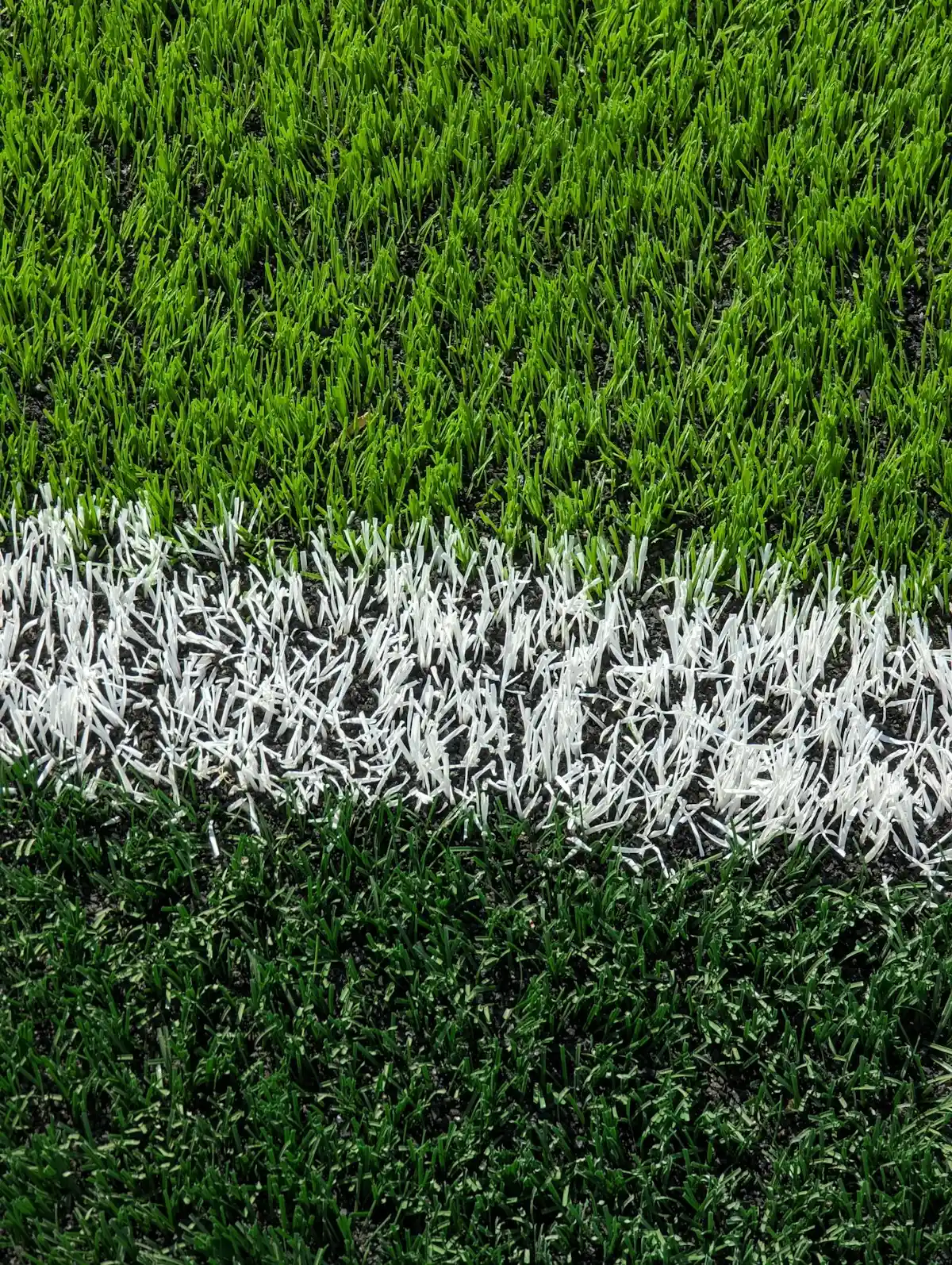
Pet Turf: High Stitch Rates That Drain
Pets impose the harshest wear pattern of any landscaping application. Dogs do not roam randomly — they patrol the same fence line, sprint the same gate path, and dig at the same corners every single day. High stitch rates solve the wear problem, but only when the rest of the specification supports them: thick yarn, a resilient blade profile, and a backing that drains as fast as the surface gets hit.
Why Dense Turf Mats Under Dog Traffic
Claw traffic abrades yarn more aggressively than shoe traffic ever will — and dogs repeat that abrasion along the same fence line every single day. On a sparsely stitched carpet, each yarn absorbs a disproportionate share of that abrasion, and flattened lanes appear within a single season. Dedicated pet products therefore specify 21,000–26,250 stitches per square meter — which at the 3/8-inch gauge this section recommends equals roughly 200–250 stitches per meter — distributing wear across many more tufts so no single fiber fails first.
Stitch rate alone does not guarantee recovery. At that density, the yarn must carry the load: 11,000+ Dtex monofilament resists claw abrasion, while a C-shaped blade profile gives each fiber the memory to spring upright after flattening. The same stitch count built on thin, flat yarn will lie down permanently along a dog run, no matter how impressive the number looks on the spec sheet.
Drainage: Density Only Works With an Open Backing
Dense tufting naturally slows water, so drainage has to come from underneath. Quality pet turf is perforated during coating — holes punched through the PU backing at regular intervals — so urine and rinse water pass through in seconds. Skip that step and liquid pools beneath a thick carpet, where ammonia odor builds within days. High drainage rates are what keep a dense pet lawn puddle-free and odor-controlled.
- Stitch rate: 21,000–26,250 stitches per square meter to spread concentrated patrol-path wear. That’s roughly 200–250 stitches per meter at a 3/8-inch gauge.
- Yarn thickness: 11,000+ Dtex for claw resistance
- Blade shape: C-shape monofilament for upright recovery
- Backing: perforated PU rather than a sealed coating
- Gauge: the balanced 3/8 inch spacing keeps dense rows resilient; the tight 3/16 inch stitching belongs on putting surfaces, not pet runs
The costly mistake is buying on density alone. Two turfs can look identical in a product photo, yet without 11,000+ Dtex yarn and open drainage holes, the same matting and odor problems return within the first season of real dog use. Evaluate the pairing, not just the headline number.
Playground Turf: Dense and Durable for Kids
Playground turf calls for the highest stitch density in the landscape category: a working band of 21,000 to 26,250 stitches per square meter. Below that range, infill migrates and the pile mats flat under constant kid traffic; far above it, the face stiffens into an abrasive carpet that punishes skin on every fall. The target is a surface that stays dense, soft, and upright through years of sliding, running, and swing-zone abuse.
Why Playgrounds Punish Loose Stitching
A schoolyard concentrates wear into small zones — slide exits, swing arcs, climbing bases — where the same few square meters absorb hundreds of impacts daily. Sparse stitch rows let rubber or sand infill displace sideways there, exposing backing and accelerating matting exactly where children play hardest. Dense stitching locks infill in place and distributes each impact across more yarn ends, so no single fiber bears the load alone. Specifying a garden-grade density for a playground is the costliest mismatch a contractor can make: the turf survives, but the surface looks worn and threadbare within two or three seasons.
Resilient Yarn Beats Raw Numbers
Durability under playground loads is decided as much by the yarn profile as by the density figure itself. C-shaped and stem-shaped fibers with strong memory rebound after compression instead of folding flat, and UV stabilizers blended into the polymer prevent the brittleness that full-sun playgrounds inflict. For child-facing surfaces, softness is non-negotiable: non-toxic colorants and rounded blade tips keep a dense face gentle on palms and knees, while tightly anchored tufts resist the shedding that loose builds show under dragging feet.
- Stitch density: 21,000–26,250 stitches/m² for high-traffic play zones
- Gauge: 3/8 inch balances density with blade flex; pushing to 3/16 inch raises stitch count but trades away child-safe softness
- Yarn profile: resilient shape with UV inhibitors and lead-free, non-toxic colorants
- Thatch layer: curled support fibers add body and keep blades standing under repeated load

Sports Turf: Why Fewer Stitches Actually Works
A filled-field quote that looks ‘low’ next to landscaping numbers is not a discount — it is the engineering. If a sports turf spec comes in below a landscaping grade, don’t read it as a cheaper build — read it as your cue to scrutinize the infill line of the quote before you sign.
Infill-based sports turf runs 9,450–13,230 stitches per square meter — a figure that looks low next to landscaping grades, and is deliberately engineered that way. On a filled football or multisport field, the sand and rubber granule layers hold the fibers upright and govern how the ball behaves. The stitching’s job is to anchor the yarn, not to do the surface’s structural work.
The Infill Does the Structural Work
In a filled system, each fiber leans against its column of infill for vertical support. Wider stitch spacing leaves open channels between tuft rows, so granules can penetrate down to the backing during installation and migrate freely during play. Fibers flex and rebound instead of standing packed rigid. Gauge selection backs this up: the 3/8-inch gauge offers a balance of softness and resilience suited to filled field products, while the tighter 3/16-inch gauge signals the denser stitching used in carpet-style turf.
What Over-Stitching Costs a Field
Raising stitch count on an infilled field increases yarn consumption and price per square meter without improving play. Cramped tuft rows restrict infill penetration and trap granules near the surface, where boots displace them fastest. The surface starts behaving like carpet: ball roll slows and deviates, foot drag rises, and skin-abrasion risk in slides climbs.
Excess density on a filled field is a cost line, not a performance line.
Where 21,000+ Actually Belongs
Non-infill hockey turf and comparable tennis products run 21,000+ stitches/m². With no infill cushion to carry load, the yarn must deliver density, resilience, ball behavior, and wear life on its own — dense tufting at a tight gauge is correct engineering there, not excess.
So the buying error runs both ways: rejecting a filled-field quote of 13,230 stitches/m² as “low-spec,” or paying landscaping-grade density for a sports surface where it degrades ball roll. Read the stitch figure only inside its system — filled versus non-infill — and the number makes sense.
Commercial Turf: 16,800–21,000 Stitches for Busy Spaces
Commercial turf lives in the 16,800–21,000 stitches per square meter band — mid-to-high density built for spaces where foot traffic never lets up. Rooftop terraces, office park courtyards, and retail storefronts sit here because they absorb persistent daily use but rarely justify premium sports-grade yarn counts. Density does the durability work; the yarn spec keeps the budget controlled.
Why Mid-to-High Density Handles Persistent Traffic
Every additional stitch spreads traffic load across more anchor points. At 16,800–21,000 stitches/m², no single yarn carries enough repeated pressure to flatten and matte the way a sparser residential-grade turf would under the same footfall. That matters most where traffic channels — walkways between office buildings, queue zones outside retail entrances, rooftop gathering spots — because concentrated wear, not total footfall, is what kills a surface prematurely.
The trade-off is deliberate: mid-tier yarn count instead of premium decitex.
Matching Gauge and Build to the Space
- 3/16 inch gauge: The tighter choice for high-concentration zones such as retail entries and event plazas, packing maximum anchor points into every meter to resist matting.
- 3/8 inch gauge: The balanced option for open commercial lawns and hospitality patios, where some softness underfoot matters alongside traffic tolerance.
- Perforated backing: Non-negotiable on rooftops and ground-level plazas, where rain needs a path through the turf rather than pooling against the membrane or sub-base.
Buying the wrong tier here is expensive in both directions. A residential spec under plaza footfall matts within its first season; sports-brief turf on a retail front ties up budget in engineering the space never uses.
What Contractors Should Lock Down Before Ordering
At volume, the bigger risk is variation between rolls, not the number on the spec sheet. Write stitch rate, gauge, and yarn lot into the purchase contract so every pallet in a multi-zone install matches — a density drift between rooftop sections reads as a visible texture and color seam once laid. Tuft lock matters equally: a PU-backed build grips fibers firmly enough to survive trolley wheels and cleaning equipment, where weak adhesion starts pulling tufts loose precisely in the traffic lanes the turf was bought to handle.
Which Stitch Rate Tier Fits Your Project?
The correct stitch tier is dictated by foot traffic and performance expectations — not by the biggest number on a spec sheet. Match the tier to the use case first, then let pile height and yarn weight fine-tune the look and the price.
Matching the Tier to the Application
Read the tier table that closes this guide as a shortlisting filter, not a verdict. The logic behind it is simple: every project tier is defined by three variables — daily foot traffic, what actually sits on the surface, and whether the buyer is paying for appearance or endurance. A display corner and a dog run may sit meters apart on the same property, yet they demand fundamentally different stitch architectures. This is where the fear of the wrong spec for the use case is entirely justified: mismatched turf underperforms no matter how impressive its numbers look on paper.
Both mismatches cost money, and they burn it in opposite directions. Specifying an ultra-dense, fine-yarn display tier on a working pet or play zone produces a surface that flattens quickly and traps debris, because delicate filaments were never engineered for abrasion. Specifying a heavy, coarse sports-grade product under a decorative flower bed wastes budget on recovery characteristics the area will never use. And as the sports row in the table shows, the “higher is better” assumption collapses completely in infilled applications — that counter-intuitive case is the one the Sports Turf section covered earlier.
The practical takeaway: shortlist by the traffic description, not by the stitch number. If the application profile in a supplier’s datasheet doesn’t mirror your site conditions, keep looking.
Expected Lifespan at Each Stitch Tier
Lifespan is a function of tier-to-traffic fit far more than of the tier itself. A correctly matched mid-tier residential lawn built from UV-stabilized yarn typically delivers 10–15 years of service before visible degradation, and lightly used decorative installations can exceed that figure. Commercial surfaces absorbing daily footfall generally retire closer to the 8–10 year mark even when densely specified. The dominant failure mode is almost never structural — backing and tuft bind usually outlast the aesthetics — so buyers should think in terms of “years of looking good” rather than years until replacement is forced.
Mismatch shortens that clock dramatically. An ultra-dense fine-yarn product under real traffic can look tired within two to three seasons as the filaments lose recovery, while a sturdier mid-tier under the same load brushes back upright for a decade. Drainage quality, infill decisions, and a routine brushing schedule shift these figures by several years in either direction.
How Stitch Rate Moves Price Per Square Meter
Yarn is the single largest cost input in turf manufacturing, and stitch rate directly scales yarn consumption — so per-square-meter pricing climbs with it. The relationship is not a clean ladder, however. Because pile height and yarn thickness also consume polymer, a very high stitch rate on a fine yarn can land near the same price as a moderate stitch rate on a heavy yarn. Comparing quotes without holding those two variables constant is meaningless.
The cost curve also steepens sharply in ultra-dense territory. Achieving extreme stitch counts requires tighter gauges and finer yarns, both of which slow the tufting line and raise scrap rates — so the premium on the densest products reflects production economics as much as material weight. A sound B2B benchmark: expect pricing to rise roughly in step with yarn kilograms per square meter, plus a visible step-change once a quote crosses into show-lawn density.
Pairing Stitch Rate With Pile Height
Density is co-produced by stitch rate and pile height, and neither number means anything alone. The same stitch count looks visibly fuller on a shorter pile because the identical yarn mass occupies less vertical space; as pile climbs, the load per stitch grows and blades lean apart. The pairing rule that follows: taller piles need a higher stitch rate or a heavier yarn to stay upright, while shorter piles lean on gauge tightness instead — a 3/16-inch gauge packs roughly twice the stitch rows per meter of width as a 3/8-inch gauge, the balanced workhorse for general landscaping.
This pairing logic doubles as a supplier sanity check. Each tier in the table pairs its stitch band with a matching pile and yarn weight for a reason: a quote claiming top-band stitch density on a tall pile with heavy yarn describes a product that either doesn’t exist or carries a price reflecting its true material load. When the three numbers don’t cohere, the specification — not the price — is what deserves scrutiny.
Worked in that order — traffic first, tier second, pairing third — the table becomes a complete pre-contact checklist, and every supplier conversation starts from a defensible specification instead of a marketing number.
| Project Tier | Typical Applications | Stitch Rate Benchmark | Matched Specs (Pile / Gauge / Dtex) | Why This Tier Works |
|---|---|---|---|---|
| Entry Decorative Landscape | Balconies, display corners, low-traffic ornamental gardens | 10,500–14,700 stitches/m² (≈10–14 per 10 cm @ 3/8″) | Pile 30–40 mm · Gauge 3/8″ · Dtex 7,000–9,000 | Fine 7,000–9,000 Dtex yarn keeps the face full at a modest stitch count, so the backing never shows on low-traffic surfaces — and no infill is needed. |
| Premium Residential Lawn | Family front/back lawns, moderate daily footfall, lounging areas | 14,000–16,800 stitches/m² (≈13–16 per 10 cm @ 3/8″; ≈11–13 per 10 cm @ 5/16″) | Pile 35–45 mm · Gauge 5/16″–3/8″ · Dtex 8,000–11,000 | Balanced stitch–Dtex pairing keeps the lush real-lawn aesthetic while slightly thicker filaments resist flattening from kids and everyday use. |
| Pet & Play Zone | Dog runs, kennels, playgrounds, daycare surfaces | 21,000–26,250 stitches/m² (≈20–25 per 10 cm @ 3/8″) | Pile 25–35 mm · Gauge 3/8″ · Dtex 11,000+ | Short, dense pile traps less waste and rinses clean fast, while the perforated PU backing drains urine and rain and shrugs off odor and moisture. |
| High-Traffic Commercial Landscape | Office parks, retail frontage, rooftops, event zones | 18,000–21,000 stitches/m² (≈14–17 per 10 cm @ 5/16″) | Pile 30–40 mm · Gauge 5/16″ · Dtex 9,000–11,000 | Added density gives body and recovery under constant footfall; keeping Dtex near 11,000 maintains blade recovery without a coarse, abrasive feel. |
| Ultra-Dense ‘Show Lawn’ | Show homes, photo backdrops, barefoot lounging lawns | 26,000–31,500 stitches/m² (≈21–25 per 10 cm @ 5/16″) | Pile 30–38 mm · Gauge 5/16″–3/8″ · Dtex 7,000–8,000 | Very high stitch count with fine, light yarn feels feather-soft and ultra-full; the thin filaments favor display over heavy wear, as they may flatten under sustained traffic. |
| Putting Green | Golf greens, short-game practice, recreational mini-golf | 42,000–50,000 stitches/m² (≈20 per 10 cm @ 5/32″–3/16″) | Pile 16–20 mm · Gauge 5/32″–3/16″ · Dtex 7,000–9,000 | Narrow gauge plus extreme stitch density creates a fast, true ball roll on a short, firm carpet — no infill required. |
| Football / Sports Pitch | Full-size training and match pitches, infilled multi-sport fields | 10,000–11,000 stitches/m² (≈20 per 10 cm @ 3/4″) | Pile 50 mm · Gauge 5/8″–3/4″ · Dtex 11,000–17,000 | Counter-intuitive but correct: sand and rubber infill provide support and rebound, so over-dense pile would block infill and ruin ball behavior — durability comes from heavy Dtex, not stitch count. |
Conclusion
If you take one thing from this guide, take this: never price turf on the stitch number alone. A supplier quoting 16,800 stitches at a 3/8 gauge with thin yarn can deliver less turf than one running 14,000 at 3/16 with heavier dtex. Run the density formula. Check the face weight. Then match the tier — 14,000–16,800 for lawns, 16,800–21,000 for commercial — to the traffic each site actually takes.
That arithmetic is where inflated specs fall apart. Before you commit to a container, send us the spec sheet or a 20cm cutting from your supplier. Our engineers will count the stitches, convert the gauge to true density, and cross-check face weight against the numbers on paper — free, with zero obligation. Ten minutes of checking beats a season of warranty claims.
Spec Your Stitch Rate at the Plant Gate
We are a factory-direct supplier with 18 years of export experience, producing PP+Net and PU backed residential artificial grass in 2, 4 and 5 metre rolls at 25 metre lengths. Send us your project volume and target traffic load, and our team will match pile height, density and stitch rate to every zone before you commit a container. Request an exact quote for your project volume.
Frequently Asked Questions
Does a higher stitch rate look more realistic?
Density helps hide the backing and creates the lush, even surface people associate with healthy grass, but stitch rate alone does not guarantee realism. True realism comes from combining moderate density with multi-tone yarns, mixed blade shapes, and a pile height suited to the application. Overcrowded turf can actually look unnaturally uniform and lifeless. Judge realism on physical samples viewed outdoors, never on spec numbers alone.
Do blade shapes pair with certain stitch rates?
They do, and the pairing matters more than most buyers realize. Thicker structural profiles like C-shape and spine blades need room between stitches to spring back after traffic, so they typically run at moderate densities on wider gauges. Flat, thinner blades tolerate tighter stitch spacing, which is why ultra-dense landscape products usually use them. Mismatched combinations, such as dense stitching with stiff wide blades, produce a rigid carpet that crushes instead of rebounding.
Does backing quality affect stitch retention?
Yes, and it is the most overlooked factor in density discussions. A stitch rate only matters if the primary backing and coating lock every tuft in place, because weak coating lets fibers pull free under grooming and foot traffic regardless of how dense the construction was. Test any sample by pulling firmly on the blades, as quality turf sheds little or nothing. Different coating systems anchor stitches with very different strength, so always ask what holds the tufts down.
Does a higher stitch rate need less infill?
Denser turf supports each blade more effectively, so it resists flattening with a lighter infill application than a sparse product of the same pile height. However, infill is not purely cosmetic, as pet, playground, and sports installations rely on it for ballast, impact absorption, and drainage performance that stitch density cannot replace. Reduce infill rates only when the manufacturer’s spec sheet confirms it for that exact construction. Never eliminate infill on functional installations to cut material costs.
How do I maintain high-density artificial grass?
Dense turf hides debris more easily than sparse products, so regular leaf blowing and occasional rinsing keep the surface clean and draining properly. Cross-brush high-traffic paths against the pile direction every few months to keep blades upright and prevent matting. Avoid wire brushes and harsh solvents that abrade or dull the yarn. Dense constructions need slightly more grooming attention than low-density ones, but the reward is a fuller surface that holds its look for years.
Can I order a custom stitch rate?
Yes, stitch rate is a tufting machine setting, so manufacturers with in-house tufting lines can adjust it to your target specification instead of selling only stock constructions. Custom rates make sense when you need to match an existing installation, meet a project specification, or balance density against budget. Always approve a physical sample produced at the custom rate before mass production begins. Expect longer lead times and higher minimums than catalog products.
Does stitch density increase shipping weight?
It does, and the cost impact is real for container shipments. Denser constructions use more yarn per square meter, so a full roll can weigh noticeably more than a lower-tier equivalent of identical dimensions. On ocean freight, heavier cargo means higher freight charges and tighter container weight limits on large projects. Compare roll weights on competing quotes so a density upgrade is evaluated against its landed cost, not just its per-square-meter price.
 English
  Arabic
  French
  German
  Portuguese
  Russian
  Spanish