
Here is the counterintuitive part: the cheapest bocce court to own is usually not the one with the cheapest surface. A natural lawn costs almost nothing to plant and almost nothing to mow. It still ends up the most expensive choice for anyone who actually plays, because the real price of a court is measured in lost games. That is the honest case for natural grass, and it loses on the numbers.
Turf, oyster shell, clay and gravel all outperform a lawn as a bocce surface. The reasons are practical rather than promotional: roll consistency, rain recovery and the hours a court stays playable. This guide compares them honestly, including the cases where grass genuinely still makes sense, so you can pick a surface that matches how often your court gets used.
The Case Against Mowing a Bocce Lane
A lawn looks like a bocce court for about one afternoon. The ball rolls wherever the grass blades lean, the pace changes after every mow, and any game played within a day of rain becomes a mud experiment. Surface guides for the sport treat that inconsistency as the starting problem, and players feel it before they can name it. The game itself has ancient roots, as the bocce overview records, but modern play lives or dies on the surface.
The lawn also loses to traffic. A lane that gets walked twice a week wears bare down the middle, and a worn lawn lane holds water, which circles straight back to the mud problem. Nothing about that improves with better mowing.
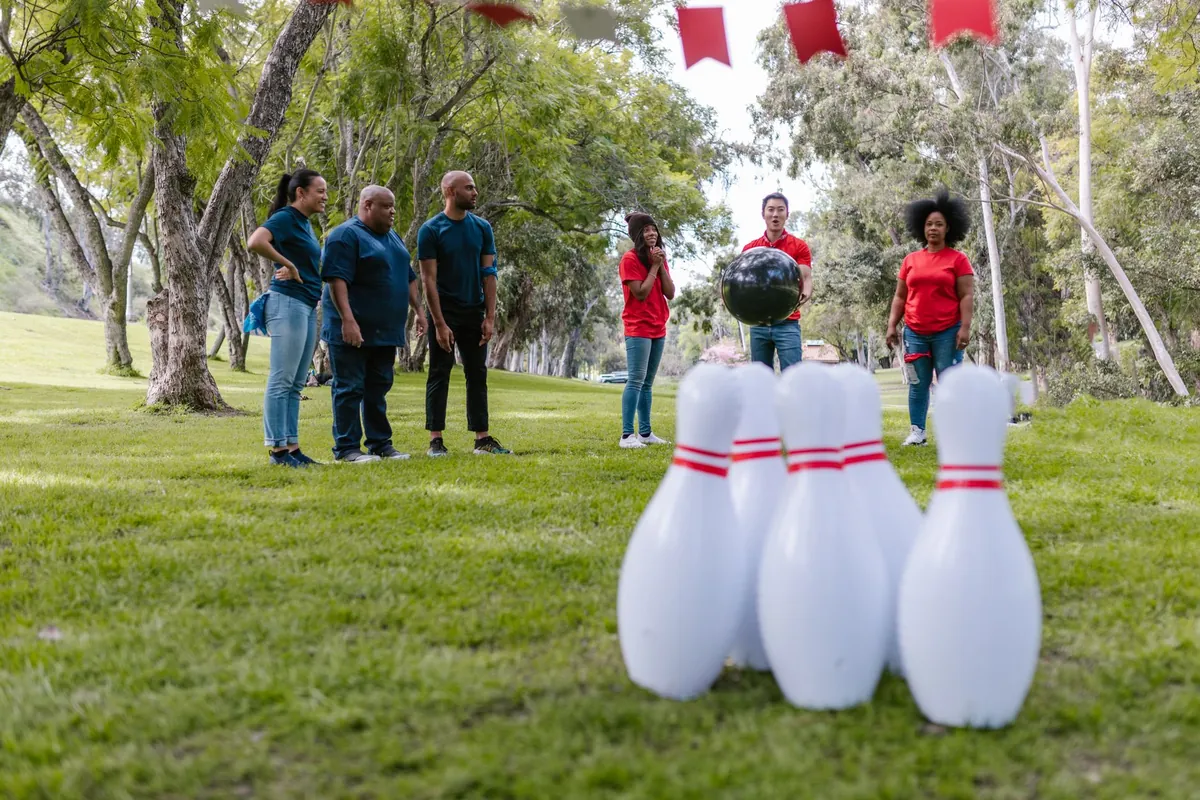
The consistency argument extends beyond just the roll. On grass, the bounce of a thrown ball changes with moisture content, foot traffic and the season. On turf, the same shot plays the same in April and September. Surface installers who build both types consistently report that league players notice the difference within the first frame. The ball tells you what the surface is doing, and grass has too many variables for the ball to tell the truth.
Roll, Bounce and Speed of Play
Bocce rewards a surface that gives the same roll every time, and this is where manufactured turf separates itself. Pile height drives the behaviour: shorter turf gives more rebound and absorbs less energy, so a well-chosen surface lets a pointing shot run exactly as far as the player judged. On grass, the same throw changes with the growth since the last mow.
Shell courts roll beautifully too, which is why they remain the traditional gold standard. But their consistency depends on constant raking and top-dressing, while a turf court holds its speed between weekends with nothing more than a brush through the pile.
Maintenance: Where the Hours Actually Go
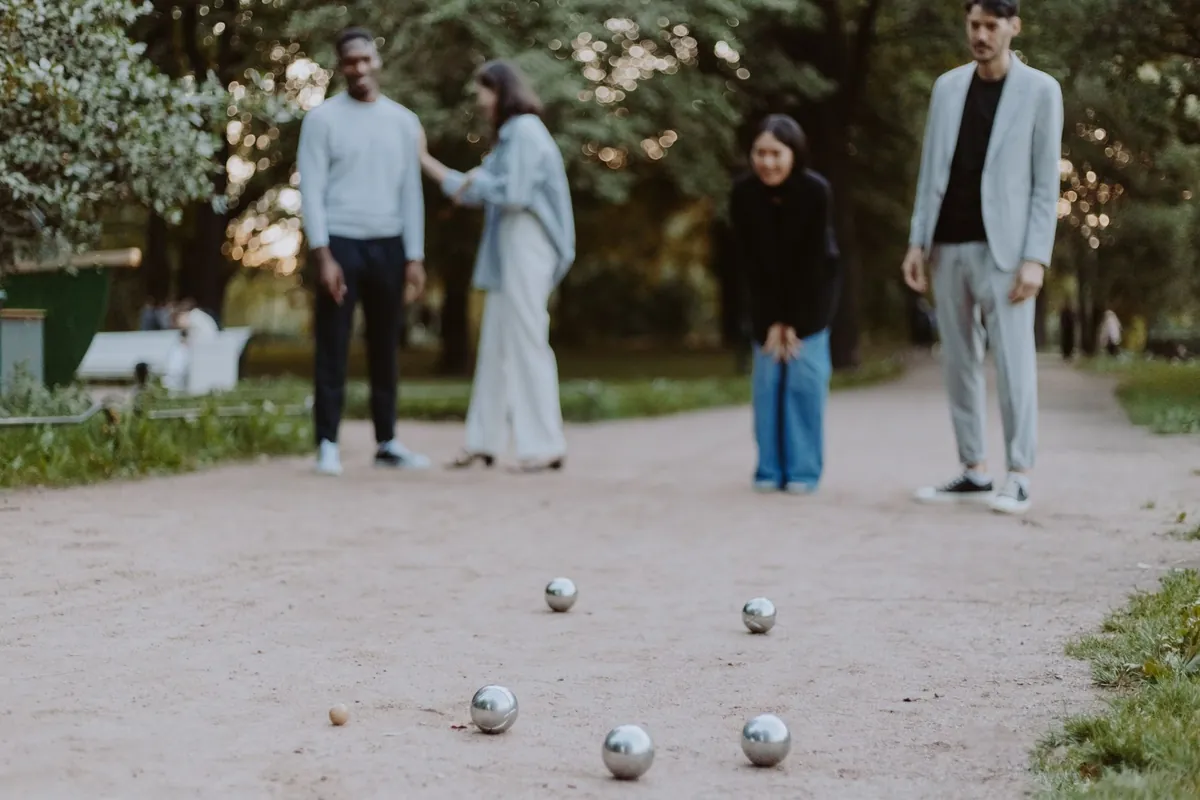
The maintenance gap is the widest column in the whole comparison. Surface guides for the sport describe crushed oyster shell courts as needing extensive, ongoing maintenance and being inherently not very clean. Clay drains poorly and solidifies. Sand and gravel need frequent raking and wander into the rest of the garden.
Natural grass needs mowing, watering and lane repair of its own. Turf asks for an occasional brush and a rinse.
| Surface | Maintenance load | Typical upkeep |
|---|---|---|
| Natural lawn | Continuous | Mowing, watering, repair of worn lanes |
| Crushed oyster shell | High | Raking after play, periodic top-dressing |
| Clay | High | Patching and scarifying as it hardens |
| Sand or gravel | Moderate to high | Frequent raking, material wanders |
| Synthetic turf | Minimal | Occasional brush and rinse |
Those rows come straight from the way surface installers describe their own market, not from a turf maker’s brochure.
The lawn row is the one to read twice, because it is the surface most first-time builders default to.
The maintenance table also hides a cost dimension that first-time builders miss. Mowing, watering and fertilising a natural lane requires equipment you already own for the rest of the garden, but the time adds up across a season.
Raking and re-dressing a shell court adds material costs on top of the labour. Turf compresses both into an occasional sweep with a stiff broom. The real cost comparison is not the install price but the total hours of care multiplied across the years you own the court.
Rain, Mud and Recovery Time
Rain is where natural surfaces show the gap at its widest. A lawn stays unplayable until it dries, and a heavily used lane dries into ruts. Shell and clay courts have their own rain behaviour, with shell washing and clay turning slippery before it hardens. Permeable turf drains through, which is why rain during a session is an inconvenience rather than a cancellation, though you still let the surface dry before the first end.
Turf or Grass: The Verdict for Your Court
For a court that gets played, turf wins the comparison outright: the roll is true, the rain rolls through and the maintenance fits in minutes.
A natural lawn only makes sense as a bocce surface when games are rare. Add the look of natural grass mattering more than the roll and a budget that cannot stretch to a base, and the choice makes itself.
That is a legitimate choice for some gardens, and it is honest to say so.
One hybrid approach works well for casual players: turf the playing lane and leave the surrounding area in natural grass or planting. The lane gets the consistent surface where the ball rolls, and the garden keeps its living texture around the frame. This split design also reduces the turf budget, because you are only buying the surface area that actually needs the performance specification.
Everyone else is choosing between turf and the shell-and-clay family, and that comparison is about upkeep and cleanliness, where turf’s case is strongest. If you are weighing shell against turf specifically, our guide to bocce ball turf shows the surface options in detail.
Still Paying to Keep a Natural Bocce Court Alive?
Watering, rolling and topdressing never really stop. Our bocce carpet ends the routine. Buying direct from the maker usually lands 30–50% below like-for-like market pricing.
What Natural Grass Still Does Well
Fairness first: a lawn is free-ish, soft to fall on, and it fits a garden that only occasionally hosts a game. If bocce is a once-a-month event rather than a weekly habit, grass plus a honest acceptance of bad bounces can be the right call. The mistake is buying a lawn as a bocce court. Buy it as a lawn, and let bocce happen to be played on it.
The same fairness cuts the other way at facilities. Clubs and venues that charge for leagues or host tournaments cannot sell mud dates, and their members compare surfaces across visits. There, grass stops being a surface choice and becomes a booking limit.
Switching a Lawn Court to Turf
The good news for lawn owners is that the conversion is the easiest kind of bocce project. The outline already exists and the family already knows the game. The work is a version of the standard build: strip the strip of lawn, set a frame, prepare a compacted base with drainage and roll the turf across. Our step-by-step guide to how to build a bocce ball court on turf covers that sequence in full, including the weep holes and slope that keep water moving.
Measure the lane before you order, because roll width decides how many seams cross the court. A typical backyard lane converts with one or two runs of standard roll, and custom-cut turf removes internal seams entirely.
What a Bocce Surface Costs Over a Decade
Published guide figures give the scale of the decision. A DIY basic court runs $2,000 to $5,000, and a mid-range build $5,000 to $12,000. Professional builders quote roughly $15 to $30 per square foot for basic construction, and more for premium surfaces. Lighting adds $2,000 to $8,000 where evening play matters, and drainage systems run $1,000 to $3,000 when a site needs help. All of those are guide ranges that move with region and site, so treat them as anchors for a quote rather than quotes themselves.
Against those numbers, weigh what the comparison above showed: the surfaces at the low end of build cost sit at the high end of lifetime raking, patching and re-dressing. The surface you can forget about is the one that keeps earning its keep every weekend for years.
Frequently Asked Questions
Is turf or grass better for a bocce court?
Turf plays truer and stays usable in all weather, while grass costs less to start. For any court that gets regular play, turf wins on consistency and upkeep.
What about traditional oyster shell courts?
Shell rolls beautifully and remains the traditional gold standard, but it needs constant raking and top-dressing and tracks mess. Turf delivers similar play with almost none of the upkeep.
Can you play bocce on grass?
Casually, yes. The roll changes with growth, wear and rain, so lawn bocce is best treated as garden fun rather than a proper game surface.
How much does a bocce court cost?
Guide figures run from $2,000 to $5,000 for a DIY basic court, $5,000 to $12,000 for mid-range builds, and professional construction around $15 to $30 per square foot.
Does turf bocce need infill?
Not necessarily. Padded turf arrives with its playing feel built in, while infilled systems let you tune ball speed on site. The choice depends on how you want the court to play.
 English
  Arabic
  French
  German
  Portuguese
  Russian
  Spanish