How much artificial turf do I need is the first question behind most inquiries that reach our desk. The honest answer rarely matches the area on the drawing. A 1,000 sq ft play area does not produce a 1,000 sq ft order; it works out to 75 linear feet off a 15 ft roll. That gap is not padding. It is what fixed roll widths do to the purchase math.
The same question arrives as how much artificial grass do I need when a distributor is quoting a multi-zone job. We run the order math on the factory side before every export shipment, and the sequence never changes: measure, add the areas, apply roll width, then size the buffer. Get the width decision wrong and no amount of careful measuring saves the budget.
Measure the Space the Right Way
Start at the widest and longest points of each zone and treat the space as a rectangle for ordering purposes. One UK measuring guide suggests adding roughly 100 mm to each dimension so the edges carry trimming margin. Suppliers will not decide quantity for you, so the tape work stays with the buyer. Where a boundary curves, the widest point still governs, because the roll is straight even when the ground is not. The rectangle is what the order follows, even where a fence line runs diagonally.

Corners rarely form true 90-degree angles, and one installer’s published guide recommends adding 1 ft to each end of the measurements to absorb that error. Measure every dimension twice and write the numbers down as they come, not from memory at the end of the day. Turf purchases are typically non-refundable, so the tape gets more chances than the invoice does. For irregular shapes, the same guide’s method is to divide the space into smaller rectangles, squares or triangles and measure each separately.
Contractors on multi-zone sites log each zone separately, because a schoolyard with a play area and a walkway is really two separate orders. Sketch the zone with straight edges, curves and cutouts marked, since that sketch is what a supplier needs to return a cutting plan. Our guide on how to measure your garden for artificial grass walks the same routine for smaller landscape jobs. Keep the sketch after ordering too. Each delivered roll is labeled with model, dimensions, batch number and production date, so the sketch is how the delivery gets checked against the plan.
Convert Dimensions Into Total Area
Multiply length by width for every section, then add the sections together. One installer’s published example splits a site into two zones: 40 ft x 30 ft and 25 ft x 20 ft. The areas add up as 1,200 sq ft plus 500 sq ft, for a 1,700 sq ft total. Triangles use base times height divided by two, and circles use pi times radius squared. The area figure is what most people mean when they ask how much artificial turf do I need, and it is only a halfway point.
Keep one unit from start to finish, because mixing square feet with square meters is where estimates drift. The useful anchors are few: 1 m² equals about 10.76 sq ft, square feet divided by nine gives square yards, and 15 ft is about 4.57 m. A 1,500 sq ft order converts to 166.7 sq yd, or roughly 139 m². Whatever system you start in, stay in it through to the order. Write the conversion on the sketch itself, so the quote request and the tape work agree.
The order unit itself is not area. US suppliers quote linear feet of turf and metric markets quote lineal meters, both meaning roll width times length. One supplier’s measuring sheet lists 26 lineal meters as equal to 96.5 sq m, which is exactly what width times length produces. Before you ask for numbers against a drawing, our post on how to prepare for a turf estimate shows which dimensions a quote actually needs. Linear feet and lineal meters are the same idea: a running length of roll, not a surface measure.
Why Roll Width Drives the Quantity
Here is the part most buying guides skip: you pay roll width multiplied by length, not the lawn’s area. The width you pick decides more about the final order than the garden size does. That single fact settles how much artificial turf do I need more precisely than any area figure, because every strip is cut from a roll of fixed width.
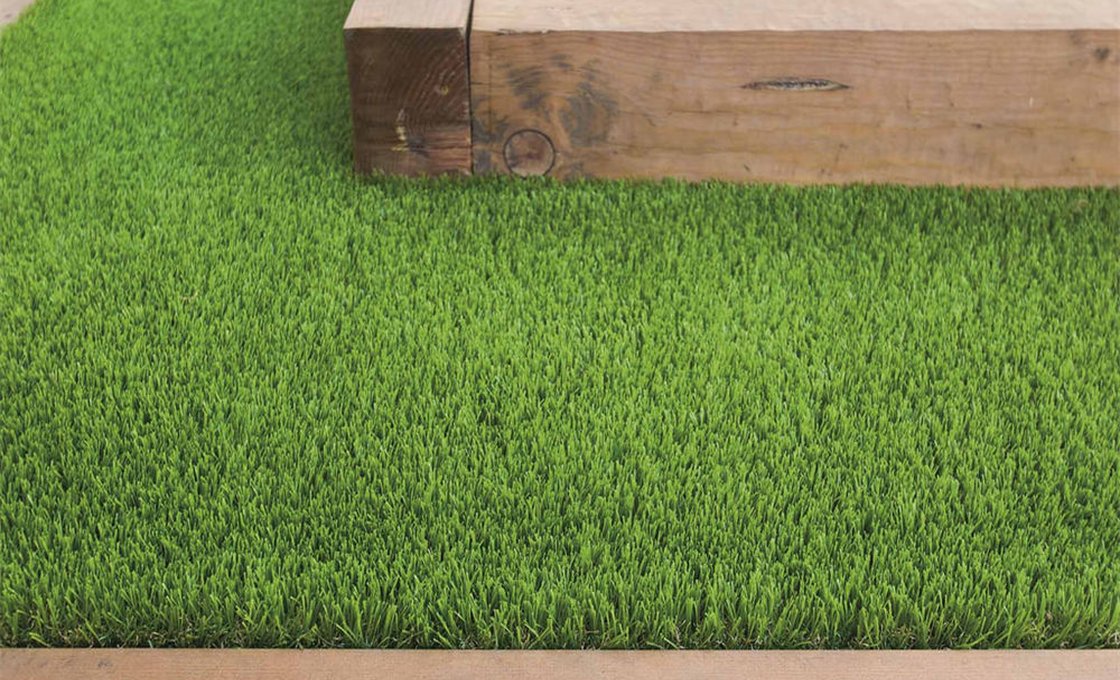
Strips are counted by dividing the area width by the roll width and rounding up. Rolls come in fixed widths, so a 13 ft wide area on a 15 ft roll still consumes the full 15 ft. About 2 ft per strip is unavoidable trim waste. This is why the purchase almost always exceeds the installed area, which one calculator FAQ calls structural waste rather than error.
The Strip Count Formula
Divide the total area by roll width for bare linear feet, then apply the buffer. A 1,000 sq ft area on a 15 ft roll needs 66.7 linear ft bare. With a 10% buffer, 1,100 sq ft divided by 15 ft is 73.3, which rounds up to 75 linear ft of turf to order.
The Just-Over-Width Trap
Nobody sells 3.4 m of width. You buy a 4 m roll and trim 600 mm off, or join two 2 m rolls, and which is cheaper depends on the length. The expensive case is a measurement just over a width. At 4.1 m, one guide notes that shaving 100 mm with a wider border can drop the order from a 5 m roll to a 4 m roll. On a 10 m lawn that saves 10 m², and 3.9 m is the lucky case.
Width menus differ by market. Metric markets commonly run 2 m, 4 m and 5 m rolls, while US formats come in 12 ft, 15 ft and 16.4 ft widths. Wider rolls mean fewer seams and faster laying; narrower rolls are easier to handle where access is tight. Our custom roll sizes made to your project spec cover widths outside the standard menu.
Match Roll Sizes to Your Project Area
The practical move is to match the roll width against the shorter dimension of the site, because that side decides the strip count and the trim. A 2 m roll is easier to handle on sites with limited access. A 4 m roll minimizes seams on large areas such as sports fields, and a 5 m roll covers big open spaces with few or no joins. The table below sets the four common formats against a drawing. When a buyer works out how much artificial turf do I need against a fixed roll menu, this matrix is the fastest route from area to order size.
| Roll size | Width | Length | Area per full roll | Best fit |
|---|---|---|---|---|
| 2 m x 25 m | 2 m | 25 m | 50 m² (538 sq ft) | Narrow strips and tight site access |
| 4 m x 25 m | 4 m | 25 m | 100 m² (1,076 sq ft) | Most landscape areas, fewer seams |
| 5 m x 25 m | 5 m | 25 m | 125 m² (1,346 sq ft) | Large open areas, minimal joins |
| 15 ft x 100 ft | 15 ft | 100 ft | 1,500 sq ft (139 m²) | US-format strips |
Length deserves as much attention as width once the order leaves the factory floor. One installer’s delivery guide keeps rolls under 20 ft for indoor carrying and under 50 ft outdoors. A longer roll may not fit a typical 36-inch door or gate opening. Weight is the second constraint: a 15 ft roll can weigh 800 to 1,200 lbs. Confirm gates, doorways and handling equipment before committing to long full rolls.
Rolls are one format among several. For the wider picture of how rolls sit against other supply formats, see our guide to artificial grass product formats: rolls, tiles, panels and mats.
Tired of Guessing How Much Turf to Buy?
We make every roll to your width and length spec — 2, 4 and 5 m sizes plus custom. Send dimensions for a cutting plan.
Add the Waste Factor Before You Buy
Even with the area and the strip count settled, the order is not complete, because cutting is never free. The question of how much artificial turf do I need is only fully answered once the waste factor is applied. Industry guides converge on tiers: simple rectangles need 5-10% extra, layouts with moderate curves or obstacles need 10-15%, and complex layouts run up to 15-20%. Other sources phrase the same discipline as 5-10% for cutting and seaming, at least 10% for most projects, or 8-10% for simple shapes and 12-20% for complex ones. An artificial turf calculator is a fair first pass, but it returns bare linear feet; the buffer is the buyer’s addition before an order goes in.
So what does the margin actually pay for? The list is concrete:
- Cuts along curves, obstacles and corners that are not square.
- The seam-side trim: rolls arrive about 6 inches narrower than labeled on one side, and installers cut away about 5 stitches from that smashed edge for an invisible joint.
- Blade-direction discipline, since turf has a directional pile and rotated scraps show shade differences at the seams.
- Measurement error, which is why the 1 ft per end margin exists.
Apply the buffer with the order formula: strips multiplied by area length, times one plus the waste percentage, then round up to the next whole unit. One guide’s worked example lands at 124.67 linear ft and rounds to 125, never down. The tiers scale with geometry rather than area, which is why the same square footage can justify 5% on one job and 15% on the next.
Plan Seams Around Blade Direction
Seam positions are an order-time decision, not an installation afterthought. Ordering rolls the full length of the area avoids head seams, which are the end-to-end joints between rolls; edge seams, where strips sit side by side, are the preferred kind. When a buyer settles how much artificial turf do I need, the roll lengths written on the purchase order decide where every seam will land.
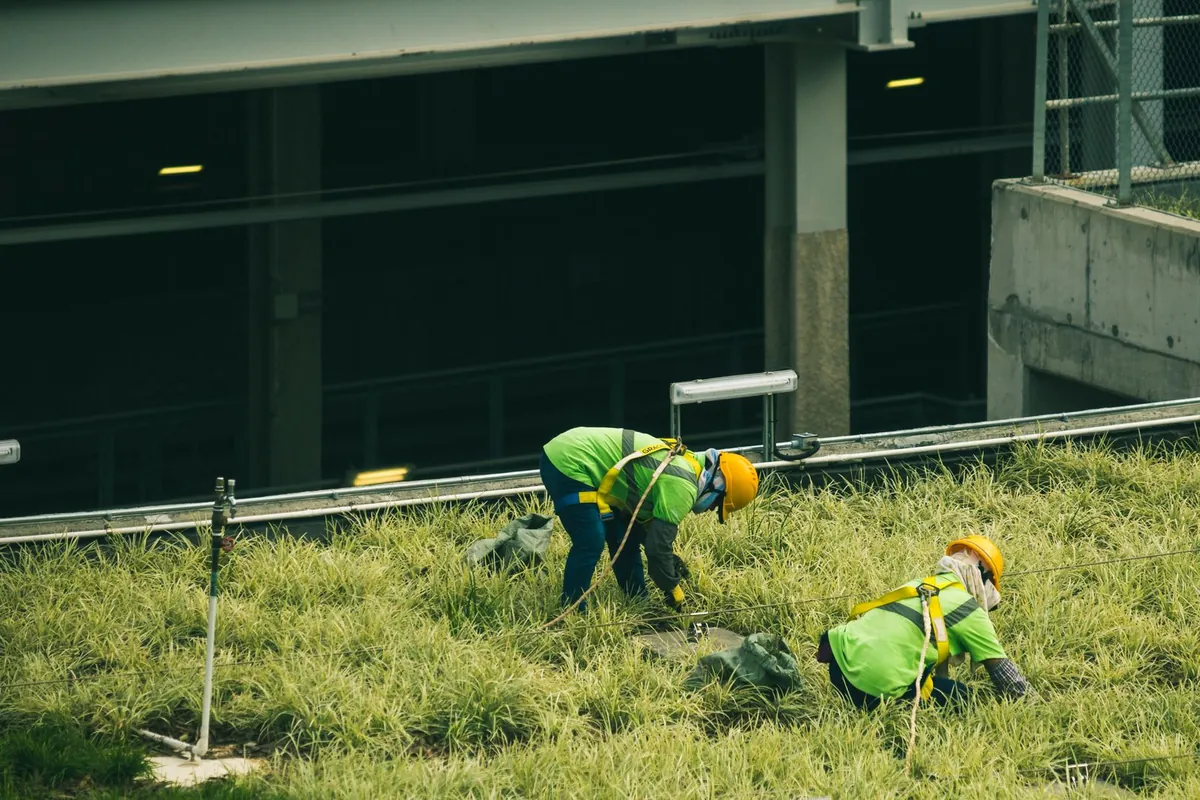
Keep seams off main sight lines and away from high-traffic zones, and align them with hardscape edges where the eye expects a break. Every strip must run the same blade direction with the pile facing the main viewing area, because pile running away lies flatter and shows more shine. Wider rolls help here too, because every seam you avoid is one less place for a shade difference to show. Scraps cannot be pieced in at random for the same reason.
Budget the seam-side trim deliberately. One side of a roll arrives smashed from rolling, so installers cut away about 5 stitches from that edge for an invisible joint. Rolls also relax for several hours after unrolling before seaming begins, so the layout is worth fixing on paper first. Ordering every roll from one production batch keeps the color matching across each seam.
One installer’s published example shows the arithmetic in practice. A 75 ft x 55 ft area takes four 15 ft x 75 ft rolls. It leaves a 5 ft x 75 ft leftover strip. If you are weighing whether a top-up will blend in, our post on will your artificial turf match if you order in two batches covers the batch question directly.
Handle Multi-Section and Irregular Areas
L-shaped and multi-zone sites are not one order; they are several rectangle orders that share a batch. Split each zone into rectangles, squares or triangles and size the strips zone by zone. Measuring only the total square footage is the mistake guides flag most, because roll widths never respect an average. An area-only figure also ignores seam positions and the direction every strip must face, so the order built from it is wrong three ways. That is the second half of answering how much artificial turf do I need on anything beyond a simple rectangle.
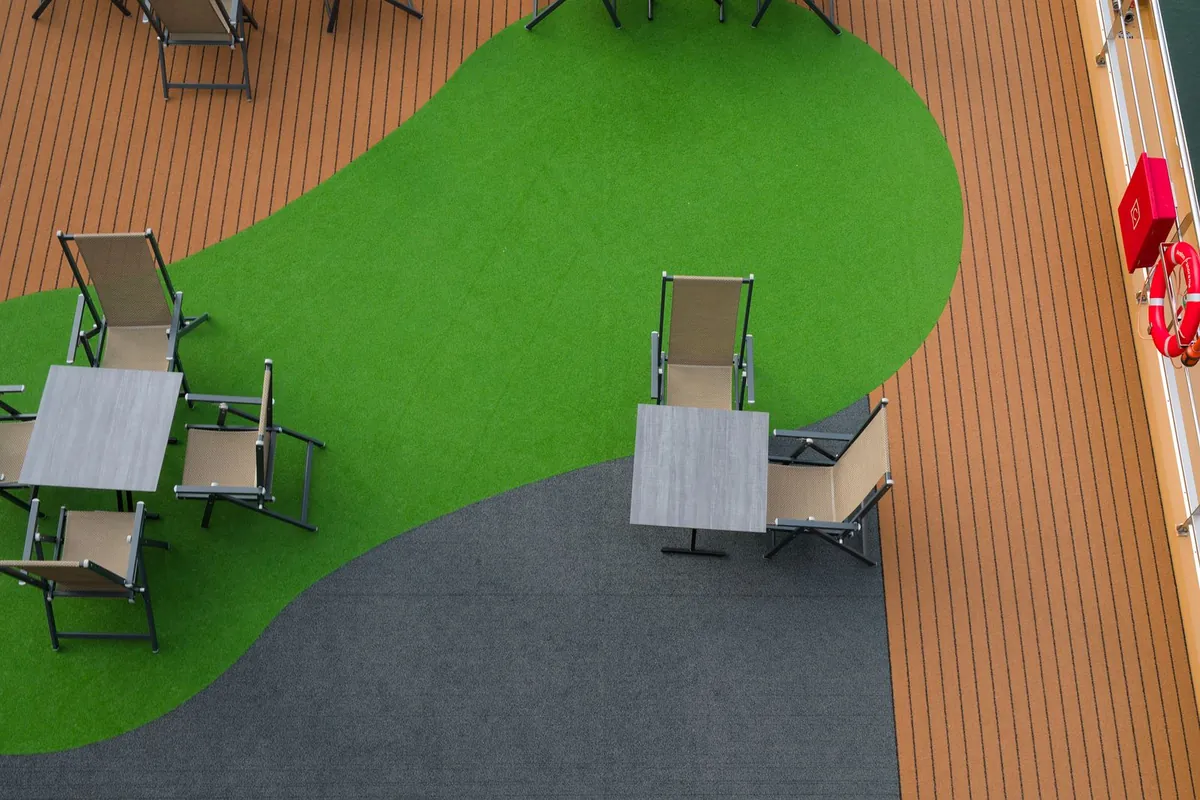
Worked examples make the pattern clear. A 15 ft x 28 ft patio takes two 16 ft x 15 ft rolls seamed together. A 22 ft x 13 ft patio takes a single 23 ft x 15 ft roll. When the area is wider than any roll on the menu, plan the join in advance, as with a 7 m x 9 m lawn. A join planned at order time lands where the drawing wants it; a join improvised on site lands where the rolls happen to end.
Harvest the offcuts before writing the final number. The corner waste from an L-shaped zone is often large enough to cover a path or a side return, which turns trim into free coverage.
On multi-zone contracts the takeoff flow is fixed: a per-zone strip list, one roll plan across all zones, a single production batch, then a supplier cutting-plan check. Write the strip list first, covering every zone, every strip and every roll length in one document. The cutting plan that comes back either confirms the layout or flags a width worth revisiting before money moves.
Decide How Much Extra Is Safe to Buy
The last decision is the buffer, and the risks are not symmetric. Order too little and the top-up comes from a different batch with a visible mismatch. Rolls come 15 ft wide and pieces must be cut to size, so a small top-up still buys a full minimum width. Order too much and the leftover is cash tied up in stock that most suppliers will not take back, since turf sales are typically final. How much artificial turf do I need, asked one final time, is the smallest number that survives every rule below.
- Round the linear length up to the next whole unit, never down.
- Keep the tiered buffer from the waste section; do not shave it to make an invoice look tidy.
- Keep every roll on one production batch.
- Plan a reuse for the leftover strip before ordering; offcuts cover paths, side returns and future repairs.
- Confirm the roll spec and layout with the supplier’s cutting plan before money moves.
- Order a 20 x 20 cm sample to confirm the product before the bulk order.
The cost of getting this wrong scales with the project, which is why the buffer and the unit price deserve a look together. Every rule in this list costs nothing to apply at order time, and each one is cheaper than a seam that shows. A deliberate buffer beats a lucky one on any contract that has to pass a second inspection. Our breakdown of artificial turf price per square foot connects the order size to what each square foot actually costs.
Frequently Asked Questions
How do I calculate the total area for artificial turf?
Measure length by width for each section, split irregular shapes into rectangles and triangles, then add the sections together. Work in one unit throughout – two zones of 1,200 and 500 square feet total 1,700 square feet.
How much extra artificial turf should I add for waste?
Industry guides put simple rectangles at 5-10% extra, layouts with curves or obstacles at 10-15%, and complex layouts at up to 15-20%. The margin covers cuts, seams, blade direction and the trimmed roll edge.
What widths do artificial grass rolls come in?
Metric-market rolls run 2, 4 and 5 m wide at 25 m long, with custom widths produced to order. US-standard rolls are 15 feet (about 4.57 m) wide, and 100 ft is a common length.
How many square feet does one roll of artificial grass cover?
A full US-format roll of 15 ft x 100 ft covers 1,500 square feet. A metric 4 m x 25 m roll covers 100 square meters – about 1,076 square feet – so check which system your supplier uses.
Should you order turf to the exact square footage?
No. Fixed roll widths mean the purchase almost always exceeds the installed area – a 13-foot-wide strip on a 15-foot roll still buys the full width. Round the linear length up and keep a modest buffer.