
A strength coach loads the sled, pushes off hard, and the runners catch on a raised seam halfway down the lane. Training stops while the crew hunts for tape, and someone asks the question that decides the project: did we install this wrong, or buy the wrong turf? In our experience, most artificial indoor turf disappointment traces back to the order form rather than the installer.
This guide sorts the decision by what the floor must do: gym sled work, indoor soccer, pet areas, putting. For each application you get the specification tendencies that matter and the checks we run before confirming an order. Prices appear as an indicative range, because honest ranges beat precise fiction. And where turf is the wrong surface for your project, we will say so plainly.
Why Indoor Specs Differ From Outdoor Turf
Outdoor turf is engineered against sun, rain and drainage before anything else. Indoor floors delete those variables from the equation, which changes what a buyer should pay for. Installers who work both sides make the same observation: indoor specifications carry no UV requirement, and pile choices split by application, gym versus pet being the obvious example.
The infill decision separates the two markets even more sharply. Outdoor fields depend on third-generation infill systems, blends of crumb rubber and sand, for cushioning and ballast. Indoors, our default recommendation is non-infill construction. Granules never get tracked into locker rooms, nothing needs topping up, and the surface vacuums like carpet. US suppliers build dedicated non-infill indoor rolls from a nylon and polyurethane blend, some with hook-and-loop strips so a training floor can move when the layout changes.
Budget discipline is the real payoff of knowing this. Every indoor dollar spent on weather features you cannot use is a dollar unavailable for the properties that decide your floor. Pile, density, backing and padding are where indoor money belongs.
Maintenance expectations change with the same logic. Outdoor systems need infill topping, dragging and drainage checks on a schedule. Indoor floors replace all of that with vacuuming, spot cleaning and an occasional deep clean, which is why facility managers usually push non-infill once they have run both.
Match the Turf to Your Application
The fastest route to a bad purchase is shopping for artificial indoor turf as one category. A sled lane, a soccer hall, a dog daycare and a putting studio share almost nothing except colour. Here are the four applications we quote most often, with the tendencies that hold across suppliers.
Gym Sled Tracks and Functional Zones
Sled work punishes the wrong pile immediately. Short and dense keeps friction predictable under runners, and face weight toward the upper range keeps fibers from tearing out under feet and equipment. Pile height works like shoe tread: sprint spikes and hiking boots are both shoes, tuned for opposite jobs. US suppliers commonly spec multipurpose gym turf around 40 ounces with a 3/4-inch pile, stepping up to 55 ounces where use runs heavier.
One safety note outranks every spec here. Turf laid over concrete for sled work must be secured properly, because a loose edge lets a sled catch mid-push and throw an athlete off balance. Adhesion, seam placement and edge fixing belong in the same conversation as pile height.
Plan the lane layout around the roll, not after it. A sled lane cut from a 4-metre roll has no transverse seam under the runners when the floor is planned first. Seams that must exist should run parallel to the direction of travel. Sketch the lanes, the racks and the walkways on the building plan before you price the order.
Indoor Soccer and Team Training
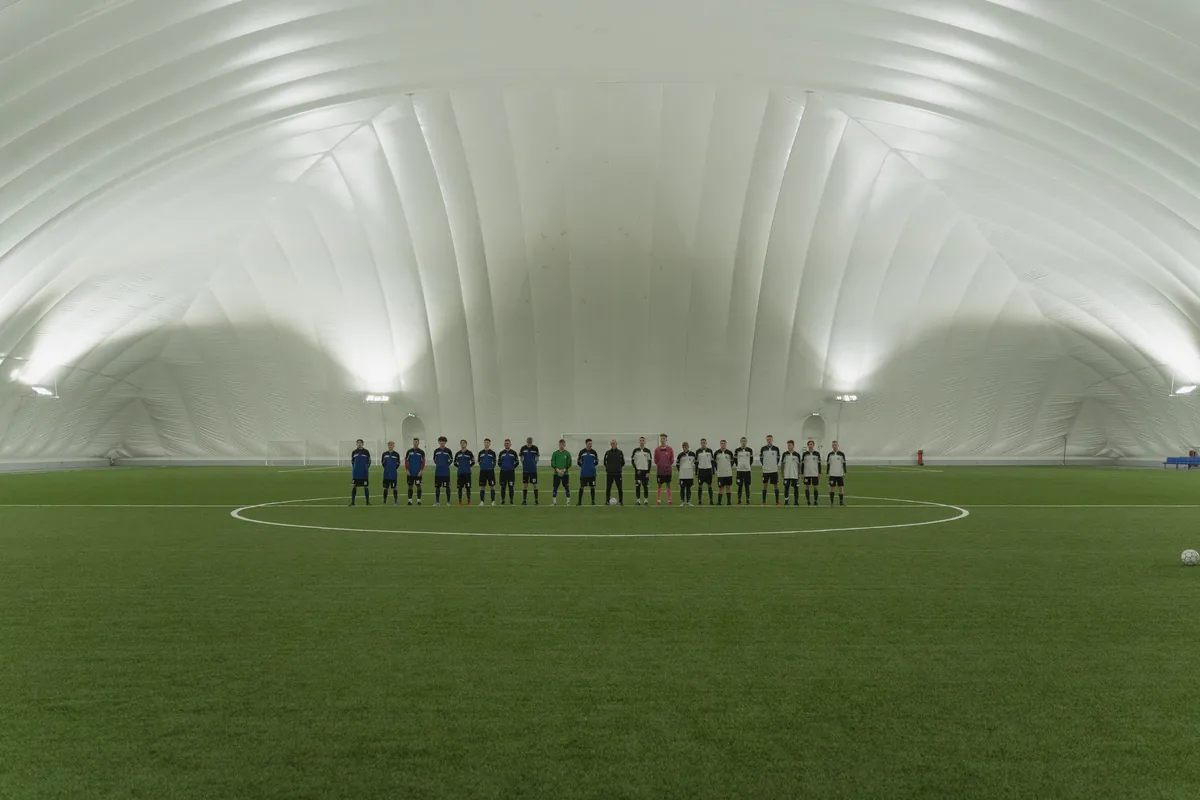
Ball behaviour drives every choice in this category. We spec a taller pile than a sled lane when the ball has to roll and settle naturally. A surface that plays fast and dead at the same time gets punished by the game within a month. For full-size floors, rolls beat tiles almost every time, because rolls cover a large space efficiently, while interlocking tiles suit sites without the equipment to move heavy stock.
For basement training rooms and small-sided setups, the same logic scales down without changing. We walk through those smaller builds in our guide to indoor soccer turf for basements and training spaces.
Sizing the system starts with the floor plan, not the catalogue. Mark the touchlines, the run-offs and the door swings first, because run-off areas decide whether one roll width covers the floor or two widths must meet mid-pitch. A mid-pitch seam is exactly where a ball changes speed, which is why roll width is a playing-quality decision, not a logistics detail.
Pet Areas and Dog Daycare Floors
Indoor pet areas live or die by cleaning, not by looks. Short, tight pile rinses and vacuums fast, and a sealed backing decides whether accidents stay on the surface or soak through. Industry buying guides list antibacterial properties among the qualities to weigh, and daycare operators should weigh them heavily. Skip the UV stabilisation charge entirely here, because sunlight never reaches this floor.
Drainage, the obsession of outdoor pet runs, becomes a cleaning question indoors. What matters instead is whether the backing tolerates your chosen cleaning chemicals, and whether seams sit away from the runs where traffic concentrates.
Indoor Putting and Golf Studios
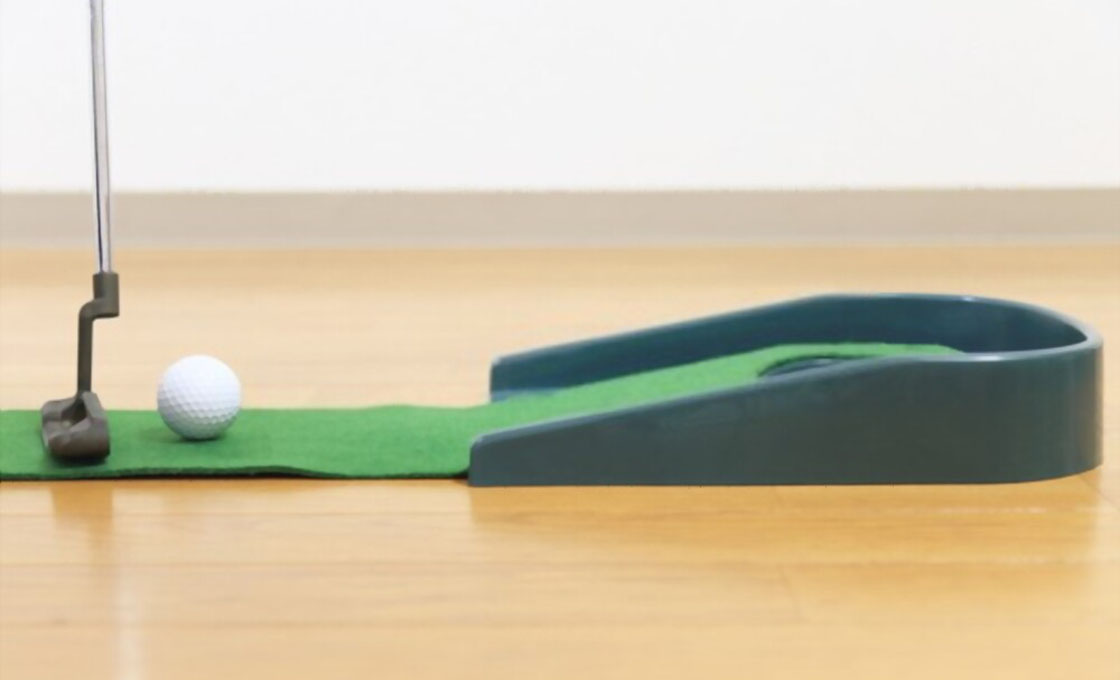
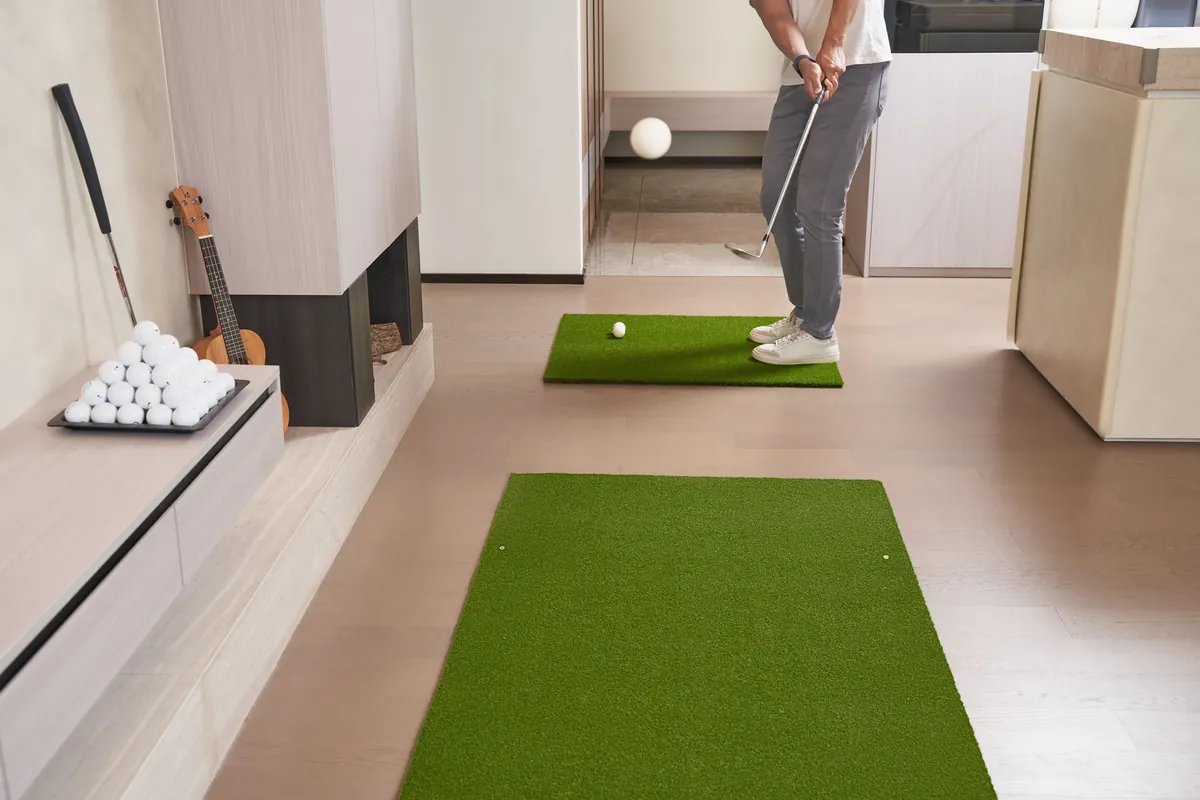
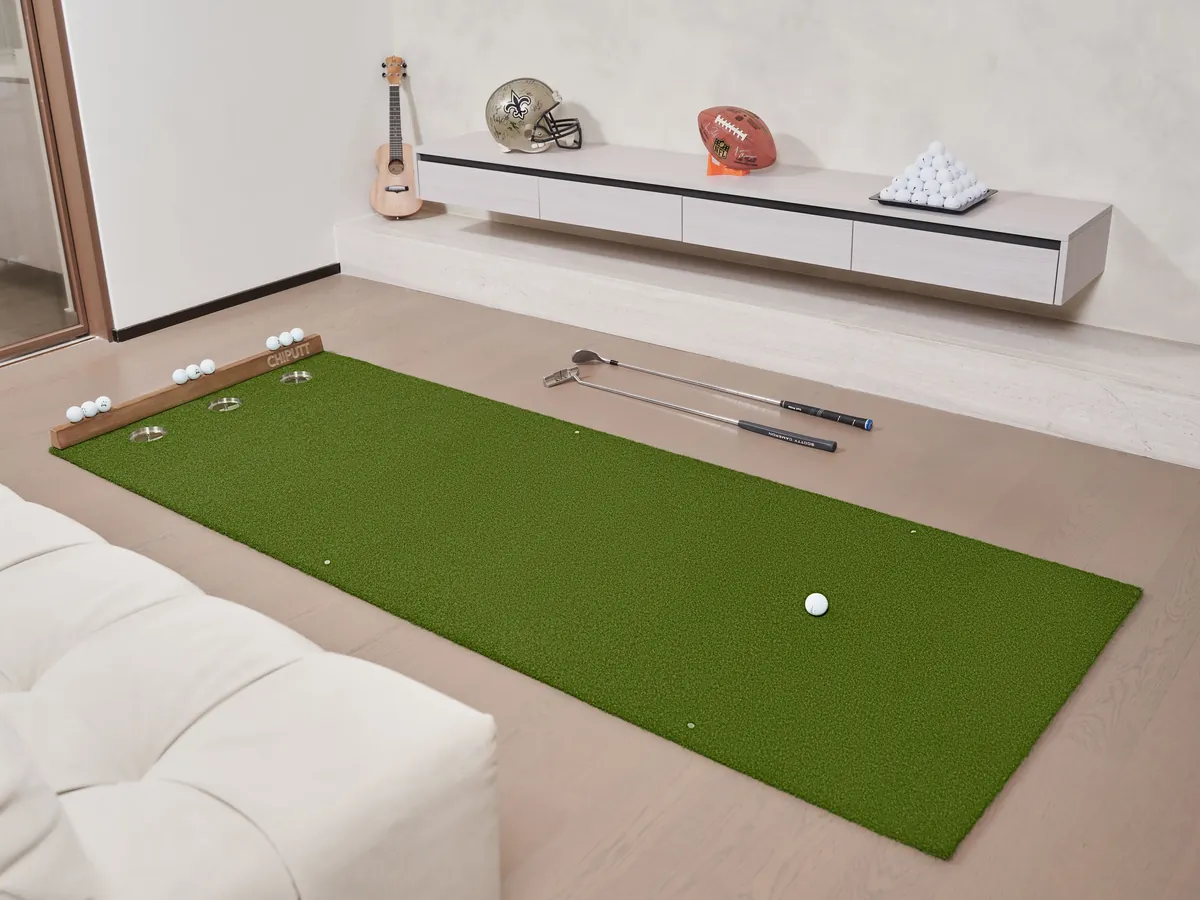
Putting is the contrarian application, because cushioning is the enemy. A putt needs a firm, dense, low pile so the ball rolls true on line and holds its speed. That is why indoor green builds feel almost hard underfoot compared with a gym floor.
Zoom in on the spec sheet rather than the product name. Face density and pile height decide the roll, while colour and marketing labels decide very little.
The table compresses the four applications into the tendencies we quote from. Read it as a starting point for a conversation with your supplier, not a substitute for one.
| Application | Pile tendency | Padding tendency | What decides it |
|---|---|---|---|
| Gym sled and functional zones | Short, dense pile, with face weight specified toward the upper range | Light pad eases floor work, stretching and dropped knees | Sled friction, fiber tear resistance and lane durability |
| Indoor soccer and team training | Taller pile where natural ball roll and settle matter | Usually none; foam slows and deadens the roll | Seam plan, roll width and ball behaviour |
| Pet areas and daycare floors | Short, tight pile that rinses and vacuums fast | Pad eases joints over hard subfloors | Backing seal, spill handling and cleaning routine |
| Putting and golf studios | Very low and very dense throughout | None; softness ruins roll consistency | Ball roll trueness and speed hold over time |
| Multipurpose floors | Mid pile as the working compromise | Thin pad where kids or group classes train | The dominant activity, not the average of all uses |
Types of Artificial Indoor Turf Surfaces
Two surface formats cover nearly every indoor project. Rolls suit big, open floors: fewer seams, faster install, and the cleanest lines for lanes and pitches. Interlocking tiles suit odd-shaped rooms, small spaces and sites without the gear to move a 25-metre roll.
Tenancy changes the calculus between the two formats. Tiles make sense for rented units, phased builds and floors that may shrink next year, because you buy only what the current layout needs. Rolls win on line integrity for permanent installations, since a pitch line crossing a stack of tile joints never looks quite straight.
Width is where factory-direct buyers can save real money. Our artificial indoor turf rolls come in 2, 4 and 5 metre widths by 25 metres long, covering roughly 50, 100 and 125 square metres respectively. The 4-metre width suits most training floors, the 5-metre width nearly eliminates seams on larger areas, and the 2-metre width fits small rooms and tight stairwells. Custom dimensions can also be produced without internal seams, which turns a seam under a sled lane from a defect into a design choice.
Backing deserves one deliberate question. PP+Net and PU are the two systems we build on, and the choice tracks moisture, so PU makes sense where washdowns, pet accidents or cleaning chemicals are a daily reality. Buyers comparing US retail specs will see 12- to 15-foot widths quoted; metric rolls map onto the same floors with a seam plan.
Padded versions exist within the same surface families, with the foam bonded to the backing at the factory. We keep that trade-off short here and cover it fully in our guide to padded, infill-free options.
What Artificial Indoor Turf Costs
Material pricing for artificial indoor turf runs $7-60 per square meter across the market, depending on padding, grade and type. Treat that band as indicative and request an exact quote against your written specification. What moves you inside the band is predictable: padding adds cost, face weight and density define grade, and non-infill construction prices differently from infill-ready stock.
Roll arithmetic matters as much as unit price. A floor built from three 4-metre rolls, about 100 square meters each, installs with a fraction of the seams of the same floor in 2-metre stock. Fewer seams mean fewer hours, fewer failure points, and a cleaner line down a sled lane or pitch.
For facility-scale and landscape-adjacent projects, the same band applies across our commercial artificial grass range, quoted factory-direct. Compare total installed cost rather than the roll price alone, because seams, adhesive and installation hours move the number as much as the grade does.
Where does quality actually show up in a quote? In yarn quality, tufting density and backing weight, none of which photograph well. Ask each supplier to state all three on the specification sheet, then compare sheet against sheet rather than photo against photo.
Order Turf You Have Already Felt
Specification sheets cannot tell you how a surface behaves under a sled, a cleat or a paw. Request free 20 x 20 cm samples of your shortlisted specifications and test them on your own floor before you commit.
Your Pre-Purchase Indoor Turf Checklist
Samples come first, and they are free. Standard swatches run 20 x 20 cm, usually three to four specifications per request, with the customer covering freight. DHL or FedEx delivers in 4 to 6 days, or 7 to 9 days to remote destinations, and custom sample production adds 10 to 15 days. Build those numbers into the project schedule from the start rather than discovering them in week six.
Second, pin down the backing. Ask which system suits your moisture and cleaning regime, and get the answer in writing on the specification sheet. A pet facility and a putting studio should not leave this conversation with the same line item.
Third, close the compliance loop before production, not after delivery. Indoor installations typically need documentation, so ask the factory for the fire-test paperwork covering your exact pile-and-backing combination. Clear the specification with whoever signs off your building, and walk wall-adjacent runs, such as sled lanes along mirrors or turf butting fixed equipment, with your installer. Nobody enjoys renegotiating a finished floor after it is down.
Fourth, agree the delivery term in writing. Quotes differ on whether the seller covers export clearance and ocean freight to your port or hands over at origin, and the difference lands in your landed cost. Importers who compare quotes across suppliers without normalising this term are comparing two different prices.
Fifth, test samples where the floor will live, not on a desk. Roll the swatch onto your actual subfloor, walk it in your training shoes, and run your sled, ball or mop over it. The sample that felt perfect in a warm office often feels thin over raw concrete. That realisation costs nothing on day one and a fortune after delivery.
Common Buying Mistakes We See Importers Make
The first mistake is buying the photograph. Choosing artificial indoor turf from a lifestyle image is like choosing running shoes by colour alone, because the photo cannot show pile behaviour, backing quality or seam discipline. Judge samples on your floor, not pixels on ours.
The second mistake is skipping the sample stage to save a week. A week of schedule pressure is cheaper than a floor that plays wrong for years. The third is ignoring roll width until the installer arrives, then paying for extra seams and hours that a wider roll would have removed.
The fourth is ordering outdoor-grade stock for an indoor job. You pay a UV stabilisation premium for sunlight that will never hit the floor, and you often inherit an infill requirement your maintenance crew does not want. That is a mistake twice over, and it is entirely avoidable once the indoor logic from the first section reaches the purchase order.
A fifth mistake shows up later in the project: customisation asked too late. Yarn colours, pile density, roll dimensions and even logo panels are all configurable at the factory, but only while the order is still a plan. Bring your marking and branding requirements to the first conversation, not the last email.
Frequently Asked Questions
Can you install indoor turf over concrete?
Yes, and concrete is the normal subfloor indoors. Secure the turf properly for sled use, because a loose edge can catch a sled mid-push. Padding bonded to the backing makes basement floors friendlier underfoot.
Does indoor turf need infill?
Usually no. Indoor facilities mostly choose non-infill rolls for easier cleaning and no granule tracking. Infilled systems still earn their place on full-size indoor pitches where ball behaviour must match an outdoor field.
How much does artificial indoor turf cost?
Material pricing runs roughly $7-60 per square meter depending on padding, grade and type. Treat the band as indicative, and request an exact quote against your written specification before budgeting.
What samples should I request before ordering?
Request free 20 x 20 cm swatches of every shortlisted specification, typically three to four pieces. They ship by DHL or FedEx in 4 to 6 days, so test them in the real space.
How long does indoor turf last?
In commercial use, well-chosen indoor turf can last up to 10-15 years. Traffic patterns, sled use and cleaning discipline decide where you land inside that range.
 English
  Arabic
  French
  German
  Portuguese
  Russian
  Spanish