

A trainer rolls the sled to the far end of an outdoor lane and stops. The colour is still green. The two middle metres have gone pale, though, and the sunward edge has lifted a centimetre off the kerb.
Nothing here is a turf failure in the ordinary sense. Every symptom traces back to exposure. Sunlight, water, frost and wind are acting on a surface that was specified as though it lived indoors. Knowing how to choose the right gym turf for an outdoor workout is mostly about treating those four forces as the primary specification, with pile height decided afterwards. Our team has surveyed enough outdoor sites to see the same sequence repeat, so the checks below follow the order in which outdoor systems actually fail.
Why Outdoor Turf Faces Different Conditions
Any artificial turf installation indoors answers to members, equipment and a cleaning rota. Outdoors it also answers to a climate. The same roll that survives three years of indoor sled work can look tired after one summer of sun and one winter of frost.
The mechanism is not mysterious. Sunlight attacks the polymer chain, water decides whether the zone is usable after rain, frost decides whether the base stays flat, and wind decides whether the edges stay down. Each one carries its own specification and acceptance check.
Our line runs eight in-line steps, from compounding through tufting to rolling up. We watch each step on the bench because it exists to hold a surface together through exactly these pressures. That is also how we learned to ask how to choose the right gym turf for an outdoor workout before quoting a roll.
Indoor and outdoor carpet are built to different rules. The differences between indoor and outdoor systems are worth reading before a spec is finalised. Outdoors the fibre has to carry UV stabilisation. The backing has to pass water. The fixing has to resist a lifting force that no indoor slab applies.
Sunlight and UV Decide Colour and Strength
Ultraviolet light is absorbed by the polyethylene in the fibre. That absorbed energy breaks bonds between the long molecules. The result is cracking at the surface and a shift in colour.
Manufacturers add UV stabilisers to slow the reaction. The stabilisers delay the process rather than cancel it. Their usefulness depends on which band of ultraviolet dominates the site. That band decides whether the surface holds its colour or greys out early. For a buyer asking how to choose the right gym turf for an outdoor workout, it is the first filter to apply.
The practical problem is verification. Laboratory weathering equipment compresses years of sunlight into weeks. Correlating accelerated results with natural exposure is difficult to achieve, which is why a lab rating alone cannot settle an outdoor choice. Field exposure and spectral colour measurement sit alongside accelerated testing in serious durability assessment. Artificial grass for sport and landscape has been built this way for decades, with tufted fibres locked into a coated backing.

Fading shows up first on the sunward side of a zone, not evenly across it. That asymmetry is the tell. When a sample square is left on site for a season and photographed monthly, the colour drift becomes visible long before the fibres lose height. A surface that yellows early also tends to shed yarn sooner. The same bond breakage that shifts colour weakens the filament.
The quality signals that matter for outdoor life are read on the spec sheet and confirmed on the sample. The technical factors behind turf quality, from yarn material to face weight, feed directly into how quickly a surface fades. Beyond colour, pigment choice has a thermal consequence, which matters for the next sections.
Drainage and Grading Keep the Zone Usable
In any artificial turf installation, water leaves an outdoor zone through a chain, not through a single layer. Backing perforation is the first gate, infill depth and type is the second, and the aggregate base with its fall is the third. A fast backing sitting on a tight base still drains slowly, because the last gate decides the rate.
This step is skipped most often. It matters when you learn how to choose the right gym turf for an outdoor workout, because the carpet is the visible purchase and the base is not.
Grading guidance is specific enough to write into a brief. Sports surfaces are typically built to a drainage slope of 1 to 2 percent, while landscaped areas use 0.5 to 1 percent. An auxiliary crushed-stone drainage layer of roughly 5 to 10 cm sits beneath the carpet.
Even over a hard base the surface still needs the same 1 to 2 percent fall away from structures. A permeable layer beneath lets water filter through rather than pooling underneath.
| Element | Outdoor guidance | What it controls |
|---|---|---|
| Surface fall | 1 to 2 percent on sports surfaces | How fast water reaches the outlet |
| Landscape fall | 0.5 to 1 percent | Drainage on lower-traffic green areas |
| Auxiliary drainage layer | Crushed stone, approximately 5 to 10 cm | Storage and lateral movement below the carpet |
| Backing perforation | Fully perforated backing required outdoors | Water entry through the carpet itself |
| Drainage outlet | Channel drain at the low edge or perimeter | Where water finally leaves the zone |
Rain is not the only delivery route. Irrigation overspray, hose rinses and heavy dew all add water, and every one of them has to find the outlet. Roll width affects how much of that water has to cross a seam.
Standard roll widths and lengths of 2 m, 4 m and 5 m by 25 m decide how many joints the zone carries. Fewer joints means fewer places for water to stall and for the base to move.
Freeze and Thaw Move the Base Beneath
An artificial turf installation in a cold climate moves twice a year. Cold itself changes the fibres, but gently. As temperature drops, molecular mobility in the polymer falls and the surface feels firmer. What cold does not do is freeze like water, because there is no water inside the filament to turn to ice.
The damage comes from below instead. Water that reaches the base can freeze, expand, and then thaw, and repeating that cycle moves things. Base movement, localised heaving, surface deformation, stress along seams and lifting at edges all follow, along with a drainage path that slowly stops working.
A crushed-stone base behaves very differently from clay soil here. It sheds water rather than absorbing it, and it does not swell when the residue freezes.
A cold-climate build therefore rests on three habits. The subgrade is compacted with a fall, several inches of graded aggregate go down in controlled passes, and the voids between particles let meltwater travel. A properly built drainage base handles this without special materials, and where the base is wrong no carpet thickness rescues it.
Winter handling matters as much as winter construction. Long snowpack in a shaded corner presses fibres down for weeks. Those patches look flatter than the rest once the thaw arrives. That is a mechanical effect of weight on frozen infill, not a failure. A stiff broom pass after the surface dries lifts the blades back and redistributes the infill.
What genuinely harms the surface is tool choice. Metal edges, picks, ice chisels and scrapers catch tufts and open seams. Sand or kitty litter used for traction contaminates infill and clogs the drainage path. Snow that melts and drains on its own is the easiest case by a wide margin.
Surface Temperature Sets Your Training Clock
An outdoor artificial turf installation gains a second clock that indoor floors do not have. It is the temperature of the surface under the athlete’s hands and feet. Artificial turf does not transpire, so it absorbs and holds solar energy instead of shedding it through evaporation. Natural grass, working through evapotranspiration, commonly sits roughly 20 to 40 F cooler than synthetic turf. It is the single biggest reason how to choose the right gym turf for an outdoor workout has to start with the site.
The numbers are wide enough to plan around. On a 100 F day the surface can reach 150 F to 170 F, against roughly 100 F to 110 F for natural grass nearby. Comparative measurements put synthetic surfaces about 41 to 59 F above air temperature depending on the month. A June 2025 case study recorded about 130 F against about 84 F on the grass next door. For context, 140 F is hot enough to burn skin in under a minute.
| Condition | Indicative surface temperature | Practical response |
|---|---|---|
| Full sun, modern system with cooling infill | About 15 to 30 F above air | Normal scheduling with shade nearby |
| Full sun, darker or legacy infill | About 30 to 60 F above air | Shift heavy sessions to mornings or evenings |
| Comparative measurement range | About 41 to 59 F above air | Treat midday as a restricted window in summer |
| Natural grass, same conditions | Roughly 20 to 40 F cooler than synthetic | The reference point on the same site |
| Terrain after a 30 to 60 second rinse | Drops 10 to 30 F, fades in about 15 to 20 minutes | A warm-up tool, not a session-long fix |
Rinsing is widely misread. A 30 to 60 second hose-down drops surface temperature by 10 to 30 F. The relief fades within about 15 to 20 minutes in the sun. The humidity that follows can feel worse than the dry heat it replaced. Facility guidance therefore leans on scheduling away from peak midday hours and on shade structures at the sidelines rather than on water.
Material choices shift the peak as well. Lighter yarn palettes reflect more solar energy than dark saturated greens, and infill colour and type influence heat gain at the base of the pile. Built surfaces in general absorb and re-radiate solar energy, which is the same mechanism behind urban surface heat.
The cheapest on-site check is also the most direct. Press a palm to the surface for five seconds. If it is uncomfortable, it is unsuitable for barefoot work at that hour.
Wind Load and Edge Fixing Hold It Down
An artificial turf installation is held down at its perimeter and nowhere else. Wind is the exposure factor that buyers notice last and regret most. An open field and a rooftop terrace both present a lifting force along edges and corners. A carpet that merely rests on a base will lift at the first sustained gust. Careful reading about how to choose the right gym turf for an outdoor workout helps little once an edge is up.
Perimeter fixing carries most of that load. The common specification is galvanised spikes of about 5 to 6 inches driven 3 to 4 inches apart along all edges. Internal fixing is staggered every 12 to 18 inches so the surface cannot shift or ripple as it expands. Perimeter-only fixing is inadequate on exposed sites. Spot gluing through the body of the surface is recommended outdoors so the carpet does not buckle or wrinkle in sunlight.

Thermal movement compounds the wind problem. The carpet expands in summer heat and contracts again in winter. Leaving no allowance against a fixed border guarantees a ripple at the hottest point of the year. A quarter-inch expansion gap against hard borders absorbs that movement instead of converting it into a wave.
Wide rolls reduce the number of joints that wind can work on, since every seam is a potential starting point for a lift. Fixing detail belongs in the installation scope, not in a post-completion punch list. Retrofitting anchors under a finished zone is disruptive work.
Sled Work and Equipment Wear One Line
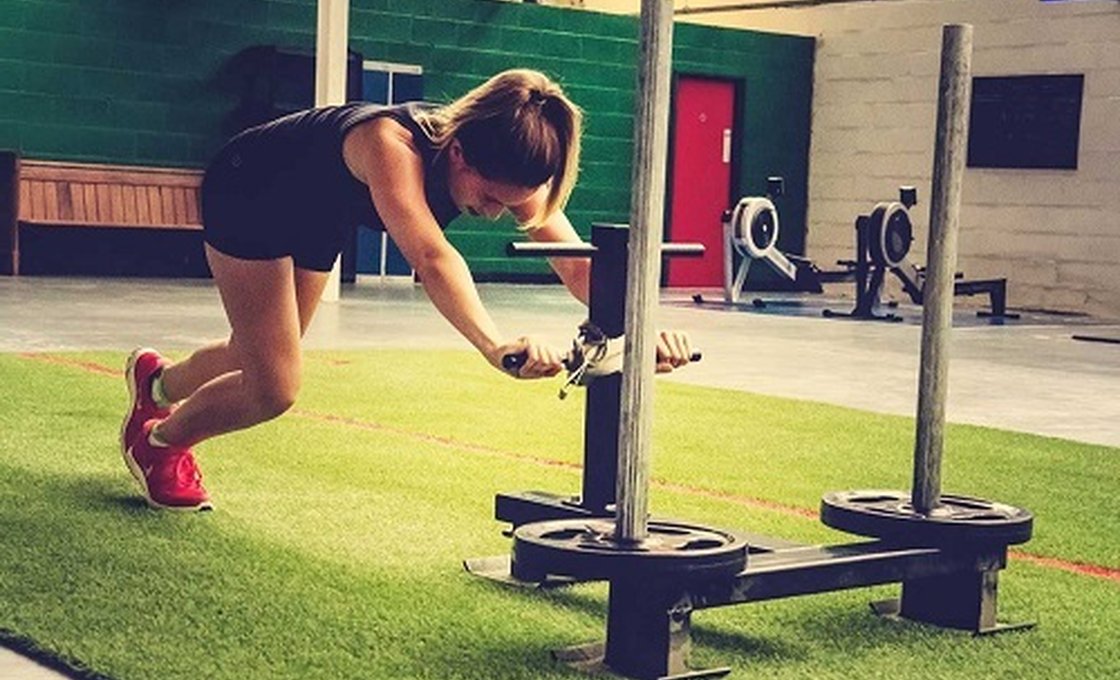
Indoor gym traffic spreads across a floor. Outdoor training traffic does not. This is where how to choose the right gym turf for an outdoor workout differs from an indoor brief. A sled lane, a tyre-flip strip and a training track all wear along a fixed line. That line becomes the first part of the system to fail.
Friction is what drives it. A loaded sled pushed hard generates heat at the contact point, and the fibre has to absorb that heat without deforming. Nylon handles this best, with a melting point of approximately 220 to 268 degrees Celsius, and its molecular structure gives fibres the memory to stand back up after being crushed.
Polypropylene behaves the opposite way. It is brittle, and once bent it tends to stay bent. A pure PP surface in a busy lane flattens within months rather than years.

Density matters as much as fibre here. A compact, dense surface lets the sled runners glide predictably, while a high pile or a spongy feel makes the drag uneven and the training feedback useless. Indoor zones use short dense carpet for the same reason, and outdoor lanes should follow that logic with added UV protection.
Colour belongs in the same decision. Brightly saturated greens fade fastest under direct sun and show wear sooner, so the busiest lane is the worst place for a fashion colour.
The fibre zone map is short and specific. Below 20 mm supports sled pushing and tyre flipping with a solid base underfoot. Between 25 and 30 mm gives a softer touch that suits barefoot stretching and group class areas. Choosing one height for every activity is how a zone ends up wrong at both ends.
Debris and Cleaning Follow the Season
Cleaning an outdoor zone runs on a different calendar from cleaning an indoor one. Indoors the driver is how many members used the floor. Outdoors it is what the surrounding vegetation and weather delivered this week.
Leaves and debris have to come off rather than settle. Organic matter that stays on the surface breaks down in place and works into the pile. Blowing or raking keeps the surface clear. A rinse with mild soap handles most marks where a petroleum-based solvent would damage the fibres. Pet waste and food spills need immediate attention rather than a weekly slot.
The maintenance work that specifically protects drainage happens before a storm, not after it. Perimeter drains, channel grates and weep holes are kept clear in advance, so meltwater and heavy rain have somewhere to go. Areas that sit in shade hold moisture and ice longer, so they deserve a place on the inspection route.
Snow management belongs in the same routine. Light snow that melts and drains away needs nothing. Where a path must be cleared, brooming off heavy layers reduces compaction and refreeze. Only plastic tools belong near the surface. The full behaviour of a routine for outdoor cleaning sits in the surface’s own care guidance.
Fighting Faded, Rippled Outdoor Turf?
Sun-bleached lanes and lifted edges shorten a zone’s working life. We build outdoor training rolls to your UV, drainage and load brief, typically 30–50% below market on like-for-like specifications.
Year-Round Use Across Four Seasons
Four-season usability is not a property of the carpet. It is the sum of how well each exposure was answered. How to choose the right gym turf for an outdoor workout is therefore a question about exposure, not about colour.
Spring tests the base. Meltwater from winter arrives all at once and the fall has to carry it away. Summer tests the schedule and the palette, because surface heat narrows the usable hours and light colours widen them. Autumn tests the cleaning routine, because leaf fall is the heaviest debris load of the year. Winter tests the fixing and the base, because frost heave and wind work together against edges and seams.
| Season | Main pressure on the system | Check that pays for itself |
|---|---|---|
| Spring | Meltwater arriving faster than the base drains | Walk the low points after the first heavy thaw |
| Summer | Surface heat narrowing usable training hours | Log midday surface temperature for a week |
| Autumn | Leaf fall and debris loading the surface | Clear drains and grates before the storm season |
| Winter | Frost heave plus wind load on edges and seams | Inspect edges and seams after the first deep freeze |
The value of that table is that it converts a vague worry about weather into four dated tasks. A zone that passes all four checks in its first year has had its specification stress-tested by real conditions rather than by a datasheet.
Four Mistakes Outdoor Buyers Keep Making
Most artificial turf installation disappointments outdoors trace back to one of four decisions made early, before anyone thought about weather.
Buying Indoor Specifications for an Outdoor Zone
An indoor carpet chosen on pile height and density alone arrives outdoors without the two things that matter most there. UV-stabilised fibre and a perforated backing that passes water are both missing. The specification looks complete on the quote and incomplete on site after one summer and one wet winter. The fix costs nothing at the briefing stage, because it only means naming the exposure conditions in the enquiry.
Judging the Carpet Without Judging the Base
Buyers spend time comparing yarn and almost none comparing aggregate, fall and outlet. Yet drainage, frost heave and long-term flatness are all base behaviours. A 1 to 2 percent fall and a properly graded base of several inches decide whether the zone is usable the morning after rain. No carpet choice compensates for their absence.
Choosing a Saturated Colour for the Busiest Lane
Bright saturated greens photograph well and fade first. On a sled lane that also receives direct sun, the colour shift is visible within a season. It reads to members as wear, even where the fibre itself is sound. Lighter palettes reflect more solar energy and hold their appearance longer. The heaviest-traffic routes are where that choice pays most.
Treating Fixing as a Finishing Detail
Perimeter fixing gets treated as the last line of a scope, after the carpet and the base. On an exposed site it is a primary structure. Edge anchors go in at 3 to 4 inch centres, internal fixing is staggered across the surface, and spot gluing runs through the body. A quarter-inch gap is left at hard borders. Left to the end, these details are the ones that get dropped, and a lifted edge is the visible result.
Outdoor Specification Checklist Before You Commit
Five items turn an artificial turf installation brief from a wish list into something a supplier can quote accurately and a site can be measured against.
Read them in order. Together they cover how to choose the right gym turf for an outdoor workout from the exposure data through to the sample square on the ground.
Write the Exposure Conditions Into the Artificial Turf Installation Brief
State the daily hours of direct sun, the annual rainfall pattern, the lowest winter temperature the site sees, and whether the location is exposed to sustained wind. These four lines let a supplier read the brief the way the site will read it. They are the same four lines that decide UV grade, drainage design and fixing method.
Fix Fibre and Backing on the Written Specification
Yarn material, UV stabilisation, pile height, density and backing type belong on paper before any price comparison. Outdoor zones also need the backing’s perforation pattern stated, because that is the first drainage gate. Where a supplier cannot state these on the record, the comparison is not yet possible.
Set Acceptance Criteria for Base, Fall and Outlet
Decide in advance what will be measured and what counts as a pass. That means the finished fall across the zone, the aggregate type and compacted depth, and where water leaves the site. Writing these down before work starts removes the argument that otherwise happens in the first wet week. Where the zone is custom-built, the requirements behind custom pile height, density and colour should be paired with them.
Put Fixing and Expansion Allowance in the Scope
Edge anchor spacing, internal fixing pattern, and the allowance left at fixed borders are installation requirements rather than options. On an exposed site, add spot gluing through the body of the surface. Specifying them keeps the responsibility with the party doing the work and puts a number on what “securely fixed” means.
Compare Samples Under Real Sunlight
A colour card viewed indoors tells you very little about how a fibre will read outdoors after a season. Requesting sample squares and leaving them on the actual site for a few weeks shows pigment drift, heat feel and foot feel together. A 20 cm by 20 cm square costs nothing and prevents the most expensive kind of surprise.
Frequently Asked Questions
Can gym turf stay outdoors all year?
Yes, when three things hold together. UV-stabilised fibre slows sunlight degradation, a drainage base carries meltwater away, and edge fixing resists wind. A gap in any one of them, not the carpet itself, sets the real service life.
What pile height suits an outdoor training zone?
Match it to the main movement. Below 20 mm gives the solid, predictable base that sled pushing and tyre work need. Between 25 and 30 mm feels softer underfoot for barefoot stretching and group classes.
Does outdoor gym turf need infill?
Not always, though infill helps. It adds ballast against wind, supports the fibres underfoot and shields the backing from direct sunlight. Drained outdoor zones usually benefit from some, matched to the drainage design.
How do I keep outdoor turf cooler in summer?
Scheduling and shade work better than water. A 30 to 60 second rinse drops the surface 10 to 30 F but fades within about 15 to 20 minutes. Mornings, evenings and shade structures hold the gain.
How does water leave an outdoor workout area?
Through the whole build, not one layer. Backing perforation lets water in. A crushed-stone layer of roughly 5 to 10 cm and a fall of 1 to 2 percent then carry it to a channel drain at the low edge.
Will frost damage outdoor artificial grass?
The fibres stiffen in cold but do not freeze like water. Frost heave attacks the layers below instead. The defence is a compacted base of graded aggregate that drains, plus fixing that holds edges through freeze-thaw cycles.


 English
  Arabic
  French
  German
  Portuguese
  Russian
  Spanish