








A surveyor sets one back line first, finds its midpoint, and runs a perpendicular across the full 55.00 metres. Every other line, every arc and every corner squares back to those two references. Start from a touchline that happens to be already marked on site and a pitch finishes out of square by a metre at one corner.
Our guide to hockey turf is built on that order of work. It treats dimensions as a checking exercise rather than a drawing detail. We tuft grass rolls on our own line. That is why we read layouts the way a scheduler reads them: field of play, run-off, markings, goals, orientation, surface type, then roll and seam positions. Every number below carries a published source.
Field of Play and Its Two Boundary Edges
A hockey pitch is rectangular. The two longer edges are the side lines. The two shorter edges are the back lines, and the middle section of each back line between the goalposts is the goal line. The side line measures 91.40 m and the back line measures 55.00 m, which gives a field of play of 5,027 m2 before any run-off is added.
Two conventions decide whether your measurements agree with everyone else’s. First, every dimension is taken to the outside edge of the perimeter lines, because a line belongs to the area it encloses. A ball on the side line is still in play, and a ball on the circle line is still inside the circle.
Second, all line markings are 75 mm wide. That single figure is why a paint estimate works from centre paths while a layout drawing works from the outside rectangle. A check that mixes the two drifts by half a line width at every edge. Any guide to hockey turf has to state the reference before it quotes a number. The published rules behind these figures are set out in the reference description of the hockey pitch and its markings.
These are the numbers that carry through to every later decision, including roll width. Our hockey turf systems for club and school pitches are specified against a field of play that has already been fixed on paper. It is the same order most artificial turf installations follow once a client arrives with a drawing rather than a wish.
| Measurement | Value | What it bounds |
|---|---|---|
| Side line length | 91.40 m | The long perimeter edge |
| Back line length | 55.00 m | The short perimeter edge, with the goal line at its centre |
| Field of play area | 5,027 m2 | Playing surface only, before any run-off |
| Line width | 75 mm | Every painted line on the field |
| Reference point | Outside edges | Dimensions are taken to the outer edge of each line |
Run-Off in Two Layers Not One
Run-off is where most facility plans come unstuck, and the reason is that the rules ask for two things at once. The playing surface must continue past the lines by a set distance. Beyond that surface there must be unobstructed clear space. A fence placed two metres behind the back line satisfies neither requirement on its own.
Read as a single figure, run-off is ambiguous. Read as two layers, it is simple arithmetic. Behind each back line the surface extends at least 2.00 m, with 1.00 m of clear space beyond it, for a minimum total of 3.00 m. The recommended figures are wider: 3.00 m of surface plus 2.00 m of clearance, giving 5.00 m in total. Across artificial turf installations of every size, this is the pair of numbers that gets collapsed into one.

The side lines follow the same logic at smaller distances. Outside each side line the surface extends at least 1.00 m and the clear space beyond it brings the minimum total to 2.00 m; the recommended total is 3.00 m. Note what these figures are measured from: the outer edge of the side line, not its centre.
Treat run-off as a planning constraint rather than a detail, because it governs the land you need to buy or fence, not the playing rectangle. Most artificial turf installations on school and club sites fail here rather than at the turf itself. A site that fits 91.40 m by 55.00 m but cannot carry both layers around it will not host the competition it was designed for.
| Run-off location | Surface band | Clear space | Minimum total | Recommended total |
|---|---|---|---|---|
| Behind each back line | 2.00 m minimum, 3.00 m recommended | 1.00 m minimum, 2.00 m recommended | 3.00 m | 5.00 m |
| Outside each side line | 1.00 m minimum, 2.00 m recommended | Counted within the total | 2.00 m | 3.00 m |
Clear space need not be playing surface, which is why the two layers can be finished differently. Many pitches use a contrasting colour across the run-off so that players read the boundary early, a treatment the rules permit on the run-off portion of the surface.
Twenty-Three Metre Lines and the Shooting Circles
Beyond the perimeter, four groups of markings do the tactical work: the half-way line, the two 23-metre lines, the two shooting circles and the penalty spots. The 23-metre line in each half sits 22.90 m from its back line, measured between the furthest edges of the two lines rather than centre to centre.
That distinction sounds pedantic until someone paints it wrong. Measure centre to centre and the painted band sits astride the 22.90 m mark instead of inside it, which shifts every restart position in that half by 75 mm. The same outside-edge convention applies wherever a dimension is quoted on artificial turf installations, and any guide to hockey turf that skips it will disagree with the rules.
The circle is the marking players actually feel. It is not a true semicircle: the shape is a 3.66 m straight line parallel to the goal line, joined at both ends to two 14.63 m quadrant arcs. Those arcs are quarter-circles centred on the inside front corner of each goalpost, which is exactly why the circle has a straight section at all.
Set the penalty spot last. Its centre lies 6.475 m from the outside of the goal line, and the same point is quoted as 6.40 m from the inner edge. Both figures are right for their own reference; mixing them puts the spot 75 mm too deep. The spot itself is 150 mm in diameter.
| Marking | Dimension | Measured from |
|---|---|---|
| 23-metre line | 22.90 m | Furthest edge of the line to furthest edge of the back line |
| Circle straight section | 3.66 m | Parallel to the goal line, matching the goal mouth |
| Circle arc radius | 14.63 m | Inside front corner of each goalpost |
| Penalty spot centre | 6.475 m | Outside edge of the goal line |
| Penalty spot diameter | 150 mm | Centre of the spot |
Goals Position Mouth and Board Heights
Goal geometry is not a separate supply question; it decides the layout. The circle arcs are struck from the inside front corners of the posts. That means the position of the goal along the goal line fixes the span of the circle straight section. Move the goal and the circle moves with it.
The mouth itself is 3.66 m clear between the inner edges of the posts, and the lower edge of the crossbar sits 2.14 m above the ground. Posts and crossbar are rectangular in section, 50 mm wide and 50 to 75 mm deep, and both must be white.

Behind the mouth, depth is specified at two levels: the goal must be at least 1.20 m deep at ground level and at least 0.90 m deep at crossbar level. The goal area at ground level is closed off by a backboard and two sideboards, each 460 mm high.
The backboard spans the full 3.66 m width, and the sideboards run back from the posts. Together with the net, they give the surface a defined pocket that the ball either stays in or leaves. That pocket has to sit on the finished level of the field of play, so its footprint belongs in the setting-out drawing rather than in a later fitting visit.
Level of Play Decides the Total Footprint
Competition and training pitches are not two different rectangles. The field of play stays 91.40 m by 55.00 m in both cases. What changes is the margin wrapped around it, and how much of that margin must be finished surface.
On a competition layout the run-off is layered. A two-metre inner band and a one-metre outer band run along the sides, with a wider arrangement at the ends and an operational margin outside that. The resulting total footprint reaches about 101.40 m by 61.0 m. A training layout trims the same structure back to roughly 97.40 m by 59.0 m.
That gap is roughly four metres on each axis, and it is the number a school or a club actually spends. Buy land for the training footprint and you get a pitch that trains well but cannot host a sanctioned fixture. Buy for the competition footprint on a site that will never host one, and you have fenced ground you did not need. Most artificial turf installations answer that question with a fixture list rather than a brochure, which is the trade every guide to hockey turf ends up teaching.
| Aspect | Competition layout | Training layout |
|---|---|---|
| Field of play | 91.40 m by 55.00 m | 91.40 m by 55.00 m |
| Inner run-off | 2.0 m by 1.0 m | 2.0 m by 1.0 m |
| Outer run-off | 1.0 m by 1.0 m | 1.0 m by 1.0 m |
| Operational margin | 1.0 m by 1.0 m | Not applied |
| Minimum total size | 101.40 m by 61.0 m | 97.40 m by 59.0 m |
Orientation Access and Drainage Fall
Orientation is settled early because it locks in everything downstream. A hockey pitch is laid out north to south, and a training pitch is preferably oriented the same way. The reason is low sun rather than tradition: an east-west pitch leaves one goalkeeper facing into the glare for half the fixtures. It is one of the few choices artificial turf installations cannot fix later.
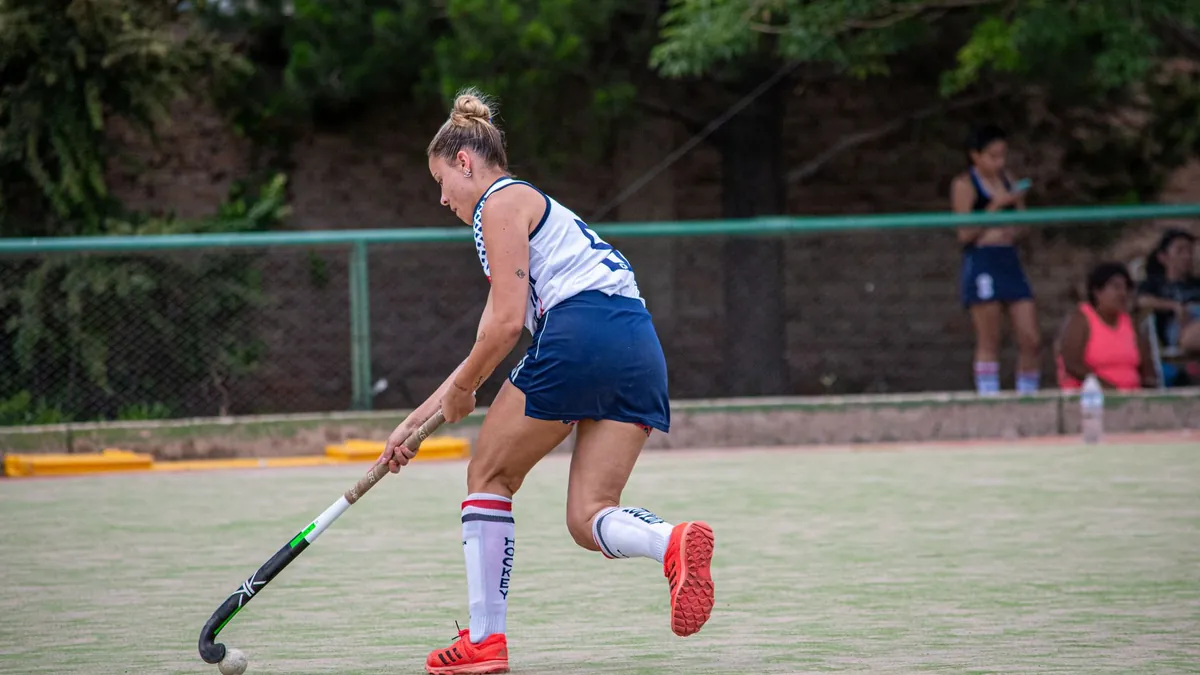
Once orientation is fixed, the run-off layers become usable space. The extra depth behind each back line becomes the natural place for goalside storage, camera positions and player access. That is also why the rules keep those areas free of permanent or temporary obstructions. A camera platform parked inside the clear space has removed the clearance it was relying on.
The drainage fall belongs on the same drawing. Water has to leave the surface and the run-off band in a controlled direction. The fall therefore runs from the field of play outwards towards the perimeter. Squeeze the run-off band and the fall has nowhere to finish, which is why a reduced margin usually shows up first as standing water at the edges.
Surface Type and the Dimensions It Allows
Surface type does not change the rectangle, but it changes what you can promise inside it. Within a guide to hockey turf, the three families matter before any roll is ordered.
Artificial hockey surfaces come in three families. Unfilled or water-based surfaces use densely packed fibres stabilised by irrigation. Dressed or sand-dressed surfaces use sand to support the fibres through part of the pile depth. Filled or sand-filled surfaces use sand across the full pile depth.
Each family ties the layout to an operational commitment. Water-based surfaces rely on water reaching the pitch before and during play, which means storage, pumping and a sprinkler layout drawn alongside the fall. Sand-dressed and sand-filled surfaces drop that dependency, and a sand-based build typically carries a slightly longer pile than a water-based one.
Colour is part of the same specification. On an artificial surface the field of play should be green, ultramarine blue or signal blue, and the run-off portion may be a different colour. Rolling out the guide to hockey turf against a fixed colour plan keeps the markings legible from the stand and from a broadcast camera. Almost every artificial turf installation on a shared site also carries inlaid lines cut from the same roll, so colour and roll layout are settled together.
| Surface family | Fibre and support | Dimensional consequence |
|---|---|---|
| Unfilled or water-based | Densely packed fibres stabilised by watering | Requires irrigation before and during play; pile is typically 13 mm or less with minimal or no infill |
| Dressed or sand-dressed | Sand supports the fibres through part of the pile depth | No pre-play watering needed; workable where water supply is limited |
| Filled or sand-filled | Sand supports the fibres through the full pile depth | Pile is typically 18 to 22 mm; simpler operation for training and school layouts |
Marking inlays are where colour planning meets roll layout, and both are customisable on our line, including custom roll dimensions, colours and markings matched to a fixed pitch drawing.
Roll Layout and Seam Planning on Site
With the rectangle and the markings fixed, the remaining layout question is how the carpet arrives. Roll format drives seam count. Seam count drives both the labour and the number of places where the surface can lift later. A guide to hockey turf that stops at the markings leaves the most expensive decision open.
Plan the main run direction first, then align roll length with the long axis of the pitch. Seams then fall parallel to the side lines and can be pulled away from the goalmouths, where studs and stick contact concentrate. A seam running across a shooting circle is a seam in the busiest part of the field.
Next, check the arithmetic between roll width and pitch width. Standard rolls come in 2 m, 4 m and 5 m widths at 25 m long, and the width you choose decides how much offcut each row leaves. Wider rolls cut seam count across a 55.00 m width, while narrower rolls suit the trimmed strips along the perimeter. Most artificial turf installations on a 5 m roll reach the far side line in eleven runs, while a 2 m roll needs twenty-eight. Review the roll widths and roll construction before you commit a layout.
- Set the main run along the long axis so seams stay parallel to the side lines.
- Keep seams out of both shooting circles and away from the goal fronts.
- Match roll width to the pitch width to control offcut, then trim the perimeter rows last.
- Log every seam position on the setting-out drawing so it can be checked after installation.
Shared Pitches and Multi-Sport Compromises
A shared pitch asks one rectangle to carry several sets of markings. The compromise happens in the margins, not in the field of play. The 91.40 m by 55.00 m rectangle stays fixed, and the overlays are fitted inside it. They are usually inlaid lines in contrasting colours so each sport reads its own cues. We plan artificial turf installations this way whenever a fixture list mixes hockey with football or athletics.

Size the whole site around the most demanding set of markings, then step back to confirm the second sport still fits comfortably. A layout that satisfies the primary sport while crowding its own run-off has simply moved the problem to the fence line.
Perimeter fencing is a shared-pitch decision too. Hockey fencing is typically lower than football fencing, with 1.2 to 1.8 m adequate for most club and institutional applications. A hockey ball leaves the field less often than a football and on flatter trajectories. Our shared multi-sport turf layouts are planned around that kind of overlap.
Confirm the fence line and the gate positions before the roll widths are released, because both change where the perimeter rows are cut. A gate set inside the run-off turns an otherwise straight edge into a series of short cuts, and each of those cuts is a seam. Move the gates outside the run-off band and the roll layout stays rectangular and simple to schedule.
The layout drawing is finished once the field of play, both run-off layers, the circles and the seam positions are on paper. What remains is turning those dimensions into a roll specification that arrives in the right widths.
Roll width, pile height, density and backing all follow from the drawing, and the mapping runs in one direction only: the pitch fixes the roll, not the other way round.
Layout Fixed but Run-Off Depth Still Undecided?
Wrong margins force perimeter rows to be re-cut. Send field and run-off figures, and we roll to your pile and backing. Factory-direct, typically 30–50% below market on like-for-like specs.
Common Layout Mistakes to Avoid
These six faults account for most of the rework we see on hockey layouts. Each one is cheap to correct on paper and expensive to correct after the surface is down.
Treating Run-Off as a Single Figure
A single number cannot describe a two-layer requirement. Behind the back line you need at least 2.00 m of surface plus 1.00 m of clear space, and a fence at the two-metre mark satisfies neither layer. Write both figures on the drawing as separate dimensions.
Striking the Circle From the Goal Centre
The arcs are struck from the inside front corners of the posts, which sit 3.66 m apart, not from the centre of the goal. Using the goal centre removes the straight section of the circle and distorts the area where a goal can be scored.
Mixing the Two Penalty Spot References
The spot centre is 6.475 m from the outside of the goal line and 6.40 m from the inner edge. Both are correct in their own reference frame. Using 6.475 m from the inner edge puts the spot 75 mm too deep.
Measuring the 23-Metre Line Centre to Centre
The 22.90 m is measured between the furthest edges of the two lines. Measuring centre to centre shifts the painted band and moves every restart in that half with it.
Buying Land for the Field of Play Only
A site that fits 91.40 m by 55.00 m has not yet accounted for a single metre of run-off. The competition footprint reaches about 101.40 m by 61.0 m once the margins and the operational strip are added.
Running Arcs Before the Rectangle Is Square
If the two diagonals differ, the rectangle is a parallelogram and every arc struck from a back line inherits the error. On a correct field of play the diagonals are equal at 106.68 m, so check them before any paint is opened.
A sample square of the actual roll is the quickest way to confirm pile and colour before a layout is signed off. You can check a roll sample before you fix the layout in daylight.
Checking the Layout on the Ground
Before the first line is painted, walk the setting-out drawing against the site. This sequence catches the faults above while they are still measurements rather than repairs, and it applies to artificial turf installations at any level of play.
Establish the Centre Line and One Back Line First
Find the midpoint of one back line and run a perpendicular across the full 55.00 m. Square every other line from those two references instead of trailing a touchline that was already on site.
Check Both Diagonals Before Painting
On a correct field of play the diagonals match at 106.68 m. A mismatch means the rectangle is out of square, and every arc and corner drawn afterwards will carry that error.
Confirm Every Dimension Is Taken to the Outer Edge
Walk the drawing and check the reference line for each figure. The 91.40 m by 55.00 m rectangle is measured to the outside edges, so the centre of the painted band runs 37.5 mm inside it.
Walk Both Run-Off Layers Separately
Measure the surface band and the clear space as two figures at each side line and each back line. Then confirm no permanent or temporary obstruction, including camera equipment and advertising boards, sits inside the clear space.
Match Roll Width to the Width You Measured
Divide the pitch width by the roll width and check the offcut. Seam positions should land outside both circles and clear of the goal fronts before the rows are cut.
Verify Goal Position Against the Circle Straight
The goal mouth and the circle straight section are both 3.66 m, and the arcs start at the inside front corners of the posts. If the goal sits off its mark, the circle will not close correctly.
Work through this sequence on a guide to hockey turf before the surface is ordered. Six checks on paper cost a morning; the same six after laying cost a season.
Frequently Asked Questions
What are the official dimensions of a hockey turf pitch?
The field of play measures 91.40 m along each side line and 55.00 m along each back line, taken to the outside edges of the lines. That rectangle covers 5,027 m2 before any run-off is added.
How much run-off does a hockey pitch need?
Behind each back line you need at least 2.00 m of surface plus 1.00 m of clear space, a 3.00 m minimum total. Outside each side line the minimum total is 2.00 m.
Where is the penalty spot marked from?
Its centre sits 6.475 m from the outside of the goal line, and the same point is 6.40 m from the inner edge. Both references are correct; mixing them puts the spot 75 mm too deep.
How wide is each line on a hockey pitch?
Every painted line is 75 mm wide, and a line belongs to the area it encloses. A ball on the side line is still in play, and a ball on the circle line is still in the circle.
Which surface type suits a pitch that is not elite level?
Sand-dressed and sand-filled surfaces avoid pre-play watering, which suits school and club layouts. A water-based surface needs irrigation before and during play, with a pile typically 13 mm or less.
Can a school site use a smaller hockey layout?
The training footprint trims to roughly 97.40 m by 59.0 m while the field of play stays 91.40 m by 55.00 m. A field below those playing dimensions cannot host sanctioned matches.


